One Word Image/Picture/Drawing

This is probably the most effective no-prep activity you should become familiar with:

1) Say or ask for one(1) word.
2) Draw it on the board (or have the Class Artist draw it).
3) Ask about it, and add details to the image.

I’m never at a loss for what to add because I rely on my Question Word Posters as reference to drive the image. Looking at the posters around my board, I usually just ask questions in order and get corresponding supporting details without planning a single thing. Here’s an example that began with a single word, fūr (thief)…

Where? = The thief is in Starbucks
From Where? = Lived in Spain
To Where? = Wants to go to Peet’s Coffee in Berkeley, not Cambridge
What? = Has a gladius (Roman sword)
Who? = The thief’s name is Tom
Whose? = The gladius is actually the Starbucks barista’s gladius
When? = It’s night time
Whom? = The thief sees someone with a better, bigger gladius
With Whom? = Donald Trump (obviously!)
To Whom? = The Starbucks barista gives a coffee to Donald Trump
How? = The thief has the gladius because he stole it from the Starbucks barista
How many? = Actually, the Tom the Thief has 7 gladiī—one from each Starbucks in Starbucksville
What sort of? = Tom is actually a bad thief…the Starbucks barista saw him steal the gladius
Why? = Donald Trump is there because he wants to buy all the Starbucks’

Note how some of the details don’t connect (e.g. there is another person with a sword but doesn’t get mentioned again), but realize that they don’t have to. We’re just creating an image, not any kind of plot. Also note, however, how easily this COULD turn into a prompt for a Timed Write, or a Storyasking session, especially given the image we’ve established as a class.
Parallel Stories

The latest Tea with BVP episode was “Teaching Without Textbooks.” Whether you’ve already ditched the textbook, or still work alongside one, parallel stories are important. Parallel stories include the same language found in a narrative, but the details (maybe plot) change. This year, I’ll be using a mix of parallel stories that compliment a textbook’s narrative, and co-created stories via TPRS.

For years I used TPRS story scripts to ask a story and then type up and read the exact story as a class. I’m now sold on parallel readings that include all the language found in the class story during acting, but now in a new context with details unknown to the students. Following Michele Whaley’s current practices on Embedded Readings, each of our stories will have at least three versions—this builds interest along the way by withholding information (vs. knowing exactly how the class story ends).

There will be more on how I adapt a textbook’s narrative later, but for now, here’s a link to our Latin 1 parallel stories (updated throughout the year in this single document).

Using the New Curriculum Map

**New iteration of the Curriculum Map as the Universal Language Curriculum (ULC) Updated 2.4.18**

For many teachers, the New Curriculum Map is just what they need to to articulate what it means to teach for language acquisition. For others, it isn’t structured enough, and falls short of what they’re accustomed to using. Surprisingly, a few even consider this curriculum format TOO restrictive with its high frequency words and suggested structures and topics. If you are in the first two camps, this post will help you see the big picture of how simple it is to teach without a grammar syllabus and instead focus on high frequency vocabulary, just like the Sample CI Schedule for the Year:

Continue reading

A New Curriculum Map

**New iteration of the Curriculum Map as the Universal Language Curriculum (ULC) Updated 2.4.18**
**More recent post on USING the New Curriculum Map**

As stated in its introduction, this New Curriculum Map is designed to reconcile Second Language Acquisition (SLA) principles with planning demands that exist within the current educational landscape. It is part theory but 100% practical. I hesitate to call it a “CI Curriculum” because I agree with Bill VanPatten from Episode 23 of Tea with BvP that some people think that CI is a strategy used to teach the stuff they’ve been teaching all along (e.g. explicit grammar rules, cultural facts, purposeless paired activities, dialogues, etc.). This is wrong…totally wrong, in fact. In an age when educators prefer an “eclectic” batch of “tools for the toolbox,” CI can’t be considered one of them along side others. CI is an absolute requirement for language acquisition. The only thing that’s debated is exactly how much of a role output plays in language acquisition, and for some, it’s null. No theory of language acquisition disputes the need for understandable messages (= CI).

Furthermore, a call from Ellie Arnold during this past week’s Episode 24 of Tea with BvP was right on topic, and Bill confirmed that a curriculum based on targeted structures (i.e. phrases that contain parts of the language’s grammatical structure) will lead us “off track.” That doesn’t mean we can’t plan for a class with targeted structures in mind; it means that we don’t want to write ourselves into a corner by prescribing targeted structures as part of a curriculum.

Without further ado, you can access the New Curriculum Map here. If you have another idea for the organization of Latin vocabulary Tiers, either based on frequency or preference, treat the document as a template and add your own vocabulary. If you teach another language, use your own frequency lists and/or the English equivalents as a guide. Enjoy!

VERBA™ Storytelling

Untitled

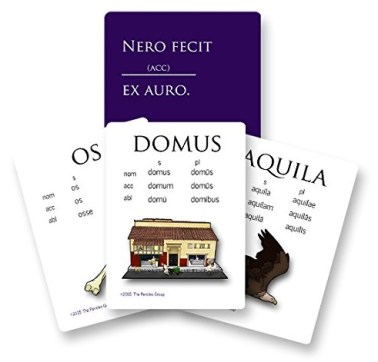
VERBA is an Apples to Apples clone game for language learners designed by the great folks who brought us the Picturae database. Aside from playing the game as-is following original rules (during which I monitor groups and deliver CI by asking students about their choices, etc.), I now use the white noun cards during storyasking/storytelling (e.g. “Once upon a time, there was a ______<reveal card>”).

What makes this different from TPRS? Vocabulary is limited to what’s on the cards, which is already in the target language along with a super clear image. You’re less likely to go out of bounds with infrequent target language vocabulary, or have to accept English details from students. On the other hand, you might WANT to accept English details from students (especially if they’re compelling). In that case, use the VERBA cards as non-examples for your students to reject, and then take their cute/hilarious/dark suggestion, etc.

What makes this different from using Rory’s Story Cubes? Story cubes contain images ONLY, no target language, so using VERBA might help keep your story more “on rails.” For an interesting storyasking/storytelling hybrid, use the white VERBA noun cards for details AND Rory’s Story Cubes: Actions set for verbs.

CI Program Checklist: Summary

**Update 4.26.16 See how the checklist sets up a Sample CI Schedule for the Year**
**Read a post on the Week & Day Updated 12.9.17**

Classroom MGMT
✔   Rules (DEA & CWB)
✔   Routines (Routines, Student Jobs, Interjections & Rejoinders)
✔   Brain Breaks

Comprehensibility
✔   Inclusion (Safety Nets, Gestures & Question Posters)
✔   Shelter Vocab (Super 7, TPR ppt, TPR Wall, and Word Wall)
✔   Unshelter Grammar (TPR Scenes)

Camaraderie
✔   Secrets (Class Password)
✔   Students (People)
✔   Stories (TPRS, MovieTalk, Magic Tricks, Free Voluntary Reading (FVR))

Counting
✔   Reporting (Quick Quizzes)
✔   Showing Growth (Fluency Writes)
✔   Grading (DEA & Proficiency Rubrics)

Community
✔   Groups, Blogs, Contacts (LPB, moreTPRS, Tea with BvP, Ben Slavic)

Continue reading

CI Curriculum

**Updated 2.28.18 with the Universal Language Curriculum (ULC)**

The bad news; there isn’t one for Latin. The good news; we do have a list of Most Important Latin Verbs. More bad news; most teachers new to CI don’t know what to DO with the list, yet this is what they crave, and NEED the most. It makes perfect sense. There just isn’t time to create a realistic curriculum from the ground up, or tons of Embedded Readings while we’re just getting used to the idea of CI from reading blogs, articles, and research, let alone honing our craft when it comes to delivering understandable messages.

The role of a curriculum changes when a skilled CI teacher is able to use more student details to drive content, and can create teachable moments ex tempore. There’s also the case for non-targeted input which leaves a curriculum optional. STILL, all that’s advanced stuff, and this is about getting teachers help who crave it most.

Some support.

Although I’ve heard recently that some teachers have ditched TPR at the start of the year in favour of beginning storytelling immediately, I will continue to start with TPR since I really haven’t exhausted the possibilities. There’s an updated, or “evolved” version of TPR anyway, which I find is more powerful and I’d like to get some experience with that.

So, I’ve been working on an essential list of classroom vocab (remember, “shelter vocab, unshelter grammar!”) to use with the most important verbs…about the closest thing to the high-demand curriculum that’s needed.

Access the TPR Word Wall here.

 Update 10.08.15 DO NOT attempt to work through the TPR Word Wall as a curriculum to complete. Like EVERYTHING we teach, when something loses steam, move on. My pattern has been to work on a verb or two, then get some details from a student with DISCIPVLVS ILLVSTRIS, and read, give a dictātiō, etc. For reference, I am just past the 8 hr mark with my (online) classes, and haven’t begun storytelling.