Quick Quizzes: Piantagginish

The more recent open-book style Quick Quizzes completely changed how I assess for the better. To recap, I used to say 4 True/False statements in the target language about something that happened during class. Kids either remembered the details, or didn’t, or didn’t understand what I said in the target language. Now I say the statements in English and the target language is projected (or printed) so students READ the text during the quiz. This has led to an interesting take on the whole “quizzing” idea.

I’ve often heard teachers claim that their “assessments are part of the learning process,” but in almost every case, their practices just don’t back that up. Here’s a look at how you can really get it done with Quick Quizzes using a fake language, Piantagginish, since the best way to really understand how practices that support CI work is to become a student yourself. Imagine you’re a kid who’s been out of school for a couple of days and at the end of class there’s a Quick Quiz. Normally you’d panic, but not in my class. Here’s why…
Continue reading

A New Curriculum Map

**New iteration of the Curriculum Map as the Universal Language Curriculum (ULC) Updated 2.4.18**
**More recent post on USING the New Curriculum Map**

As stated in its introduction, this New Curriculum Map is designed to reconcile Second Language Acquisition (SLA) principles with planning demands that exist within the current educational landscape. It is part theory but 100% practical. I hesitate to call it a “CI Curriculum” because I agree with Bill VanPatten from Episode 23 of Tea with BvP that some people think that CI is a strategy used to teach the stuff they’ve been teaching all along (e.g. explicit grammar rules, cultural facts, purposeless paired activities, dialogues, etc.). This is wrong…totally wrong, in fact. In an age when educators prefer an “eclectic” batch of “tools for the toolbox,” CI can’t be considered one of them along side others. CI is an absolute requirement for language acquisition. The only thing that’s debated is exactly how much of a role output plays in language acquisition, and for some, it’s null. No theory of language acquisition disputes the need for understandable messages (= CI).

Furthermore, a call from Ellie Arnold during this past week’s Episode 24 of Tea with BvP was right on topic, and Bill confirmed that a curriculum based on targeted structures (i.e. phrases that contain parts of the language’s grammatical structure) will lead us “off track.” That doesn’t mean we can’t plan for a class with targeted structures in mind; it means that we don’t want to write ourselves into a corner by prescribing targeted structures as part of a curriculum.

Without further ado, you can access the New Curriculum Map here. If you have another idea for the organization of Latin vocabulary Tiers, either based on frequency or preference, treat the document as a template and add your own vocabulary. If you teach another language, use your own frequency lists and/or the English equivalents as a guide. Enjoy!

Sample CI Schedule: The Year

**Use this schedule with the Universal Language Curriculum (ULC) Updated 2.4.18**
**Read a post on the Week & Day Updated 12.9.17**

A major reason to ditch what you’ve been doing (or what others expect language learning to look like), and teach with CI is for the flexibility in planning. In fact, the longer I teach with CI, the less I plan, and the better the results. This is probably the least intuitive concept as an educator, especially for anyone still green from their teacher training that included an obsession over Wiggins and McTighe’s Understanding by Design, the push for posted objectives, a need for required lesson plans tied to Bloom’s, etc.

I’ve written 13 blog posts and a summary about what should be considered and/or put in place in your classroom in order to continue teaching with CI. Here’s a perspective on a full year of teaching that might help you see the big picture of how simple it is to actually make this happen:

The Day **Added 12.9.17**
– Routines
– Reading
– Students
– Stories

The Week
– Telling/Asking stories, then reading them
– Learning details about students
– 1-3 unannounced “open-book” Quick Quizzes

The Month
– 1-2 unannounced, no notes, 5-10min Fluency Writes

The Grading Term
– Students self-assess Rubric (but check these to see if they’re being too hard on themselves)

The bulk of “planning” then becomes varying how you tell/ask stories (e.g. One Word Image, TPRS, MovieTalk, Magic Tricks, etc.), what you do with them (e.g. Choral Translation, Airplane Translation, Read and Discuss, Running Dictation, Draw-Write-Pass, OWATS, etc.), and how you’ll learn more about each other (e.g. ask students for a new batch of  questions to use during La Persona Especial/Discipulus Illustris, etc.).

VERBA™ Storytelling

Untitled

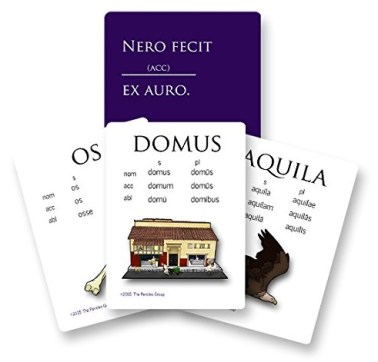
VERBA is an Apples to Apples clone game for language learners designed by the great folks who brought us the Picturae database. Aside from playing the game as-is following original rules (during which I monitor groups and deliver CI by asking students about their choices, etc.), I now use the white noun cards during storyasking/storytelling (e.g. “Once upon a time, there was a ______<reveal card>”).

What makes this different from TPRS? Vocabulary is limited to what’s on the cards, which is already in the target language along with a super clear image. You’re less likely to go out of bounds with infrequent target language vocabulary, or have to accept English details from students. On the other hand, you might WANT to accept English details from students (especially if they’re compelling). In that case, use the VERBA cards as non-examples for your students to reject, and then take their cute/hilarious/dark suggestion, etc.

What makes this different from using Rory’s Story Cubes? Story cubes contain images ONLY, no target language, so using VERBA might help keep your story more “on rails.” For an interesting storyasking/storytelling hybrid, use the white VERBA noun cards for details AND Rory’s Story Cubes: Actions set for verbs.

Grading & Reporting Schemes

Over the years, I’ve heard from many teachers in different situations looking to move towards Proficiency-Based Grading (PBG), or possibly beyond. Elsewhere on this blog, I’ve written very long explanations about grading practices. Here are various grading scheme options presented in a straight-forward manner. If you’re in a situation that seems very different from those listed below, comment and we’ll think of something!

Latest Expectations-Based Grading Scheme

Expectations-Based Grading (EBG) **NEW, added 3.4.18**
100% – Input Expectations Rubric, includes Proficiency Levels
0% – Quick Quizzes, or anything else you want to report a score for
Use this scheme if you have complete control, want maximum freedom, and want to focus on students receiving input.

Zero-Autonomy Quick Fix **NEW, added 8.2.18**
Percentages vary based on wacky school requirements
In each grading category:
1) Create assignments that do NOT count towards the final grade (usually a check box)
2) Create ONLY ONE assignment that DOES count towards the final grade
3) Use a—ANY—holistic rubric to arrive at that grading category grade
Use this scheme if you have absolutely no control, and people are telling you what kinds f things to assign, and how much value to give them.

Continue reading

3.31.16 Tea with BvP Takeaways

I’ve been following (and calling into) Bill VanPatten’s Second Language Acquisition (SLA) show since its debut last Fall. I’m proud to say that I have the honor of being the first SLA Quiz winner. Yes, it’s on my CV, and yes, the first prize was a branded bag of teaI edit the episodes so busy people who don’t have an hour to listen still get some nuggets of wisdom. This past week’s episode was important. I had to listen to the show again (even AFTER I edited it), as well as send Bill VanPatten two or three emails to clarify a few points. Here are some takeaways with major implications for teachers who facilitate acquisition in their classrooms:

Continue reading

Reporting Scores vs. Grading

**Update 4.11.16** See this post for some Grading & Reporting Schemes

If you’re one of the “lucky” teachers who has those classically typical, or absurdly unexpected grading restrictions, I don’t envy you! Nonetheless, the key is to find the wiggle room within these restrictions, and focus on delivering understandable messages in the target language (= Comprehensible Input, CI).

Continue reading

No Proficiency, No Problem: How CI allowed me to teach Spanish

At the end of November, I was hired to teach a new 7th grade Exploratory Language program. This was the administration’s solution to a failed compulsory extension of their 8th Spanish program that was halted in October by the abrupt resignation of their teacher. I wasn’t certified to teach Spanish, so the workaround was to reestablish 7th grade Spanish as a 7th grade Exploratory Language, and offer Spanish, Latin (for which I DO hold certification, and actually know), and French.

When I accepted the position, I knew very little Spanish, and French wasn’t even on the map. I was willing to invest the time needed to teach them, though, and I had a secret weapon…my CI language training. The administration recognized such value, and I was on my way.

Continue reading

CI Program Checklist: Summary

**Update 4.26.16 See how the checklist sets up a Sample CI Schedule for the Year**
**Read a post on the Week & Day Updated 12.9.17**

Classroom MGMT
✔   Rules (DEA & CWB)
✔   Routines (Routines, Student Jobs, Interjections & Rejoinders)
✔   Brain Breaks

Comprehensibility
✔   Inclusion (Safety Nets, Gestures & Question Posters)
✔   Shelter Vocab (Super 7, TPR ppt, TPR Wall, and Word Wall)
✔   Unshelter Grammar (TPR Scenes)

Camaraderie
✔   Secrets (Class Password)
✔   Students (People)
✔   Stories (TPRS, MovieTalk, Magic Tricks, Free Voluntary Reading (FVR))

Counting
✔   Reporting (Quick Quizzes)
✔   Showing Growth (Fluency Writes)
✔   Grading (DEA & Proficiency Rubrics)

Community
✔   Groups, Blogs, Contacts (LPB, moreTPRS, Tea with BvP, Ben Slavic)

Continue reading