There’s been some progress since February when I last wrote about TFAM. Notably, I have established TFAM as a conceptual framework in my proposed dissertation, and recently managed to complete a big missing piece of its puzzle. This post explains a bit of both.
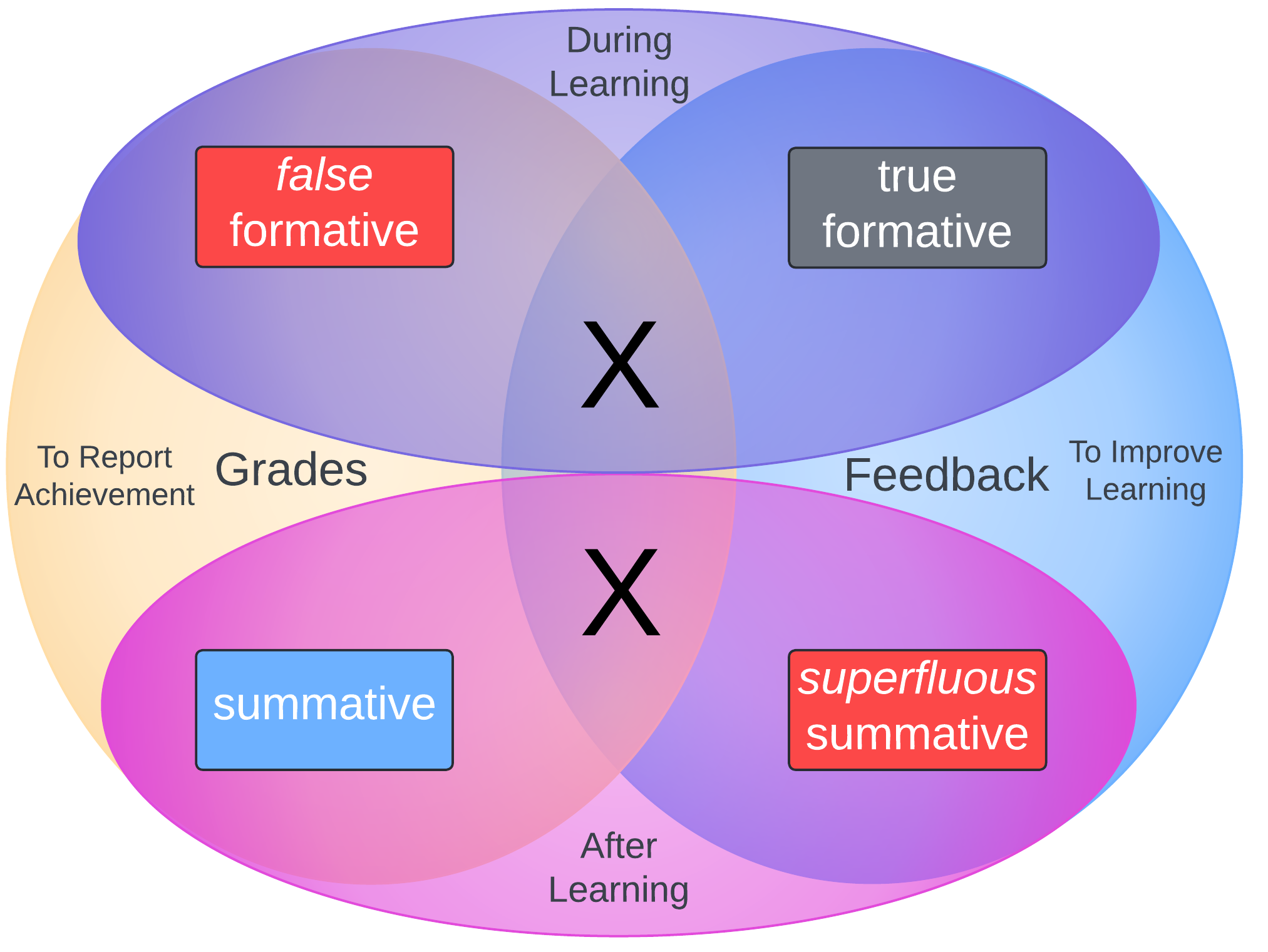
TFAM draws from classroom assessment definitions in the literature (see the February post above for all those references). It’s all standard stuff, too, like how feedback is a formative characteristic used to improve learning and grades are a summative characteristic used to report achievement. There’s nothing new here. The thing is, research thus far has stopped short of treating these characteristics as exclusive.
And this is where TFAM makes its mark…
While teachers should certainly assess in both summative and formative ways, the characteristics of each remain separate in the TFAM conceptual framework due to conflicting purposes and negative impact on learning. Given what we know from research over the last century, even something like a teacher assessing summatively 25% of the time and formatively the other 75% probably isn’t enough to mitigate that negative impact. It’s more likely 5/95, meaning just 5% of a teacher’s assessment uses should be summative and 95% should be formative. If this comes off as prescriptive, that’s fine because it probably should. This is kind of like the doctor who says “you probably should lay off caffeine and alcohol. They have known harmful effects on your health.” Of course, we hear fantastical stories of the chain-smoking centenarian who drinks themself into oblivion, etc., but that hardly represents most of us.
Research on grading is similar. There might be an exceptional study that finds some kind of benefit from tons of grading, or even typical amounts of grading, though I haven’t come across it. And as a Ph.D. Candidate who is ABD (all but dissertation), I am officially recognized as an expert in the field. As such, I’m here to share that there is no evidence suggesting that teachers should be grading much at all, especially prior to high school. And even if there were a hint of compelling data to support grading, we should advise just like the medical doctor: for almost all cases, teachers probably should lay off grading as much as possible.
5/95 vs. 80/20
My 5/95 estimate (i.e., summative use/formative use) is based on 180 days of assessing, just 8 of which are used to report achievement through grades on progress reports and report cards, and the other 172 on improving learning through checks for understanding and feedback cycles. That’s it. Now, don’t confuse this with a common “80/20 policy” of a course grade based on an 80% summative grading category and a 20% formative one. These are just labels. Not only is the origin of this policy shrouded in mystery, it’s incoherent since grading is a summative function, not a formative one, meaning 100% of a course grade is summative, regardless of how schools label their gradebook categories.
Superfluous Summatives
The names of zones within the TFAM Venn diagram are intended to warn against the negative effects of combining formative and summative characteristics, like grading during the learning process (re: false formatives). False formatives have made sense to people because it’s clear enough to imagine how constant grades during the learning process even though we expect mistakes is a bad thing, and how putting a grade on daily/weekly exit tickets without any feedback isn’t really doing anything for learning. Since I began using TFAM, however, teachers have wondered a lot about what that lower right zone represents. Surely, it makes sense to provide feedback on a final paper and students can benefit from those comments, right?
Not quite.
To understand why, we first must distinguish between feedback and information. Students can read comments and receive information, yes, but feedback is more than just information. An effective feedback cycle requires students to self-assess where they are and then apply the feedback to a follow-up opportunity (see Hattie & Timperley, 2007; Sadler, 1989 in the reference section of the February post at the top). Self-assessing might happen, and certainly can if you carve out class time for that, but applying feedback cannot if the semester is over. And if you’re thinking the student will have another chance at the end of the next semester to apply feedback on that final paper, then you might be forgetting about the importance of recall at spaced intervals, and you also might be putting faith in an event that might never happen. In other words, feedback used summatively leaves that loop wide open, and it’s unlikely to be closed. Open loops probably won’t improve learning.
So, I’m calling the new zone in the TFAM Venn diagram “superfluous summative” to signal how feedback given after learning has taken place is…well…extra. It likely wastes teacher time since the student has no opportunity in sight to apply any feedback. And if the teacher does provide the student an opportunity to apply feedback, then this paper was never a summative event in the first place (i.e., learning was still taking place). If so, achievement didn’t need to be reported since the student was still showing their learning.
Feedback vs. Advice
When comments are added to final assignments with no opportunity to act upon that information, the feedback loop is left open. This kind of information is best considered advice. Can learners benefit from advice? Certainly. But advice doesn’t qualify as feedback within the formative assessment process according to TFAM. And this is what makes conceptual frameworks so important. If someone comes along and has an explanation for how advice improves learning, then they can develop a framework that supports summative feedback as an effective practice. Until then, TFAM is something that is probably just as good a place to start as laying off caffeine or alcohol.

