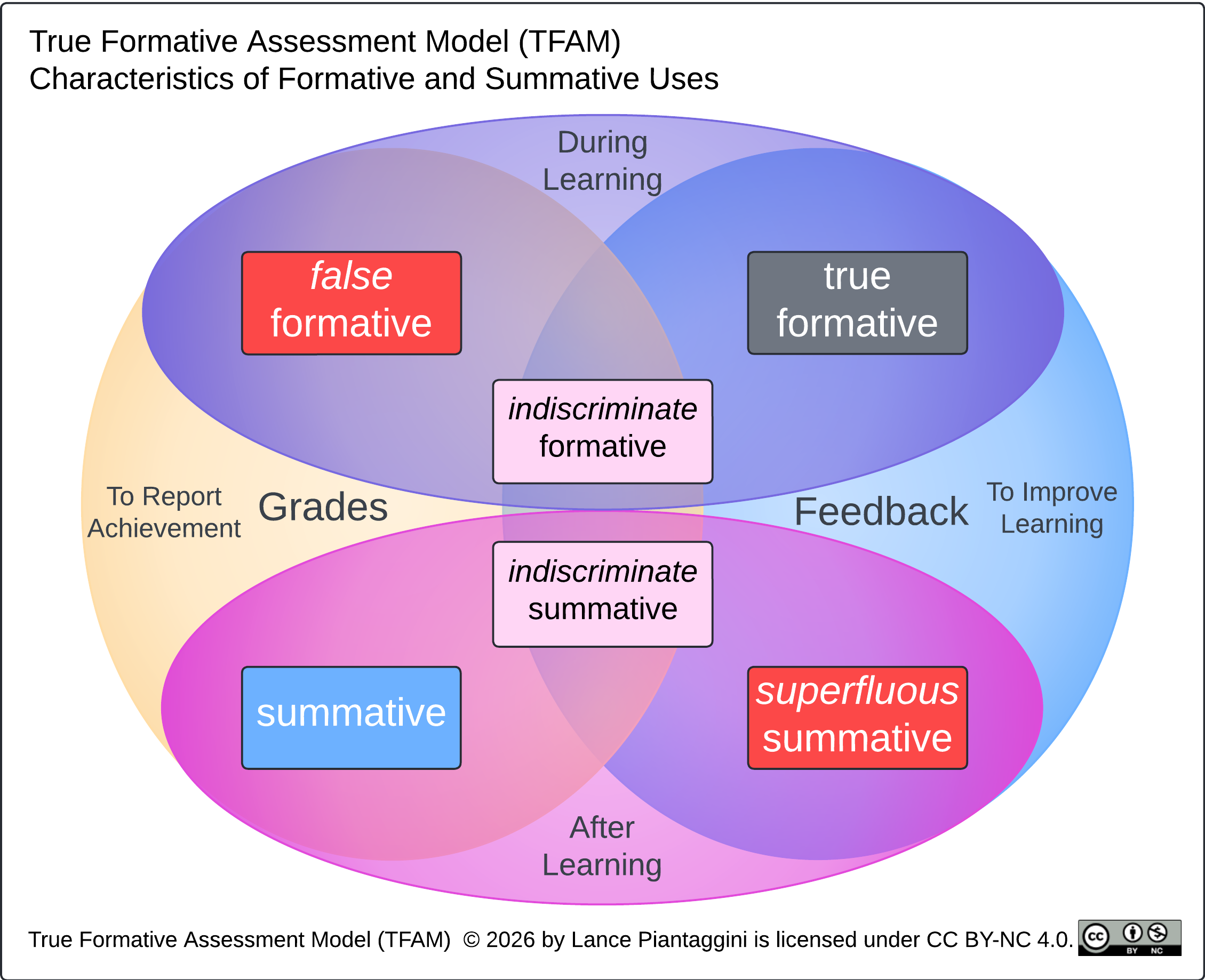
I added the superfluous summative to TFAM back in June, and after the MTA Summer Conference I revisited my TFAM conceptual framework once again. This latest (last?) update is the most complete version yet. I’ve also established Creative Commons licensing as this gets shared around (“CC BY-NC” basically means use this figure, cite me, and don’t make money off of it :)).
Indiscriminate Assessments
One thing bugging me about the previous version(s) of the TFAM Venn diagram was the “Xs” in the center zones. These represented assessments with mixed formative and summative characteristics. The idea behind those “Xs” was to focus on the other, more impactful zones of the Venn diagram while sending a message to teachers that combining formative and summative characteristics clashes and usually results in neutral outcomes (or at least not devastating ones), instead of the positive ones of true formatives. What I found, though, is that the “Xs” didn’t help me talk about those kinds of mixed assessments with teachers. This was a major limitation since many of teachers’ assessments ended up in these zones when we plotted their characteristics. Furthermore, there often wasn’t any particular reason for mixing formative and summative characteristics. It turns out that most of these assessments were designed that way by chance, without treating formative and summative uses differently…
Therefore, I’ve landed on the term “indiscriminate,” using its definition of “not marked by careful distinction” (Merriam-Webster). I like how indiscriminate formatives can refer to graded assessments that might have feedback—or not—and how those characteristics were not deliberately chosen. Perhaps this is the result of default, autopilot practices that teachers might not have thought much about, or perhaps because the school requires two grades per week per student. Regardless, this assessment use is indiscriminate because it doesn’t distinguish between improving learning through feedback, or reporting achievement through grades. Indiscriminate assessment use combines characteristics and purposes, and it all might have been on accident!
Indiscriminate summatives could take the form of final papers with feedback on how to improve, but no opportunity to apply that feedback and revise. If the purpose had been to improve learning, then these would not be graded, feedback would’ve been given during the learning process (not at the end), and the student could then revise their work, thus making it a true formative. But that had to be the intent of this assessment from the outset, and it would have occurred much sooner than an end-of-term paper. Hence, an indiscriminate use of assessment.
Careful Distinction
This definition does imply that teachers do not care. It means that the difference between when and when not to grade and the purpose of each are not taken into consideration when assessing students. There are a host of factors leading to this, and they don’t have anything to do with individual teachers on a personal level.
Of course, grading is often tied to identity, which complicates the issue.
Unlike other practices that teachers grab from Instagram or mentors, grading is usually their own, like choosing practices that differ from the teacher next door, perhaps trying something new. Even if there were 1,000 reasons to be doing anything else other than what was decided, learning about those reasons can feel like an attack on identity (and so it gets personal). This is if grading is even a consideration, though. Another reason I like the term “indiscriminate” is that grading is often taken for granted, which more likely represents how decisions generally are not being made about assessment characteristics. They tend to just…happen. To assess students in a truly formative way, however, TFAM can raise awareness and help teachers design assessments with distinction.

