In August of 2020, I wrote 0 To 70: Five Years Of Latin Novellas. Two years later, the number of Latin novellas nearly doubled. Well, another two years have gone by and we’ve seen 40 more, which is an increase of 31%! Above all, there are now 38 authors out there writing different kinds of Latin. In this post, I want to celebrate that different kind of Latin while revisiting some findings…
Curriculum & Results
Novellas were a small, but key resource in the early days of the Latin program I developed. Later, I was fortunate enough to have been joined by another prolific novella author, Emma Vanderpool as novellas really started booming. The first year we gave the ALIRA, data showed that a heavy does of novella-input in Latin 1 with continued attention to comprehension-based teaching prioritizing CI in Latin 2 produced 33% of students in the Intermediate range. One of Emma’s students even earned the Seal of Biliteracy (i.e., Intermediate High) as a Sophomore! Later percentages of students in the Intermediate range were hovering between 25% and 30%, and I began thinking that our next steps would be to make a deliberate increase in novella use schoolwide in Latin 2+. This hunch was confirmed by ALIRA data showing that the absence of novellas in place of traditional texts (e.g., Ovid, Catullus) produced a loss in reading ability and/or affect, with 65% of Latin 3 students in the Below Reading/Novice Low range (up from 19%). Not only that, but a direct comparison between Latin 1 students and Latin 3 students showed strikingly similar reading levels. This means that students with two years fewer class hours (~240hrs) were reading just as well. Truth be told, I can barely tell which class is which since the charts are so similar and the data is anonymous.
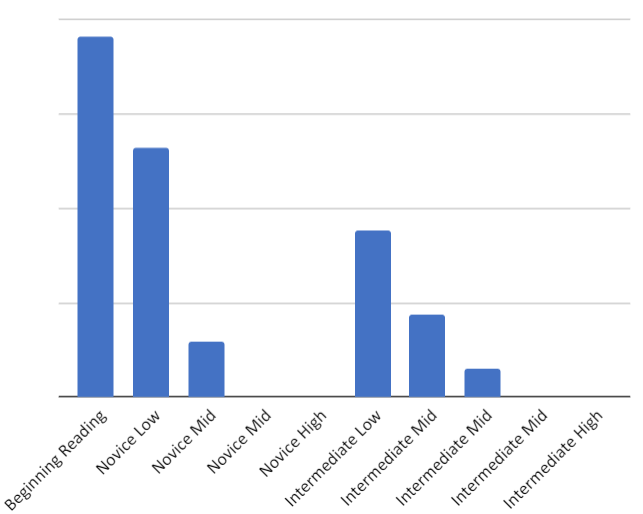
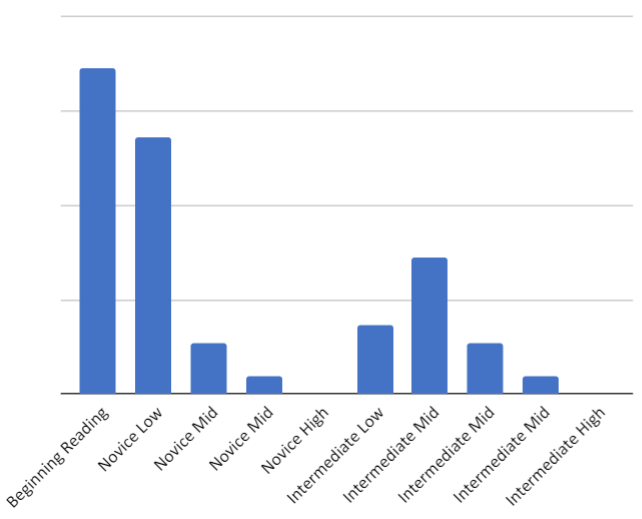
The pedagogical implications are fairly serious, with these data suggesting that reading development over two years can be undone or at least inhibited by a single year of limited input from texts far above students’ reading level. This is support that novellas are actually proving to be effective, not just theoretically useful. What I find most fascinating about this is that the kind of Latin that students in one of these classes read is a very different kind of Latin found in the other class what what was on the ALIRA. If…”novella Latin”…were inferior, we should see that in the ALIRA scores, but we don’t. Therefore, I maintain that reading A LOT of any Latin can prepare students to read other Latin, and there’s a great variety of Latin than what you’ll find across the 38 authors and 170 books.
Novella Principles
A recent thought I’ve had is whether the indirect benefits of novellas have gotten enough air time. That is, I wonder what novellas have changed about teaching that might contribute to the positive results being shared. Have novellas gotten more teachers to adapt ancient texts using tips and tricks they’ve seen in novellas, like sheltering vocabulary and unsheltering grammar? Have they made teachers more aware of how low reading must be for students to read on their own (vs. teacher help)? These are questions I encourage people to explore.
Reading Ability
Each year, I found that students were able to get reading sooner and sooner, finishing more and more books (as a class and independently). That’s because the goalpost kept moving as newer, very low level books made their way into classrooms. I’m a bit hesitant on where things stand at the moment. That is, some are in the 500+ unique word range and fairly short. Others are quite long. These are very high-level books. On the one hand, they serve a certain group of students. On the other hand, these students have never really had a problem accessing ancient Latin anyway. While it’s great that these kids might have a more compelling Latin experience, I think about the kind of Latin students historically excluded from those upper level courses. Novellas have been one way to reach these learners. Let’s make sure they continue to do so! Therefore, I will keep calling for more lower-level books than higher-level. Will I ever be satisfied? Maybe. Like, if the next 30 novellas that push the number past 200 come out all with fewer than 100 unique words, then yes, you won’t hear from me about this again. Until then…
 Magister P.