5.5.16 Tea with BvP Takeaways

Today on the show, Bill did not give the same definition of Forced Output from Episode 18 when he told a caller that anything more than one word responses (e.g.yes/no, either/or, fill in blank) was considered “forced” (listen to that brief definition, here). Why? He was thinking about that term in a new way, referring to what happens when you make someone speak in an activity or task, which may not have anything to do with what has been acquired (e.g. “I am teacher, you are student, do this.”). The definition of Forced Output was expanded by Karen Rowan on Mixler to include any “Output beyond the level of acquisition.” Bill’s previous definition along with Karen’s mean that although acquisition rates vary, all students can give a single word response, so it is the only thing we should expect. Anything else is a bonus.

We also got a definition for Output as “any learner production that is embedded in the communicative context/event.” Martin Lapworth noted that this immediately rules out  a lot of what’s been going on in classrooms involving certain acts of speaking and writing, which some teachers have misunderstood as Output for the sole reason that something is coming OUT of their head that other people read, see or hear. Here’s how we can categorize Bill’s take on some examples of exercises, activities, and tasks within the context of Output…

Continue reading

Quick Quizzes: Piantagginish

The more recent open-book style Quick Quizzes completely changed how I assess for the better. To recap, I used to say 4 True/False statements in the target language about something that happened during class. Kids either remembered the details, or didn’t, or didn’t understand what I said in the target language. Now I say the statements in English and the target language is projected (or printed) so students READ the text during the quiz. This has led to an interesting take on the whole “quizzing” idea.

I’ve often heard teachers claim that their “assessments are part of the learning process,” but in almost every case, their practices just don’t back that up. Here’s a look at how you can really get it done with Quick Quizzes using a fake language, Piantagginish, since the best way to really understand how practices that support CI work is to become a student yourself. Imagine you’re a kid who’s been out of school for a couple of days and at the end of class there’s a Quick Quiz. Normally you’d panic, but not in my class. Here’s why…

Continue reading

Sample CI Schedule: The Year

**Use this schedule with the Universal Language Curriculum (ULC) Updated 2.4.18**
**Read a post on the Week & Day Updated 12.9.17**

A major reason to ditch what you’ve been doing (or what others expect language learning to look like), and teach with CI is for the flexibility in planning. In fact, the longer I teach with CI, the less I plan, and the better the results. This is probably the least intuitive concept as an educator, especially for anyone still green from their teacher training that included an obsession over Wiggins and McTighe’s Understanding by Design, the push for posted objectives, a need for required lesson plans tied to Bloom’s, etc.

I’ve written 13 blog posts and a summary about what should be considered and/or put in place in your classroom in order to continue teaching with CI. Here’s a perspective on a full year of teaching that might help you see the big picture of how simple it is to actually make this happen:

The Day **Added 12.9.17**
– Routines
– Reading
– Students
– Stories

The Week
– Telling/Asking stories, then reading them
– Learning details about students
– 1-3 unannounced “open-book” Quick Quizzes

The Month
– 1-2 unannounced, no notes, 5-10min Fluency Writes

The Grading Term
– Students self-assess Rubric (but check these to see if they’re being too hard on themselves)

The bulk of “planning” then becomes varying how you tell/ask stories (e.g. One Word Image, TPRS, MovieTalk, Magic Tricks, etc.), what you do with them (e.g. Choral Translation, Airplane Translation, Read and Discuss, Running Dictation, Draw-Write-Pass, OWATS, etc.), and how you’ll learn more about each other (e.g. ask students for a new batch of  questions to use during La Persona Especial/Discipulus Illustris, etc.).
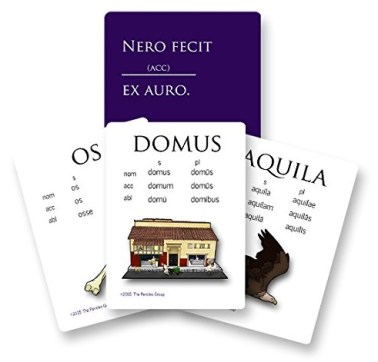
VERBA™ Storytelling

Untitled

VERBA is an Apples to Apples clone game for language learners designed by the great folks who brought us the Picturae database. Aside from playing the game as-is following original rules (during which I monitor groups and deliver CI by asking students about their choices, etc.), I now use the white noun cards during storyasking/storytelling (e.g. “Once upon a time, there was a ______<reveal card>”).

What makes this different from TPRS? Vocabulary is limited to what’s on the cards, which is already in the target language along with a super clear image. You’re less likely to go out of bounds with infrequent target language vocabulary, or have to accept English details from students. On the other hand, you might WANT to accept English details from students (especially if they’re compelling). In that case, use the VERBA cards as non-examples for your students to reject, and then take their cute/hilarious/dark suggestion, etc.

What makes this different from using Rory’s Story Cubes? Story cubes contain images ONLY, no target language, so using VERBA might help keep your story more “on rails.” For an interesting storyasking/storytelling hybrid, use the white VERBA noun cards for details AND Rory’s Story Cubes: Actions set for verbs.

CI Program Checklist: Summary

**Update 4.26.16 See how the checklist sets up a Sample CI Schedule for the Year**
**Read a post on the Week & Day Updated 12.9.17**

Classroom MGMT
✔   Rules (DEA & CWB)
✔   Routines (Routines, Student Jobs, Interjections & Rejoinders)
✔   Brain Breaks

Comprehensibility
✔   Inclusion (Safety Nets, Gestures & Question Posters)
✔   Shelter Vocab (Super 7, TPR ppt, TPR Wall, and Word Wall)
✔   Unshelter Grammar (TPR Scenes)

Camaraderie
✔   Secrets (Class Password)
✔   Students (People)
✔   Stories (TPRS, MovieTalk, Magic Tricks, Free Voluntary Reading (FVR))

Counting
✔   Reporting (Quick Quizzes)
✔   Showing Growth (Fluency Writes)
✔   Grading (DEA & Proficiency Rubrics)

Community
✔   Groups, Blogs, Contacts (LPB, moreTPRS, Tea with BvP, Ben Slavic)

Continue reading

CI Program Checklist: 11 of 13

Classroom MGMT
✔   Rules (DEA & CWB)
✔   Routines (Routines, Student Jobs, Interjections & Rejoinders)
✔   Brain Breaks

Comprehensibility
✔   Inclusion (Safety Nets, Gestures & Question Posters)
✔   Shelter Vocab (Super 7, TPR ppt, TPR Wall, and Word Wall)
✔   Unshelter Grammar (TPR Scenes)

Camaraderie
✔   Secrets (Class Password)
✔   Students (People)
✔   Stories (TPRS, MovieTalk, Magic Tricks, Free Voluntary Reading (FVR))

Counting
✔   Reporting (Quick Quizzes)
__ Showing Growth

Continue reading

CI Program Checklist: 10 of 13

Classroom MGMT
✔   Rules (DEA & CWB)
✔   Routines (Routines, Student Jobs, Interjections & Rejoinders)
✔   Brain Breaks

Comprehensibility
✔   Inclusion (Safety Nets, Gestures & Question Posters)
✔   Shelter Vocab (Super 7, TPR ppt, TPR Wall, and Word Wall)
✔   Unshelter Grammar (TPR Scenes)

Camaraderie
✔   Secrets (Class Password)
✔   Students (People)
✔   Stories (TPRS, MovieTalk, Magic Tricks, Free Voluntary Reading (FVR))

Counting
__ Reporting

Continue reading

CI Program Checklist: 9 of 13

Classroom MGMT
✔   Rules (DEA & CWB)
✔   Routines (Routines, Student Jobs, Interjections & Rejoinders)
✔   Brain Breaks

Comprehensibility
✔   Inclusion (Safety Nets, Gestures & Question Posters)
✔   Shelter Vocab (Super 7, TPR ppt, TPR Wall, and Word Wall)
✔   Unshelter Grammar (TPR Scenes)

Camaraderie
✔   Secrets (Class Password)
✔   Students (People)
__ Stories

Continue reading