Picture & Classroom Quick Quizzes

**See a recent post adding the Tense Test**

Picture Quick Quiz
Project a picture, then make 4 True/False statements about it. You could use a screenshot from a MovieTalk you just finished (e.g. choose a random point in the timeline), whatever you were discussing during PictureTalk, or an entirely new image. Here’s an example:

0009968017_10

1) The Roman is wearing a shirt.
2) The Roman’s shirt is black.
3) The Roman’s shirt is blue.
4) The statue is seated.

Classroom Quick Quiz
Make 4 True/False statements about anything in the room! Have a map? Say something about a location. Have a Word Wall? Say something about a word. Have furniture? Talk about its size, or shape. Being observed? Talk about that person.  Want to walk around? Narrate what it is you’re doing (i.e. TPR).

With the addition of these two, the total no-prep quizzes comes to 5, which you can read more about on the Input-Based Strategies & Activities post:

Quick Quiz
Vocab Quick Quiz
K-F-D Quiz
Picture Quick Quiz
Classroom Quick Quiz

To review, the Quiz process (aside from K-F-D Quizzes) is a) make 4 True/False statements, b) pass out colored pens and “correct” in class (in the target language, with PQA), and c) report the scores in the 0% grading category. That’s it.

Input-Based Strategies & Activities

**Updated 9.30.23**with Reverse Questioning
**Here’s the list of older ones I stopped using**

When choosing the class agenda beyond the Talk & Read format (now Talk, Read & Reread), it dawned on me years ago that I couldn’t remember all my favorite activities. Thus, here are the input-based strategies & activities I’ve collected, all in one place, and that I currently use (see older ones above). Everything is organized by pre-, dum-, and post- timing. You won’t find prep-intensive activities here beyond typing, copying, and cutting paper. Oh, and for ways to get that one text to start, try here. Enjoy!

**N.B. Any activity with the word “translation” in it means translating what is already understood. This should NOT be confused with the more conventional practice of translating in order to understand.**

Continue reading

Comprehension Checks as MGMT

Classroom Management is paramount. Without it, none of the strategies to provide students with CI stand a chance. They don’t stand a chance because students who aren’t paying attention aren’t receiving any input (I) at all, let alone input that’s comprehensible (C)! Of aaaaaaaall the systems in place to manage the classroom, though, comprehension checks are probably the most effective, yet most overlooked…

Continue reading

Quick Quizzes – Contextualized Vocab

Here’s a variation on the 4 statement T/F Quick Quizzes that have freed me from unnecessary quizzes and tests; I’m able to focus on providing input, and making that input comprehensible.

Instead of T/F statements, this is a contextualized vocab quiz. Project a text, ask students to read it, and then underline, circle, or just tell them which words/phrases to write an L1 equivalent for. Upgrade? If you have time, write a parallel story based on whatever text students have already read. As always, these should be self-scored by students using some colored pens along with a discussion in the target language, which you then collect and put into the gradebook with 0% weight (e.g. a “Portfolio” grading category set to 0%).

That’s it!

Use these input-based quizzes along with the original T/F Quick Quizzes and the K-F-D Quizzes, and you’ve now varied your assessments a tad more without any sacrifice to best practices in providing input. They also might make for a quick follow up to a Discipulus Illustris Truths & Lies!

Grouping/Seating Strategies

**Click for ready-to-go pairs using Picturae Database images** Updated 4.25.18

Do you have one set of cards taped to chairs, and distribute duplicate cards to students as they walk in for randomized seating? Do you have a left side/right side of the room labeled for Total Physical Response (TPR) groups? Try adding these for novelty…

Pairs/Seating
Instead of cards taped to chairs, just shuffle and deal to students at the start of class (while they’re reading the one thing you’ve typed up?). Student pairs find each other, and either work together, or just sit next to one another for randomized seating.

Picture1

Grouping/Seating
Print and laminate images/names of things from the target language-speaking world. Keep them organized, and grab a new set every few days/week. For example, my room is labeled Rome and Pompeii for left/right, but I have other sets of cities, monsters, heroes, authors, social classes, etc. tucked away in a drawer. Next week, I could distribute 1/2 social class pulārēs and 1/2 optimātēs to the class, and have each sit on different sides of the room. This both mixes up the seating as well as gives new groups for TPR, etc. For small groups, say, One Word At a Time Stories (OWATS), I could distribute the chariot racing factions Alba, Russāta, Prasina, and Veneta, or just combine any pairs already formed, etc. This is just one more way to infuse target-culture into your class.

Required Homework: A Prep-Free Solution

My go-to homework is to read/reread a text from class. This is largely the honor system, banking on students finding the text compelling. There are those who want to see EVIDENCE that reading took place, though. Under such conditions, I don’t really want to hold a reading quiz the next day in order to catch and trap students who had too much Science the night before. Thus, I need a solution…

Continue reading

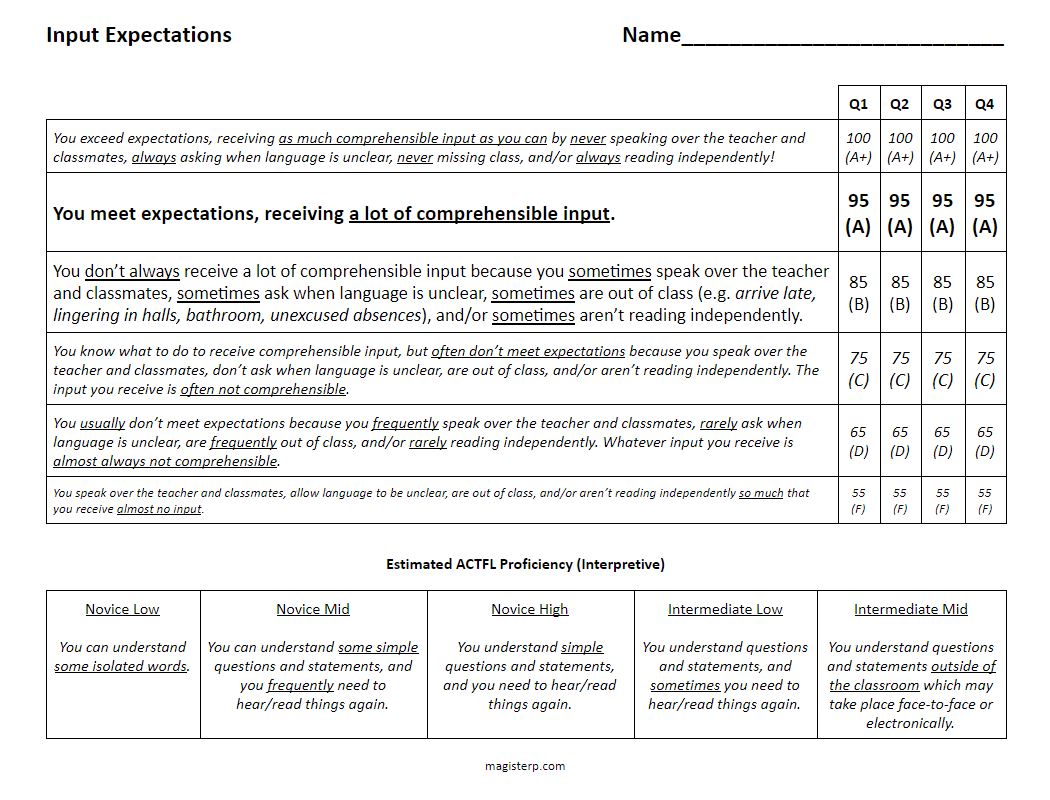
Input Expectations: The Updated ONE Rubric

I’ve had great success reporting scores of any homework, assignments, and quizzes in a 0% grading category portfolio, and then using those scores as evidence to double check and confirm each student’s self-assessed course grade based on Proficiency Rubrics. However, I’m constantly open to streamlining any teaching practice, so I’ve just updated my rubrics, distilling them into a single one. Students still self-assess their own estimated ACTFL Proficiency Level, but that level is independent from the grade they also self-assess. So, what’s the grade based on? Instead of proficiency, it’s based on course expectations of receiving input! After all, input causes proficiency, so why not go right to the source?

Move over Proficiency-Based Grading (PBG)! Hello…Expectations…Based…Grading (EBG)? It’s not as wacky as it sounds, trust me. In fact, it’s probably the least-restrictive grading practice next to Pass/Fail, yet still holds students accountable and provides all the flexibility I’ve enjoyed thus far. Here’s the rubric:

Capture

Continue reading

Super Posters (Sweet Sēdecim)

I recently updated my classroom posters as part of the Universal Language Curriculum (ULC). I now intend to focus more deliberately on those top 16 verbs each year, every year, using whatever else is needed for communication given various topics.

Here’s the next update…Super Posters!


These new posters not only have all the plural forms, but also the past tense on the back when printed double-sided! Now, I use the past tense aaaaaaaaall the time, right from the first day of Latin 1! In fact, there’s no legitimate reason not to when teaching in a comprehension-based communicative classroom (i.e. shelter vocabulary, not grammar). Usually, my signal for past tense (i.e. hand over shoulder) is enough to convey the meaning, but these new Super Posters will be particularly helpful when there’s a completely different-looking word (i.e. stem-change). My signal works, but there are those who would prefer to have the plural forms written as well. As such, I’ve added them as another set of posters, present tense, and plural. However, these words get quite long for a highly inflected language like Latin, so I won’t be using them, myself.

Capture

The plural forms of this word are quite long, and harder to see from the back of the room.

Due to that clutter from some verbs, my own plan is to continue posting the original ones with only singular. So, where do the Super Posters come into play? They’ve now become the laminated ones I hand out to students. In addition to holding up the poster when I use that verb, the student can flip it when they hear the past tense. Also, I can use one of these as-needed instead of writing any form students don’t understand.

I hope you find a use for these Super Posters, too!

N.B. Latin has a few past tenses. The most frequently used one, the perfect tense, has a completed aspect (like the Spanish preterite). The imperfect tense, with a continuous aspect, is used all the time, too. I chose mostly the perfect forms, especially since those can be completely different-looking from the present forms. Still, there are a few words I use mostly in the imperfect, so I included “erat” instead of “fuit,” and “sciēbat” instead of “scīvit.” If you want different tenses of any of these, make a copy of the Google doc and edit as you see fit. After all, these posters are to help YOU make Latin more comprehensible, and that might vary across different contexts.