Indiscriminate Formatives & Summatives: True Formative Assessment Model (TFAM)

I added the superfluous summative to TFAM back in June, and after the MTA Summer Conference I revisited my TFAM conceptual framework once again. This latest (last?) update is the most complete version yet. I’ve also established Creative Commons licensing as this gets shared around (“CC BY-NC” basically means use this figure, cite me, and don’t make money off of it :)).
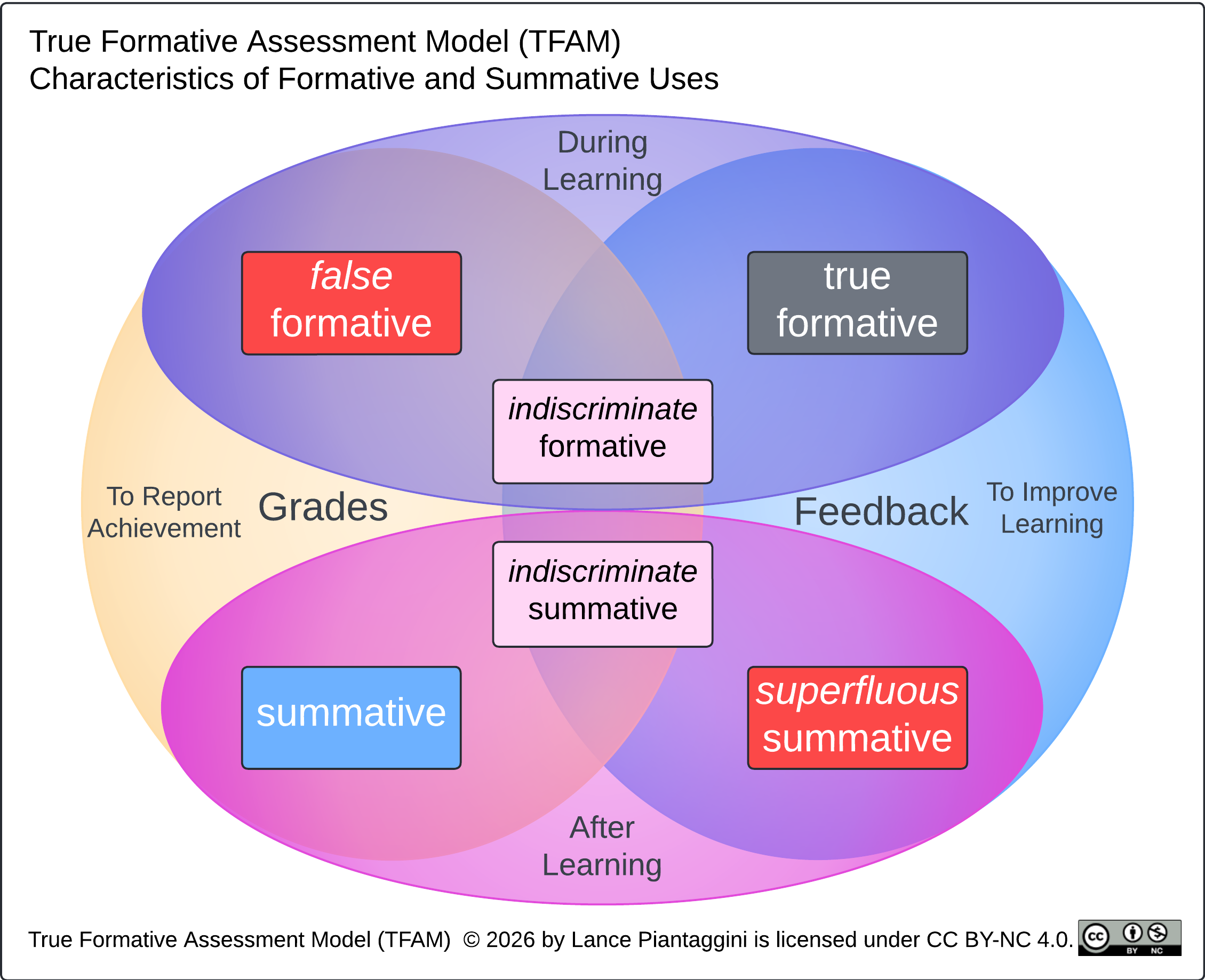
Indiscriminate Assessments
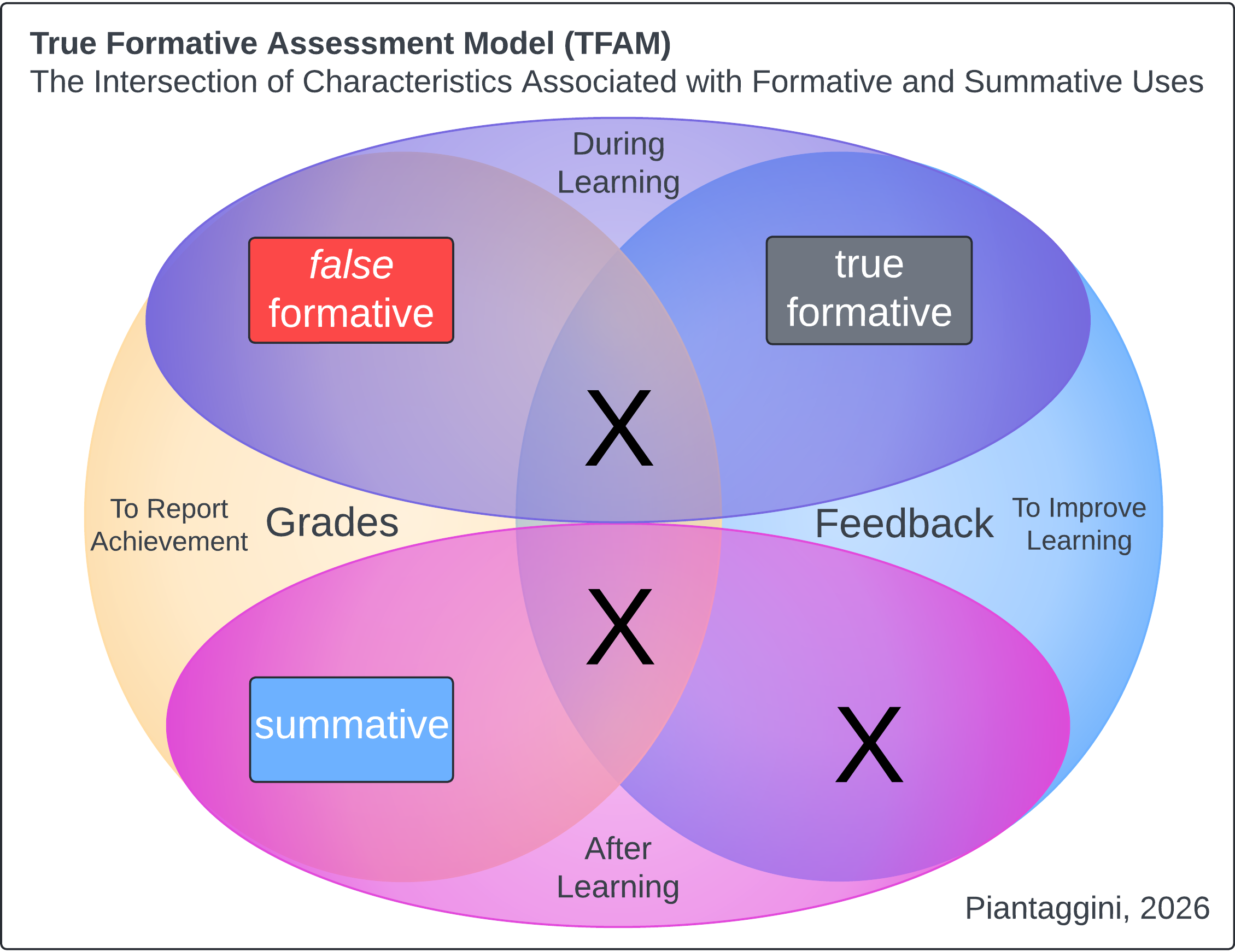
One thing bugging me about the previous version(s) of the TFAM Venn diagram was the “Xs” in the center zones. These represented assessments with mixed formative and summative characteristics. The idea behind those “Xs” was to focus on the other, more impactful zones of the Venn diagram while sending a message to teachers that combining formative and summative characteristics clashes and usually results in neutral outcomes (or at least not devastating ones), instead of the positive ones of true formatives. What I found, though, is that the “Xs” didn’t help me talk about those kinds of mixed assessments with teachers. This was a major limitation since many of teachers’ assessments ended up in these zones when we plotted their characteristics. Furthermore, there often wasn’t any particular reason for mixing formative and summative characteristics. It turns out that most of these assessments were designed that way by chance, without treating formative and summative uses differently…
Continue reading

True Formative Assessment Model (TFAM) & Guidance Phases

**Click here for the current 2026 TFAM conceptual framework**

This is an update to my 2024 presentation and assessment model reflecting insights from a continued review of classroom assessment and grading literature, findings from a new pilot study, and a novel framing of the formative assessment process I call Guidance Phases. Here’s a summary of the updates:

  • A few literature sources removed; many new ones added
  • The labeling and categorizing of assessments that mix characteristics has been abandoned to keep the focus on avoiding false formatives and incorporating more true formatives.
  • Rather than a characteristic, the role of self-assessment has been expanded to fall under Guidance Phases as part of the feedback cycle; it no longer appears in the Venn diagram.
  • Assessments, themselves, cannot be formative or summative. It is the use that determines one or the other. Therefore, I’ve clarified that the terms “formative” and “summative” in this model refer to characteristics. For example, a true formative is an assessment used in a formative way as seen through its associated characteristics (and not other characteristics associated with a summative use).

True Formative Assessment Model (TFAM)
This is the name of my model using a Venn diagram to show the intersection of assessment characteristics associated with formative and summative uses:

Continue reading