Parallel Stories

The latest Tea with BVP episode was “Teaching Without Textbooks.” Whether you’ve already ditched the textbook, or still work alongside one, parallel stories are important. Parallel stories include the same language found in a narrative, but the details (maybe plot) change. This year, I’ll be using a mix of parallel stories that compliment a textbook’s narrative, and co-created stories via TPRS.

For years I used TPRS story scripts to ask a story and then type up and read the exact story as a class. I’m now sold on parallel readings that include all the language found in the class story during acting, but now in a new context with details unknown to the students. Following Michele Whaley’s current practices on Embedded Readings, each of our stories will have at least three versions—this builds interest along the way by withholding information (vs. knowing exactly how the class story ends).

There will be more on how I adapt a textbook’s narrative later, but for now, here’s a link to our Latin 1 parallel stories (updated throughout the year in this single document).

Pīsō Ille Poētulus: A New Latin Novella

**Update 11.14.16** Piso has been published! See this announcement post.

Over the last couple years, I’ve doubled-down on pedagogy, becoming very comfortable teaching Latin, and can now place more emphasis on improving my own proficiency. Whatever my current proficiency level is, however, I’ve written a poetry-themed historical fiction novella set in Rome for the Novice reader (including 22 original lines of dactylic hexameter), which, as many have noted, we are in dire need of as a profession.

As a speaker, my Latin is not great, but it’s certainly NOT WORSE than most teachers out there. This novella, then, is an educational tool to get those teachers AND their students to read more fluently (ease + speed). It also happens to be a confidence-boosting read as an intro to Latin poetry if used in upper-levels. Pīsō Ille Poētulus now contains just 108 words (excluding names, different forms of words, and meaning established within the text, so this is quite low). I strongly feel that reading material with a low word count and frequently recycled vocabulary is a great asset to the Novice reader. Because of this parameter, decisions were made, such as esne hīc? in place of adesne? Here, I didn’t use an additional word, adesse (even if it’s a compound of other words that occur frequently), since the same, or similar meaning could be expressed with other words that already appear in the novella. Because I fully admit that my focus has been on pedagogy, I recognize that some people might have excellent suggestions to make Pīsō Ille Poētulus an even better resource for the Novice reader and our students reading Latin poetry.

So, I’m releasing the first five chapters of Pīsō Ille Poētulus (though without illustrations or all poetry audio files) for you to pilot in your classes, or at least read over Labor Day weekend. Why? This is for us—as Latin teachers—especially those who’d like to share Latin poetry with their students before the majority of them bail after year 2 or 3, and an opportunity for those with high levels of Latin proficiency to contribute to the profession.

Interested? I’m asking that you take a look at the first half of the novella, maybe run off a class copy (or project it and read through with upper-level students), and then get back to me with ways to improve it—particularly concerning the buzz about “Latinity” and “Classically Attested” and attention to Latin idiom. Keep in mind, however, the need for a Novice-level novella with a very low word count. If both can exist, hooray! If not, I’m sticking with a low word count as the priority, and you can go ahead and write a perfectly idiomatic Latin novella for Intermediate+.

Given that parameter of keeping the word count low, I’ll gladly accept suggestions for direct substitutions, especially ones that can be used in many places, or ones that don’t increase the word count by more than a word or two. Some suggestions I’ve already received have been fantastic, yet would have pushed Pīsō Ille Poētulus beyond what you’d expect from novellas with higher word counts, such as Cloeliaor Itinera Petrī. After October 1st, I’ll begin editing Pīsō Ille Poētulus for November publication. Remember, this novella is for us, so speak now or…

Click here to access Pīsō Ille Poētulus for piloting. **Update 11.14.16** Piso has been published!

Tea with BVP (9.1.16): Teachers with Low Proficiency

It’s clear that non-idiomatic language (hopefully not with structural errors) has an effect on the mental representation of a student. It would be silly to deny that. Although Bill VanPatten advocates for teachers to have high proficiency levels in this week’s Tea with BVP, he also mentions that we don’t know for certain what the negative impact of exposure to low-quality input is over different periods of time (e.g. K-12 Spanish vs. 4 years of Latin). Regardless, I think we should be asking this:

Does the negative impact of using non-idiomatic Latin outweigh the benefits of an improved experience and inclusion of ALL students in the Latin classroom?

If the answer is “yes” in a catastrophic way, an extreme suggestion would be that all Latin teachers below X proficiency level should immediately resign, or at least refrain from creating and/or publishing materials for students. These teachers should attend the available immersion events (e.g. conventicula, rusticātiō, Living Latin in NYC, etc.), listen to Nuntiī Latīnī and Quōmodō Dīcitur, read as much Latin that they understand as possible, and then get back on the horse when they’re up to speed. A less-extreme suggestion would be that they should simply not teach Latin communicatively.

If the answer is “no,” or “yes” in a non-catastrophic way, then the teacher should still definitely seek out those same ways to improve proficiency, but perhaps with less urgency. They should certainly keep teaching, and we could certainly use the published materials.

Personally, I feel that ANY mental representation of language is more beneficial than what has been going on with Grammar-Translation, and my hunch is that the negative impact is nowhere near catastrophic. Thus, it’s only a matter of time until the teacher’s proficiency improves to a high level, which means that each year students will be exposed to richer and richer input.

Note how the most effective solutions to improving proficiency become an issue of access—the immersion events aren’t cheap, and not everyone has a local Latin conversation group with highly proficient speakers. Teachers with more money and time have greater access to understandable Latin. Note, also, how the issue of access brings us right back to the classroom. A CI classroom is about extending access to Latin to all students—students typically left out in the grammar game. Realize, too, that most Latin teachers, themselves, have been denied access to communicative proficiency, and are doing what they can to improve it.

Tea with BVP – Season 2

Season 2 of Bill VanPatten’s show kicked-off today. Click on the first link you see, here, for highlights from the show in just under 15min, but catch the full episode if you have more time.

People have criticized me for not quoting many Second Language Acquisition (SLA) researchers other than VanPatten. Until the others make their work accessible by coming out with their own show, or make themselves more available by answering my emails and phone calls, I’ll continue to promote a guy whose work easily applies to what we do in classrooms—especially at the secondary level—and is advocating for positive change in our departments.

Here’s a 30sec soundbite from Episode 28 that covers 1) context as a “straw man,” 2) language acquisition vs. time, 3) setting realistic goals, and 4) ability vs. knowledge:

Language Acquisition Takes Time (Episode 28)

How Comprehensible Must Reading Be?

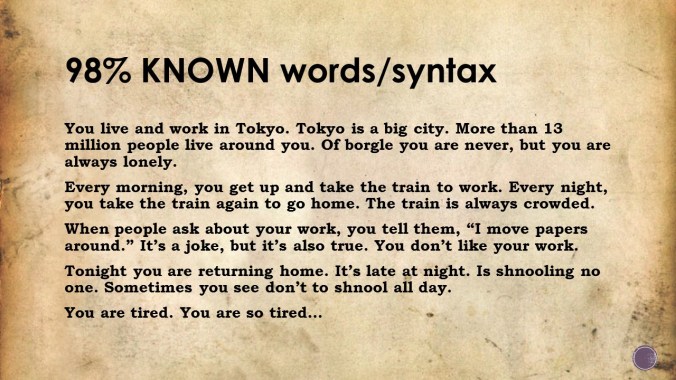
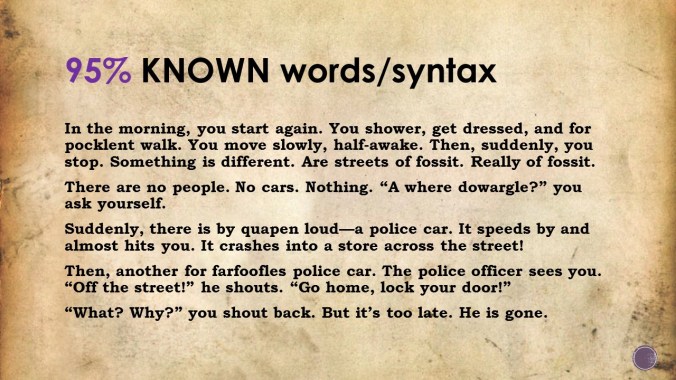
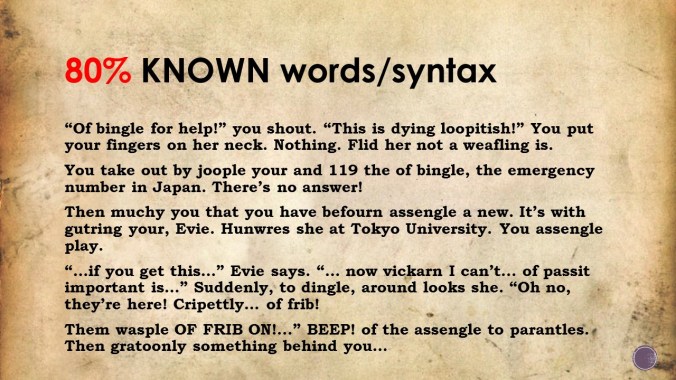
Marcos Benevides’ Slideshare PPT has been floating around for over a year now. It’s a powerful illustration of how unknown words affect reading fluency (speed + accuracy), especially for anyone who thinks students will be OK reading anything that’s less than 98% comprehensible.

Still, the syntactical clues in Marcos’ PPT helped native speakers. In order to simulate a student’s reading experience more accurately, I removed those clues. Here’s the result (download, here, for sharing):

Slide1Slide2Slide3Slide4Slide5

Negligent Motorist = 1, Lance = 0

Yesterday, the following events unfolded while riding my motorcycle:

  1. I notice a car rolling towards towards the road at a TD Bank exit driveway—the driver isn’t looking left (i.e. my direction).
  2. The driver doesn’t look my way, keeps rolling, then suddenly turns left into the road directly in front of me.
  3. I stop short. The momentum sends my motorcycle down on its right side, and me forward, also on my right side.
  4. I’m on the ground now and can’t move, but it’s for an OK reason—I realize that my helmet is stuck between the pavement and bumper of the driver’s car.
  5. The driver gets out of the car and tries to move me (idiot!).
  6. I take some time to watch horrified rubberneckers looking downward at a motorcycle on the ground and its rider partly under a car.
  7. After the disorientation dissipates, I get bored not doing anything under the car, extract myself, take off my gear, and take in the situation.
  8. Motorcycle doesn’t start (it won’t shift BELOW 3rd gear—the one it was in before going down).
  9. I wrap things up with the officer, get the moto towed, start calling insurance companies, and text Bob Patrick. No, Bob is not my emergency contact, but he just happened to have caught a typo in Discipulus Illustris, which led to a nice suggestion (i.e. Quō in annō es? for Quō in gradū es?)

Continue reading

“Classically Attested” & “Latinity”: The Latest Buzz

**Updated 5.19.18** I forgot about this post until a comment came through just now. Was I really not using http://latin.packhum.org in 2016?!?! Sure enough, Perseus is utterly unhelpful, still showing no hits even when “different forms” is checked or if they are there, it’s not in Latin, and it’s buried deep within the pages. Packhum, however, has 60 hits, instantly. 60?!?! There I was this fine night in 2016 thinking I had to defend myself for using “magis placet,” yet look at all those beautiful instances right there! Anyway, the particular phrase, then, is a proxy for any phrase we actually DON’T have. I’m not editing this post.

Teacher-written reading material for Novice & Intermediate language learners is not new, at least for modern languages. TPRS Publishing and TPRS Books frequently add more to their roster, so teachers have their choice of topic. 2015 saw the publication of the first two of these novellas in Latin, [self-]published by Pomegranate Beginnings (i.e. Pluto & Itinera Petri). Since then, there has been a wide range of reception amongst Latin teachers (or Classicists, or Linguists, or Scholars, etc.). The general consensus regarding the positive reception has been something like  “this is helping our students feel successful and have a positive experience in Latin class. If you don’t like it, you don’t have to use it.” Regarding the negative reception, most of it revolves around two buzzwords:

Continue reading

Forget about the Fossa: [Textbook] Embedded Readings Done BETTER

After attending Michele Whaley’s presentation on Embedded Readings at NTPRS, I was convinced that we’ve been playing a game of Telephone since she and Laurie Clarcq began sharing the concept back in 2012. It turns out that it’s “yes and no,” but there is an important distinction that is being made in current Embedded Reading practice. Whereas many of us THINK we’re creating Embedded Readings, most of us might be just adapting authentic texts, class stories, or textbook narratives. Those products are fine, but aren’t necessarily Embedded Readings. Most of us are missing two key features in our adapted readings that make them better:

  • Parallel Stories
  • Withholding New/Tantilizing Information (not just more words)

Continue reading

Grading vs. Reporting Scores: Clarification

In the recent sliding scale scheme, Proficiency is given 0% weight at the start of the year. This doesn’t mean that students see “0” in the gradebook. What this means is that their 95, for example (which they see in the gradebook), holds 0% weight because in the sliding scale scheme we’ve placed all 100% weight on DEA for first quarter in order to set expectations and establish routines. By the fourth quarter, 100% of the weight is on Proficiency, and whenever possible, we manually change the entire course grade to that final Proficiency number/letter so nothing else averages throughout the year.

NTPRS 2016: More Changes, More Thoughts

After attending iFLT, I spent another week in Reno at NTPRS. While iFLT offered more opportunities to observe teachers teaching students, NTPRS offered more opportunities to actually BE a student for those of us in the Experienced track. I appreciated the short demos that most presenters gave, even when the workshops were not titled “___ language demo.” There are some game changes here that warrant their own posts  (e.g. embedded readings straight from the source, Michele, Whaley), but I have much  else to report on. Like last week’s iFLT post, this one includes more of what I intend to think about and/or change for 2016-17. They’re organized by presenter:

Continue reading