I’m returning to my stomping grounds in what feels like a guest post on my own site! That is, every now and then I think “if I were to teach high school (or middle school) Latin again, I’d try this.” Well, it does nobody any good to keep those ideas in my head, so here’s what’s been on my mind…
Continue readingTeaching with Compelling CI
0 To 170: Nine Years Of Latin Novellas
In August of 2020, I wrote 0 To 70: Five Years Of Latin Novellas. Two years later, the number of Latin novellas nearly doubled. Well, another two years have gone by and we’ve seen 40 more, which is an increase of 31%! Above all, there are now 38 authors out there writing different kinds of Latin. In this post, I want to celebrate that different kind of Latin while revisiting some findings…
Continue readingCI Assessments
I was recently asked a very good question about how to change one’s assessments to align more with CI. By that, we’re talking about comprehension-based language teaching (CLT) that prioritizes comprehensible input (CI) in the Latin classroom. First, it helps to think in terms of what standards were being assessed beforehand, even if they weren’t explicitly called “standards.” These old standards were mostly discrete skills you’d expect to find in tests accompanying popular textbooks, like vocabulary recall, derivative knowledge, grammar identification, and cultural trivia. New standards based on CI—whatever they are—will have meaning at the core. My suggestion is to focus on assessing comprehension of Latin, because that’s more than enough to ask for. One benefit of this standard is that is that it has those old discrete skills embedded within something larger and more meaningful that you can assess (i.e., comprehension). Let’s look at how each one of the old standards is contained within assessing comprehension…
Continue readingPre-Ballet: The Piantaggini Method (Published!)
No, not that Piantaggini, who published 35 Latin novellas (i.e., me), but my cousin, Amy, also very much interested in curriculum design.
Continue readingChants Of Sennaar: A Video Game Illustrating The Need For CI
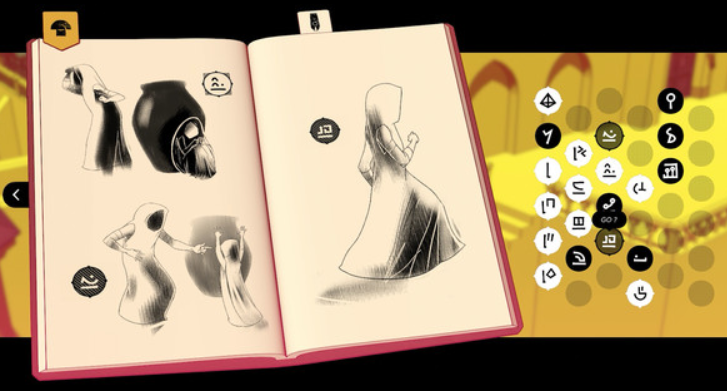
When I first started playing Chants of Sennaar on Steam, I said “uh oh,” thinking it would be a game that suggested language learning was all about immersion and guessing. Luckily, I was wrong.
“Legend says that one day, a traveler will reunite the Peoples of the Tower who are unable to communicate with each other. Observe, listen, and decipher ancient languages in a fascinating universe inspired by the myth of Babel.”
The basic gameplay is you moving about the world and clicking on things to interact with, like puzzles, or other humanoids, as you’re shown glyphs. The point is to learn the glyphs and progress throughout the narrative. While the game certainly has an inductive element to learning those glyphs, you eventually get what you need: comprehension. And it’s full comprehension, too, not just that “gist” stuff that only gets you so far. The game gives you comprehended input.
Teacher Narratives + Student Self-Grading
Maybe having students collect, evaluate, and grade their work entirely isn’t for you. This post offers a slightly different approach with the same outcome.
Narrative accounts of student learning aren’t new. In fact, I just read about them recently in Off the Mark: How Grades, Ratings, and Rankings Undermine Learning (but Don’t Have To) One thing I haven’t heard yet is anyone combining narratives with self-grading. This would eliminate a LOT of the issues teachers have reported, namely the time it takes to score them, and the consistency needed to score them well (Schneider & Hunt, 2023).
Narratives go back about 100 years. They were the next step in efficiency following the practice of teachers visiting homes of their pupils and presenting an oral report on how the child was doing. As high school enrollment skyrocketed, though, narratives were abandoned for even more time-saving percentages, with the A-F scale in place sometime in the 40s (Brookhart et al., 2016).
One way to resurrect narratives on a smaller scale by bringing them back into your classroom would be to a) look at students’ learning evidence, b) make a statement, and then c) have the student select a grade that they feel corresponds to what you wrote. For example, my Process criteria—one of two equally weighted categories/standards—was “you receive a lot of Comprehensible Input (CI).” That’s basically it; clear, and effective. When my students self-graded, though, I provided examples in a single-point rubric of what that could look like, as well as some non-examples to help 9th graders with some critical, evaluative thinking. Here’s a screenshot:

That worked well, but maybe you want to add a narrative account to the grading. To come up with a narrative from this criteria, let’s imagine a student missing assignments who doesn’t respond in class, and hardly ever asks Latin to be clarified. The statement could be “you’re missing learning evidence that could otherwise show you’re receiving CI. In class, you rarely show understanding, and hardly ever ask for Latin to be clarified.” Then, the student would select a grade on the 6-point scale (55, 65, 75, 85, 95, 100). If they say something like “85,” just follow up and talk about how missing assignments and rarely meeting expectations surely isn’t something represented by that number. If they say “75,” or “65,” that sounds about right depending on the degree of what is/isn’t happening.
This doesn’t have to be rocket science.
We already know that the more students think about how well they’re doing something, the worse they actually end up doing (Kohn, 1993), so limiting this exchange to once a quarter reduces any negative impact to to a minimum. Overall, this practice might be worth trying for teachers who want to retain a bit of control while still being in pursuit of getting scores and points mostly out of the picture.
Self-Grading: Explained
Is self-grading effective, and worth it? All signs point to “yes.” Some research findings appear at the end of this post.
Along with the minimum 50, self-grading is another high-leverage practice often found in an ungrading approach that keeps the focus on learning. In practice, though, self-grading is often misunderstood. If anyone hears about students giving themselves a grade and imagines a kid with their head on the desk all quarter who suddenly pops up and says “I get an A,” that’s dead wrong. With a solid self-grading practice that maximizes teacher prep time and empowers students to evaluate their learning, this student would lack evidence to make such a claim. And that’s one focus of this post (i.e., making a claim). Let’s first start with what teachers have been doing—historically—to make a claim about students’ grades so we can explain self-grading…
Continue readingLatin & CI Criticism: Challenging Work & Higher-Order Thinking

A frequent complaint of comprehension-based Latin teaching is that students aren’t challenged enough. Critics point to Bloom’s “understanding” level, assuming that everything stops there, imagining students hanging out in the lower-order thinking levels. Given that assumption, the critic’s takeaway is that “CI Latin” is unchallenging, and lacks higher-order thinking.
Untrue.
What is true is that comprehension-based Latin teaching prioritizes understanding as step zero. Under such an approach, nothing is done without first understanding the Latin in front of all students. One immediate implication is that Latin texts must be level-appropriate for beginners in the first years of a new language. And that level is quite low. Therefore, it is true that these texts are at a much, much, much lower level than the kinds of texts traditionally used in Latin classrooms, but that’s just text level. This says nothing about thinking level. Do these truths mean that students do NOT engage in higher-order thinking with these lower level texts? Are students NOT challenged when reading and discussing in class?
Continue readingCrazy vs. Calm: Reverse Questions
Reducing listening activities and doubling-down on reading last year had amazing results, even for a year with the lowest interest in the language I had ever seen. We read novellas, embedded readings from MovieTalk clips, tiered versions of various existing texts, and Type ‘n Talk (Write & Discuss) class texts. Overall, instead of what I’m gonna call crazy content creation (CRAY-CC), I had a lot of success with all that calm content creation (CALM-CC). The former is something like 110% energy-filled classes with a massive focus on interaction. The latter isn’t. Both are different approaches to comprehension-based teaching prioritizing input. The former has a far greater emphasis on communicative language teaching, which isn’t necessarily sine qua non as some make it out to be. While I truly believe this applies to all languages, it is especially the case for Latin.
Of course, I don’t disparage anyone doing the former, though I do recommend that language teachers do what they can so new teachers see CRAY-CC as just ONE approach to providing input. In other words, it would benefit anyone new to the field if experienced comprehension-based language teachers presented and shared the non-negotiables and principles of CI more than specific CRAY-CC activities, methods, etc. For me, CRAY-CC was trending when I started teaching. Granted, I did learn most of my strategies and techniques from all that, but it would have been nice to be presented with other options that fit my speed, style, mood, etc., and especially that of my students. Luckily, I became more responsive to their reluctance, and adapted. In the end after 9 years of focusing on CRAZY-CC, I finally settled on CALM-CC classes for my 10th year. The reading development truly was magical. We generated class texts based on what were were discussing, learning, and reading, and it was all more than enough content. No order-at-cafe/taberna role plays, and no paired speaking activities that lacked a purpose, either.
Granted, that doesn’t mean I ditched speaking Latin altogether, and I certainly wouldn’t recommend that. At this point, I would recommend a kind of speaking Latin in the classroom that looks different, though, such as communicating with students (fully accepting their English responses), and just skipping on the kind of listening demands that seemed to require 100% silence on their end—ultimately leading to classroom management disasters—that so often accompany CRAY-CC. For a CALM-CC approach, many greetings, instructions, and daily interactions can be done in simple Latin, and have value. Then there’s questioning.
Questioning IN LATIN can be tricky given issues with asking questions when reading a text, which I found became more of a problem when reading ramped up. But let’s say I wanted to ask more questions IN LATIN, and let’s say you do, too. Assuming you had a classic Classical background with approximately 0% speaking Latin, maybe you recently went to a conventiculum, and now you want to speak more Latin in the classroom. That’s a great idea, though not everything you learned and experienced can be applied to your students who have an uncia of the prior knowledge you do. Just as well, here’s an activity inspired by a graduate student who recently presented a selection of Virgil (in English) during a mini lesson, asking yes/no, either/or, and “do you think that” questions that reminded me of what I used to ask IN LATIN as early as the first weeks of school. I call it Reverse Questioning…
Continue readingFormative Grades: Not Really
In this post, I’ll write about the very, very, very few times all those grades in your “formative” category are, indeed, likely formative. Otherwise, I make the claim right here and now that they’re almost always summative…
Continue reading Magister P.