Teaching Grammar without the Grammar-Translation Method

Among the many misconceptions about CI, such as some mission against the Classics, “not teaching grammar while providing CI” is probably the most-cited, yet misinterpretissimus of misconceptions.

We teach grammar, oooooooh do we, although mostly in the context of complete Latin messages since even words/phrases contain grammatical information. There’s even explicit instruction, too, though brief student-initiated pop-up grammar explanations (e.g. “Mr. P, why does that word end with nt and not t?”) comprise most of this in a comprehension-based communicative classroom.

Still, even after all that, we do give explicit instruction when students are ready, usually in years 3 or 4. That’s right—even CI-advocating teachers explicitly teach grammar, and they do so using a host of methods and method-free strategies—all grammar-translation alternatives.
Continue reading

Latin Stories Videos Series: Rōmulus et Remus

maxresdefault

Rōmulus et Remus is the third video in this series after Pygmaliōn & Mīnōtaurus. This is Rome’s foundation myth retold using 37 unique words. The story is 259 words total in length.

For an improved sensory experience, play Arvo Part’s Fratres while reading & discussing the text. 3:50 could represent the surmounting conflict, and 6:05 could represent Remus’ exit and Romulus internal struggle (that is, if he even had one, right?).

1) Class
2) Story (link to Google Doc text found in YouTube video description, but also here)
3) Questions

Establishing Meaning: Confusion

Step 1 of TPRS is “establish meaning” to show what a word/phrase means in the target language (TL) before using it to co-create a story. The most efficient and effective way to do this is by using a native language (L1) common to all students (e.g. “fēlēs means cat“). In TPRS, we write the TL on the board, underline it, then write the L1 below in a different color. We refer to this throughout class by pointing and pausing.

Establishing meaning is also Step 1 for anyone providing comprehensible input (CI), regardless of the method or strategy.

If this step doesn’t occur, teachers are providing input (I) that might not be comprehensible (C). Although there’s some role that noise in the input plays (Incomprehensible Input?), it’s clear that acquisition doesn’t happen with high levels of that noise. This is why no one—NO ONE—disputes that CI is necessary; it’s the sine qua non of acquisition, which is why establishing meaning is so important.

Still, there’s been confusion over establishing meaning, and that confusion has to do with purpose…

Continue reading

LLPSI Challenge

CI is not out to destroy the Classics. On the contrary, those advocating for teaching with more CI are the professions’ biggest cheerleaders, aiming to increase interest and enrollment worldwide. How? It starts with including all students.

Still included in the included, though, are those students most like us who have always thrived in conventional Latin classrooms. We can’t leave them out. At this point, I’ve had about 10 classes with students this year, which is just around the time when it becomes clear who’s really into Romans, and/or really into learning (as opposed to everything else that interests adolescents). Since a few of these students have made their presence known in my inclusive classroom, I have a plan…

Continue reading

All You Need Is One: Text, Sentence, Word

I agree with Justin Slocum Bailey that something great can come from nothing. Most teachers fall into the habit of planning waaaay too much. Even if all that planning is enjoyable, somehow, it often results in insignificant gains in student happiness and/or proficiency. In the spirit of “no fail no burnout,” then, plan whatever you have to in order to sleep well at night, but begin class ready for any compelling diversion to take you away from those plans! Sometimes a sentence is all you need, and depending on the content, a single word (e.g. One Word Image, or One Word Drawing).

Continue reading

Writing for the Novice: Fewer Words, Shorter Sentences

When it comes to writing for the novice, nothing is more important than using words students know, and keeping sentences short. The use of fewer words is self-evident. Shorter sentences, however, help reduce cognitive demand, and likely result in more repeated words from restating the subject, and clearly separating contrasting ideas instead of piles of subordination.

Magister Craft’s latest October Equus is the most understandable novice-categorized Latin video out there that doesn’t establishing meaning in the video itself (though complete subtitles in English are available). There are 127 total words, and 86 unique. If we exclude names, and a handful of words with different forms, that brings it down to about 60 words. The most frequently repeated words are est (6), in (6), et (5), caput (4), and equus (4), with another 5 words repeated 2x. Even this most-likely-to-be-understood video is nowhere near comprehensible to my first year students, or any other students who aren’t familiar with about 58 of those particular words.

How to make this more comprehensible for my students? The first step, without reducing the word count, is breaking up sentences (the longest sentences are 10 words in length). This allows us to restate the subject, or verbs with multiple subjects, and then add one or two words from the original longer sentence. As a result, the novice student has more exposure to the big content words that hold meaning, and increases the chance that any new words are comprehended instead of part of a string of new words all at once. Here are examples:

Continue reading

Rūfus et arma ātra: Teacher’s Materials & Rūfus et gladiātōrēs (Student FVR Reader)

**Updated 6.29.18**

3000 additional total words in 28 scenes and stories for the novice reader featuring more vivid descriptions of weapons, deeper character development, mud, fights with animals, retiarii, baths, rumors, mysterious odors, infants in danger, Crixaflamma’s real name, and more…

This is a different kind of teacher’s guide.

This slideshow requires JavaScript.

Continue reading

K-F-D Quiz: Fun With Data Analysis!

I spent about 15min entering data from the diēs Mārtis (i.e. Tuesday) Latin class K-F-D QuizzesN.B. These are “sneaky quizzes” per my NTPRS 2017 presentation, No Prep Grading & Assessment, referring to “assessments” that satisfy most quizzing/testing requirements, yet are actually an opportunity to interact and acquire.

chart

28 students were in class for the K-F-D Quiz. Here are some observations:

Continue reading

Making Latin More Comprehensible: Cognates

Teacher’s Materials for Rūfus et arma ātra are just days away from being published, featuring 28 additional stories that expand the unique word count, and increase sentence lengths. This will provide the novice+ student with 3000 more total words to read in Latin, and is the first of my Latin texts written with deliberate attention to super clear cognates—45 of them!

When it comes to a student-centered acquisition-rich classroom, the main responsibility of a teacher is providing input. Given time constraints, as well as what we know about general anxiety over learning languages, the input (I) should be as comprehensible (C) as possible. Therefore, the teacher would benefit from spending most of their time making the target language more comprehensible, but doing so requires training in particular strategies and techniques.

An oft neglect technique for Latin teachers is the liberal use of cognates.

Continue reading

Kahoot English Quadrant Word Race

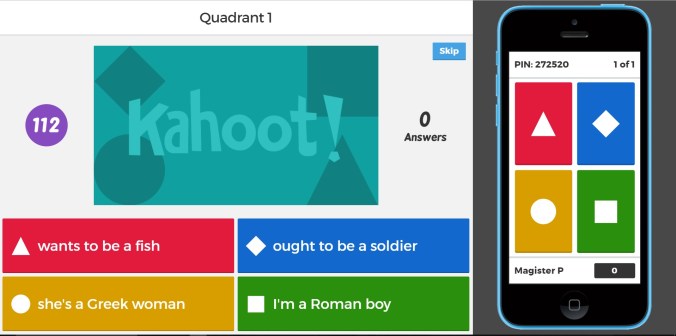
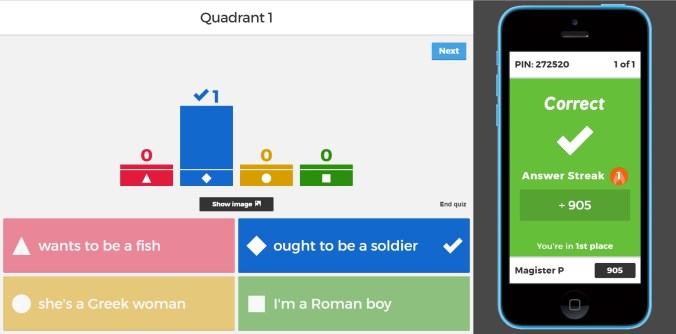
The low-tech/no-tech paper version of the English Quadrant Word Race (included in Pīsō Ille Poētulus Teacher’s Guide, as well as the upcoming Teacher’s Materials for Rūfus et arma ātra) is an awesome, simple, input-based competitive activity.

The more-tech version is to take 5min and make a Kahoot quiz for the whole class, or teams. On Kahoot, students earn more points the faster they answer, so you’ll get a whole class/team winner (vs. the 1 winner per pair in the low/no-tech paper version).

kahoot 1

The process is the same—just read slowly in the target language, and when students hear you say one of the options, they choose it on their smartphone/computer.

kahoot 2