Communication: Definition & Clarification

Recently on Twitter, Tea with BVP caller extraordinaire, Longinus, as well as some Inclusive Latin Classroom folks, got me thinking about the definition of communication. What follows are terms I’ve been using for a while (almost entirely unoriginal), clarified by Bill VanPatten on Episode 68 of Tea with BVP.

Communication isn’t only speaking:
Communication is the interpretation, negotiation, and expression of meaning. We interpret when we read, and express when we write; no speaking necessary.

Two people are usually involved, but not required:
If I write a note (expression), and place it in a drawer, but then the apt. catches fire (yes, we have renters insurance), there’s no possible way for anyone to read it (interpretation), or ask me about it (negotiation), even if that was my intent. I most certainly expressed my ideas, there just wasn’t anyone around to interpret them.

In Latin, reading—though not to be confused with translating—is the primary form of communication. ACTFL modes of communication are helpful, here. Reading is one-way, and Interpretive (i.e. interpretation), but someone had to write what we read…at some point (i.e. two people involved). That person who wrote what we read is also one-way, and Presentational (i.e. expression). Neither of these become Interpersonal (i.e. negotiation) unless there is interaction between two people, and this interaction doesn’t have to take place in person. This is why Bill VanPatten refers to communication as “expression, interpretation, and sometimes negotiation of meaning.” Both the writer and reader engage in acts of communication, it’s just that their role is different.

Timing (i.e. real, or asynchronous) & Perspective:
Ovid wrote something (expression) a couple thousand years ago that I can try to read today (interpretation). There has been no interaction between us, eliminating the possibility of negotiation. However, if I write an adaptation of Ovid (expression), and then send it to John Bracey, a couple things could happen. John could star the email, forget, and never end up reading it (no interpretation, just my expression). Or, John could read it (interpretation), and send back some notes or questions (negotiation). This interaction between us would be delayed, but still the same process communication-wise as if we were in person. Now, if I also star and forget about that latest correspondence from John, however, neither negotiation nor interpretation occur. This doesn’t change the fact that John expressed ideas and attempted to negotiate with me. That is to say, from John’s perspective, he still engaged in communication, but it was only one-way without my involvement.

Communication as a concept, not as verb “communicate:”
Although I’m engaging in the act of communication by trying to read Ovid (interpretation), one could hardly say that I’m “communicating with” Ovid anymore than Ovid is “communicating with” me, or us as a society. Ovid certainly expressed meaning, itself communication by definition, but in the absence of real time interaction and negotiation, or even delayed negotiation of meaning over letters, we are not “communicating with” each other.

Someone correctly brought up the fact that the idea of “communicating with the ancient world” isn’t possible. Classicists use this phrase, referring to relating to [certain] ancient people’s ideas (expression) by learning more (interpreting) about the past, and making connections to our own lives, but this ends there as far as communication goes. There is no possibility of interaction (negotiating) with ancient authors. When we read about the past, communication is one-way.

Partially- or fully-communicative:
Things get more complicated from here, but the definition of communication still holds up. An activity lacking a purpose yet focusing on meaning is partially-communicative. Most teachers spend their time doing partially-communicative activities in preparation of a few fully-communicative tasks along the way. Personally, I don’t bother with tasks/Tasks, and find them awfully close to performance-based assessments, the juice of which tends not to be worth the squeeze.

Writing for the Novice: Fewer Words, Shorter Sentences

When it comes to writing for the novice, nothing is more important than using words students know, and keeping sentences short. The use of fewer words is self-evident. Shorter sentences, however, help reduce cognitive demand, and likely result in more repeated words from restating the subject, and clearly separating contrasting ideas instead of piles of subordination.

Magister Craft’s latest October Equus is the most understandable novice-categorized Latin video out there that doesn’t establishing meaning in the video itself (though complete subtitles in English are available). There are 127 total words, and 86 unique. If we exclude names, and a handful of words with different forms, that brings it down to about 60 words. The most frequently repeated words are est (6), in (6), et (5), caput (4), and equus (4), with another 5 words repeated 2x. Even this most-likely-to-be-understood video is nowhere near comprehensible to my first year students, or any other students who aren’t familiar with about 58 of those particular words.

How to make this more comprehensible for my students? The first step, without reducing the word count, is breaking up sentences (the longest sentences are 10 words in length). This allows us to restate the subject, or verbs with multiple subjects, and then add one or two words from the original longer sentence. As a result, the novice student has more exposure to the big content words that hold meaning, and increases the chance that any new words are comprehended instead of part of a string of new words all at once. Here are examples:

Continue reading

Rūfus et arma ātra: Teacher’s Materials & Rūfus et gladiātōrēs (Student FVR Reader)

**Updated 6.29.18**

3000 additional total words in 28 scenes and stories for the novice reader featuring more vivid descriptions of weapons, deeper character development, mud, fights with animals, retiarii, baths, rumors, mysterious odors, infants in danger, Crixaflamma’s real name, and more…

This is a different kind of teacher’s guide.

This slideshow requires JavaScript.

Continue reading

K-F-D Quiz: Fun With Data Analysis!

I spent about 15min entering data from the diēs Mārtis (i.e. Tuesday) Latin class K-F-D QuizzesN.B. These are “sneaky quizzes” per my NTPRS 2017 presentation, No Prep Grading & Assessment, referring to “assessments” that satisfy most quizzing/testing requirements, yet are actually an opportunity to interact and acquire.

chart

28 students were in class for the K-F-D Quiz. Here are some observations:

Continue reading

Making Latin More Comprehensible: Cognates

Teacher’s Materials for Rūfus et arma ātra are just days away from being published, featuring 28 additional stories that expand the unique word count, and increase sentence lengths. This will provide the novice+ student with 3000 more total words to read in Latin, and is the first of my Latin texts written with deliberate attention to super clear cognates—45 of them!

When it comes to a student-centered acquisition-rich classroom, the main responsibility of a teacher is providing input. Given time constraints, as well as what we know about general anxiety over learning languages, the input (I) should be as comprehensible (C) as possible. Therefore, the teacher would benefit from spending most of their time making the target language more comprehensible, but doing so requires training in particular strategies and techniques.

An oft neglect technique for Latin teachers is the liberal use of cognates.

Continue reading

Preparing Our Students For…Latin 100?!

Someone on Facebook posed a couple questions to those at the college/university level regarding the preparedness, and subsequent placement of incoming students.

These are excellent questions.

One comment reported that most incoming Advanced Placement (AP) students retake a lower level grammar course in college. Most! These AP students were successful in high school because of significant memorization, but aren’t prepared for grammar the way colleges expect them to be. Perhaps we should look at exposing students to grammar a different way, no?

I’ve asked these questions, myself, yet the few Classics Departments I solicited years ago didn’t collect any of that data beyond a handful of students they could remember from the current year. Oh, would that they had done so!

Continue reading

Kahoot English Quadrant Word Race

The low-tech/no-tech paper version of the English Quadrant Word Race (included in Pīsō Ille Poētulus Teacher’s Guide, as well as the upcoming Teacher’s Materials for Rūfus et arma ātra) is an awesome, simple, input-based competitive activity.

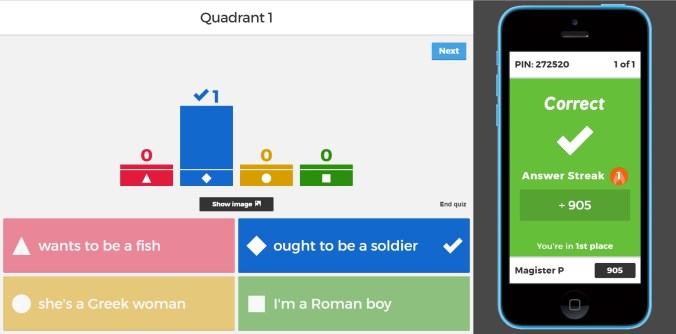
The more-tech version is to take 5min and make a Kahoot quiz for the whole class, or teams. On Kahoot, students earn more points the faster they answer, so you’ll get a whole class/team winner (vs. the 1 winner per pair in the low/no-tech paper version).

kahoot 1

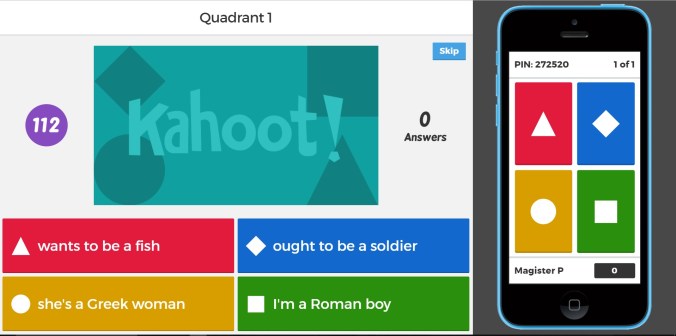
The process is the same—just read slowly in the target language, and when students hear you say one of the options, they choose it on their smartphone/computer.

kahoot 2

Sheltering Vocabulary: Caesar & Piso Fun Facts

Fun Facts:

  • Caesar’s Dē Bellō Gallicō, Liber V (i.e. just book 5, though there are 8 total) has 2900 unique words, and is 7400 total words in length.
  • All 4 current “Pisoverse” novellas combined have 233 unique words, and are 8445 total words in length.

Observations:

  • Regardless of any definition of “reading” that could possibly exist, successfully reading one of the above is an impossible task for nearly all high school students, and extremely unlikely for the remaining handful.
  • The unique word count of 108 in Pīsō Ille Poētulus—the highest of my novellas—is too high for some students to read easily. That’s with just 108 words, let alone 200, let alone 400, let alone 800, 1600, or the 2900 in Caesar.
  • Most students will fail to read anything close to this excerpt of just one ancient author (traditionally considered “easy Latin!”) that has 26x the vocabulary of a novella some students can’t yet read easily.
  • At most, high school students receive 4 years of input (5-6 if middle school Latin?). Given that some students in years 1 and 2 might not be able to read Pīsō Ille Poētulus easily, it’s clear that realistic expectations for reading are much, much lower than we think.
  • Students will be more successful reading copious amounts of Latin containing words they are familiar with.
  • Sheltering vocabulary has the greatest impact on providing contexts with more familiar words.
  • Students would benefit from reading more novellas under 100 unique words.


Why novellas? Read more, here.

A- in Conjugating, D in Comprehending

**UPDATE 9.28.17** Episode 65 of Tea with BVP, entitled “Does Instruction Speed Up Acquisition,” confirms much of what’s in this post.

I just looked up the 3rd person plural future active indicative form of habēre—or—expressed in a more comprehensible way, I just looked up how to say “they will have.” Before I looked it up, though, habēbunt didn’t sound right in my head. It didn’t sound right because I haven’t received enough input of that word. I also haven’t received enough input of other words with the same ending in different contexts. If I did, I’d have a better chance of being able to extract the parts during my parsing (i.e. moment-by-moment computation of sentence structure during comprehension), and wouldn’t have had to think about how to express “they will have.”

No one dare say that I didn’t study my endings, because I totally did. I got an A- in paradigms. I knew them forwards and backwards, UK and North American order, too! That was after I got a D in comprehension the first time I took Latin because the pace was too fast, and my memory insufficient to learn Latin. Or so I thought…

Continue reading

Writing for the Novice: Parsing

On Episode 64 of Tea with BVP, Bill mentioned a couple things we’ve heard before, only this time through the lens of parsing (i.e. “moment-by-moment computation of sentence structure during comprehension”). You’ll note immediately that this definition is different from the Grammar-Translation method teacher prompt of “Student X, would you please parse the main verb found in line 2?” in which the pupil gives the person, number, tense, voice, and mood of the verb, which we all know the diligent student can do, though has nothing to do with the psychologically real comprehension of the sentence in which it was parsed.

First Noun Principle
Novice students* of most languages process the first noun they come across (e.g. “Caesarem” in Caesarem canis mordit) as the agent (i.e. one acting, but not necessarily grammatical subject). The savvy language teacher aware of language-learners’ first noun strategy could respond to this by using word order that avoids the misleading tendency.

Continue reading