**Any mention of Google Docs means them being used as screen share during Zoom—what was projected in class—NOT for any student editing.**
This year, I’m pushing the boundaries of streamlining teaching. For years, my students have used one rubric to self-assess one grade at the end of a term. Google Docs have always been my in-class-go-to for organization and providing input, but a few updates have resulted in magic…
self-assess
Input Expectations: The Updated ONE Rubric
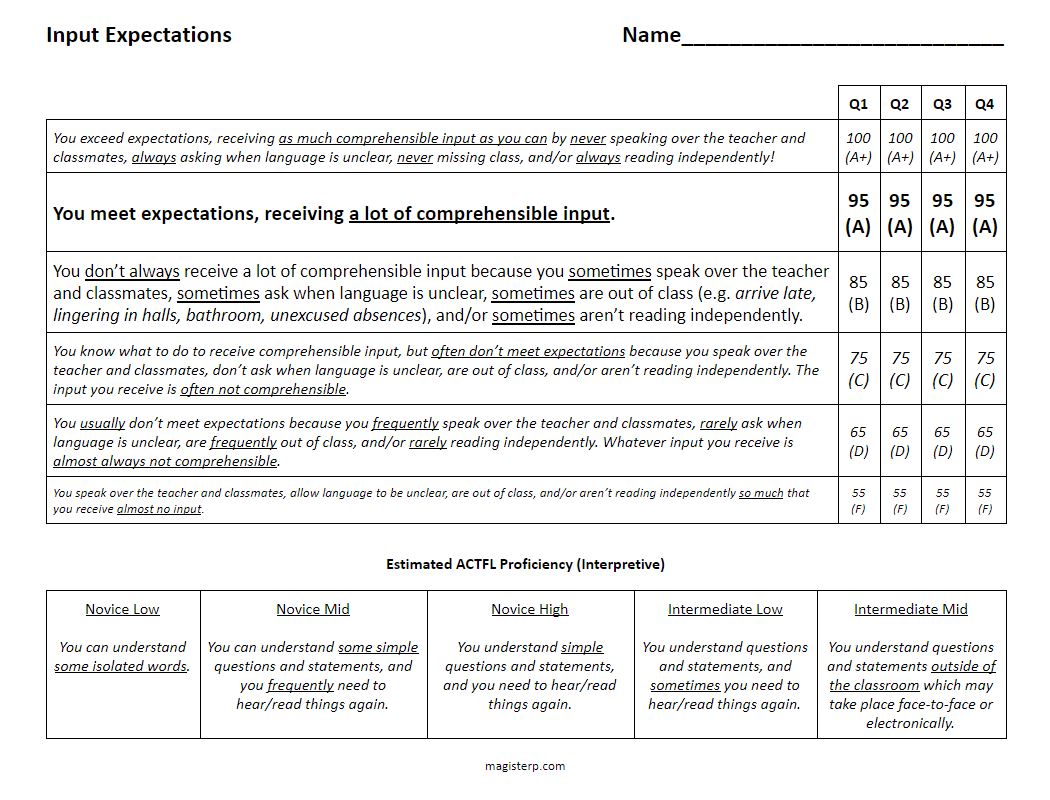
I’ve had great success reporting scores of any homework, assignments, and quizzes in a 0% grading category portfolio, and then using those scores as evidence to double check and confirm each student’s self-assessed course grade based on Proficiency Rubrics. However, I’m constantly open to streamlining any teaching practice, so I’ve just updated my rubrics, distilling them into a single one. Students still self-assess their own estimated ACTFL Proficiency Level, but that level is independent from the grade they also self-assess. So, what’s the grade based on? Instead of proficiency, it’s based on course expectations of receiving input! After all, input causes proficiency, so why not go right to the source?
Move over Proficiency-Based Grading (PBG)! Hello…Expectations…Based…Grading (EBG)? It’s not as wacky as it sounds, trust me. In fact, it’s probably the least-restrictive grading practice next to Pass/Fail, yet still holds students accountable and provides all the flexibility I’ve enjoyed thus far. Here’s the rubric:
Choose Wisely: Self-Grading & Batch Assessments
Here are more thoughts on assessment in addition to yesterday’s post. They should be timely seeing as teachers are talking about end of quarter exams, and upcoming mid-terms.
So, individually assessing student speaking one-at-a-time in the hall? This is a big waste of time, and here’s why…

