I had the opportunity to revisit Wiliams’ 2018 book, Embedded Formative Assessment, while looking for definitions of “formative assessment.” The first two chapters are simply priceless. Beyond those, the other chapters include a general problem to be solved, and then practical techniques on solving them. Here’s an overview of what I consider the best parts…
Continue readingformative assessment
READ THIS: Mark Barnes’ “Assessment 3.0”
Even though I recommend Mark Barnes’ SE2R feedback model, and have written about that, here, there’s a bit more to his “Assessment 3.0” book than just the model. It warrants further reading…
Continue readingREAD THIS: Zerwin’s “Point-Less…”
In cobbling together sources for my 2025 MTA Summer Conference presentation on “Getting More from Your Formative Assessments and Grading,” I searched my blog to link posts on books I consider foundational. Somehow, I never published the post I wrote after reading Zerwin’s “Point-less” years back. Her work deserves some attention…
Continue readingFalse Formatives
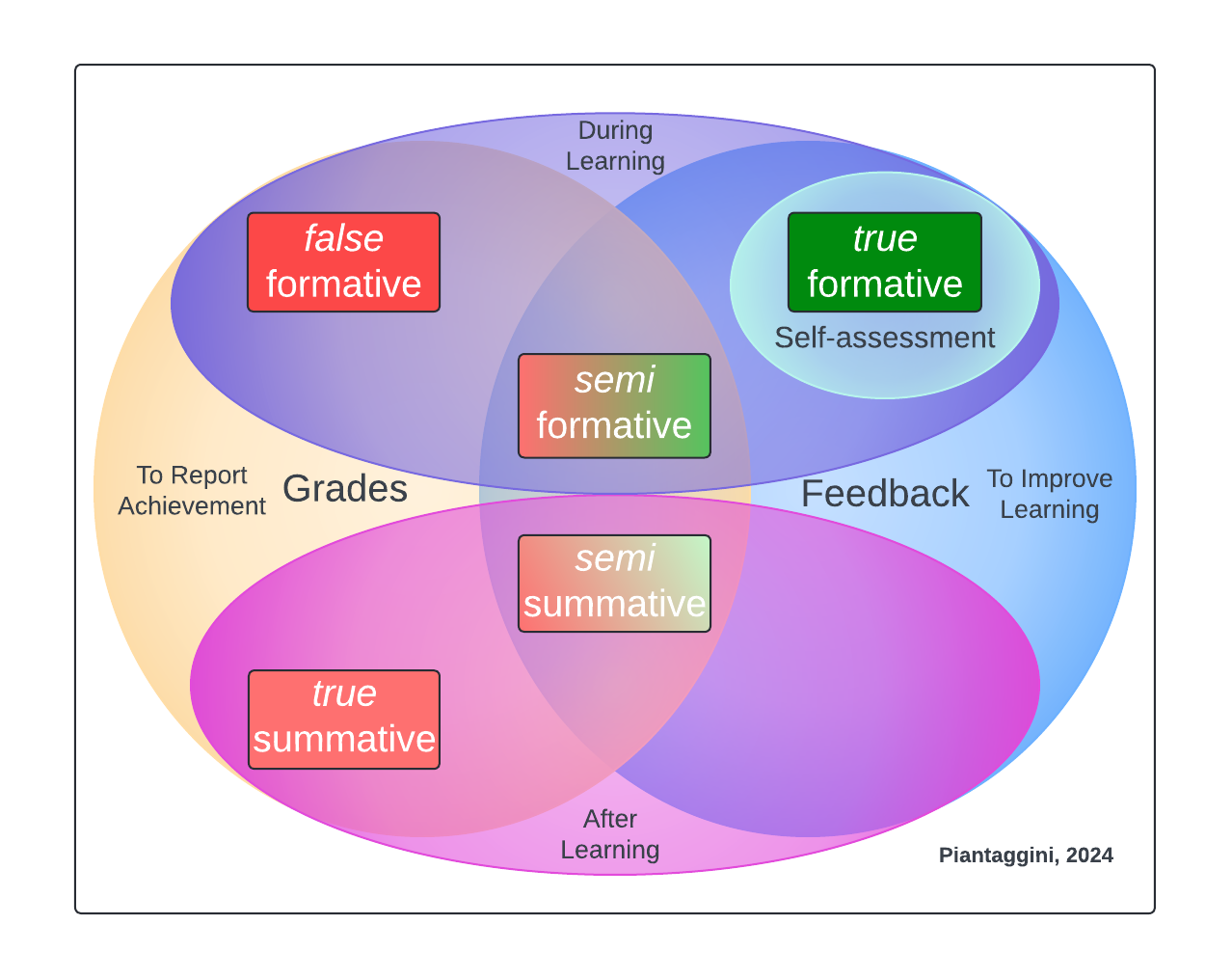
Click here for the updated model and latest research.
I just presented a poster session in Chicago for the NCME Special Conference on Classroom Assessment (Piantaggini, 2024). While I had some rough details for a proposed dissertation study, the focus of discussion with scholars who stopped by was my new assessment model and the theoretical framework that brought me to it. The message I got was “I think you’re onto something,” so I’m sharing my work here to get more eyes on it. Please contact me with any embarrassingly scathing criticism. Otherwise, reply publicly with any other thoughts or questions. After all, this is my blog, not peer review!
So, in this blog post, I’ll describe the model you see above, and how I got there, starting with a major dilemma I identified when reviewing literature on classroom assessment: confusion over grading formative assessments…
Continue readingCurrent Reading: Retakes—When They Do And Don’t Make Sense
My recent review of assessment has continued, which now includes two major findings:
- Grading is a summative function (i.e., formative assessments should not be graded).
(Black et al., 2004; Black & Wiliam, 1998; Bloom, 1968; Boston, 2002; Brookhart, 2004; Chen & Bonner, 2017; Dixson & Worrell, 2016; Frisbie & Waltman, 1992; Koenka & Anderman, 2019; Hughes, 2011; O’Connor et al., 2018; O’Connor & Wormeli, 2011; Peters & Buckmiller, 2014; Reedy, 1995; Sadler, 1989; Shepard et al., 2018; Shepard, 2019; Townsley, 2022) - Findings from an overwhelming number of researchers spanning 120 years suggest that grades hinder learning (re: reliability issues, ineffectiveness compared to feedback, or other negative associations).
(Black et al., 2004; Black & Wiliam, 1998; Brimi, 2011; Brookhart et al, 2016; Butler & Nisan, 1986; Butler, 1987; Cardelle & Corno, 1981; Cizek et al., 1996; Crooks, 1933; Crooks, 1988; Dewey, 1903; Elawar & Corno, 1985; Ferguson, 2013; Guberman, 2021; Harlen, 2005; Hattie & Timperley, 2007; Johnson, 1911; Koenka et al., 2021; Koenka, 2022; Kohn, 2011; Lichty, & Retallick, 2017; Mandouit & Hattie, 2023; McLaughlin, 1992; Meyer, 1908; Newton et al., 2020; O’Connor et al., 2018; Page, 1958; Rugg, 1918; Peters & Buckmiller, 2014; Shepard et al., 2018; Shepard, 2019; Starch, 1913; Steward & White, 1976; Stiggins, 1994; Tannock, 2015; Wisniewski et al., 2020)
In other words, 1) any assessment that a teacher grades automatically becomes summative, even if they call it “formative” (I’m referring to these as false formatives), and perhaps more importantly, 2) grades get in the way of learning. These findings suggest that best way to support learning is by a) limiting grading to only true summative assessments given at the end of the grading period (e.g., quarter, trimester, semester, academic year), and b) using alternatives to grading formative assessments that otherwise effectively make them summative. Therefore, my next stage of reviewing literature focuses on reducing summative grading and exploring formative grading alternatives (i.e., so they remain formative). As for now, one of those practices *might* be retakes, which has been on my mind ever since I saw a tweet from @JoeFeldman. Given the findings above, which establish a theoretical framework to study grading, let’s take a look at how retakes are used now, and how they could be used in the future, if we even need them at all…
Continue readingCI Assessments
I was recently asked a very good question about how to change one’s assessments to align more with CI. By that, we’re talking about comprehension-based language teaching (CLT) that prioritizes comprehensible input (CI) in the Latin classroom. First, it helps to think in terms of what standards were being assessed beforehand, even if they weren’t explicitly called “standards.” These old standards were mostly discrete skills you’d expect to find in tests accompanying popular textbooks, like vocabulary recall, derivative knowledge, grammar identification, and cultural trivia. New standards based on CI—whatever they are—will have meaning at the core. My suggestion is to focus on assessing comprehension of Latin, because that’s more than enough to ask for. One benefit of this standard is that is that it has those old discrete skills embedded within something larger and more meaningful that you can assess (i.e., comprehension). Let’s look at how each one of the old standards is contained within assessing comprehension…
Continue readingCurrent Reading: Formative Assessment
I’m going to start sharing some findings in a series called “Current Reading” as part of a lit review I’m doing on assessment and grading; nothing too fancy or cerebral, but definitely more than blog post ideas.
Why the announcement?!
On the one hand, this is not new. I’ve shared plenty of direct quotes and sources in my blog posts in the past. Also, consider this a symptom of being steeped in academia once again. I’m reading hundreds of pages of research a week, and it’s important to digest and keep track of studies that support my own research. This includes knowing who wrote about what, and when. On the other hand, a second language acquisition (SLA) researcher Bill VanPatten mentioned something online recently when I shared a 2020 post with a summary of CI non-examples. His comment was how ideas in that post were oddly familiar ones throughout the field. That’s completely true; I never claimed they were *my* original thoughts. Like many of my posts written to pass along information, that 2020 summary doesn’t include citations to any particular study. It’s a collection of ideas that have consensus in the SLA community, and that lack of citations was intentional, not an oversight.
Why intentional? For nearly all of my blog’s 12 year history, I never wrote for the academic community that would be interested in that kind of stuff. I was writing for other teachers. I sometimes added just a shorthand author and year (e.g., Feldman, 2018) to some statements that would give most people what they needed to track down the original—if they really wanted to read that original! In my experience, though, most teachers don’t read research, so I haven’t bothered much with bibliographies. Since I’m no longer teaching, and I’m now using bibliographies a lot more these days, I do want to make a clear distinction between posts of the past and posts moving forward. Granted, my posts are still actually written for teachers, make no mistake! My degree program is Teacher Education and School Improvement (TESI), and I’m still sharing ideas for practical implementation. The one difference is that they’ll now include more breadcrumbs for everyone to follow—myself included. After all, there has been no better way for me, personally, to consolidate thoughts and work through concepts than by writing these blog posts. You might also benefit as well. Now, for the good stuff…
Continue readingReporting Scores vs. Grading
**Update 4.11.16** See this post for some Grading & Reporting Schemes
If you’re one of the “lucky” teachers who has those classically typical, or absurdly unexpected grading restrictions, I don’t envy you! Nonetheless, the key is to find the wiggle room within these restrictions, and focus on delivering understandable messages in the target language (= Comprehensible Input, CI).
 Magister P.