Rūfus et arma ātra: Teacher’s Materials & Rūfus et gladiātōrēs (Student FVR Reader)

**Updated 6.29.18**

3000 additional total words in 28 scenes and stories for the novice reader featuring more vivid descriptions of weapons, deeper character development, mud, fights with animals, retiarii, baths, rumors, mysterious odors, infants in danger, Crixaflamma’s real name, and more…

This is a different kind of teacher’s guide.

This slideshow requires JavaScript.

Continue reading

K-F-D Quiz: Fun With Data Analysis!

I spent about 15min entering data from the diēs Mārtis (i.e. Tuesday) Latin class K-F-D QuizzesN.B. These are “sneaky quizzes” per my NTPRS 2017 presentation, No Prep Grading & Assessment, referring to “assessments” that satisfy most quizzing/testing requirements, yet are actually an opportunity to interact and acquire.

chart

28 students were in class for the K-F-D Quiz. Here are some observations:

Continue reading

Making Latin More Comprehensible: Cognates

Teacher’s Materials for Rūfus et arma ātra are just days away from being published, featuring 28 additional stories that expand the unique word count, and increase sentence lengths. This will provide the novice+ student with 3000 more total words to read in Latin, and is the first of my Latin texts written with deliberate attention to super clear cognates—45 of them!

When it comes to a student-centered acquisition-rich classroom, the main responsibility of a teacher is providing input. Given time constraints, as well as what we know about general anxiety over learning languages, the input (I) should be as comprehensible (C) as possible. Therefore, the teacher would benefit from spending most of their time making the target language more comprehensible, but doing so requires training in particular strategies and techniques.

An oft neglect technique for Latin teachers is the liberal use of cognates.

Continue reading

Preparing Our Students For…Latin 100?!

Someone on Facebook posed a couple questions to those at the college/university level regarding the preparedness, and subsequent placement of incoming students.

These are excellent questions.

One comment reported that most incoming Advanced Placement (AP) students retake a lower level grammar course in college. Most! These AP students were successful in high school because of significant memorization, but aren’t prepared for grammar the way colleges expect them to be. Perhaps we should look at exposing students to grammar a different way, no?

I’ve asked these questions, myself, yet the few Classics Departments I solicited years ago didn’t collect any of that data beyond a handful of students they could remember from the current year. Oh, would that they had done so!

Continue reading

Kahoot English Quadrant Word Race

The low-tech/no-tech paper version of the English Quadrant Word Race (included in Pīsō Ille Poētulus Teacher’s Guide, as well as the upcoming Teacher’s Materials for Rūfus et arma ātra) is an awesome, simple, input-based competitive activity.

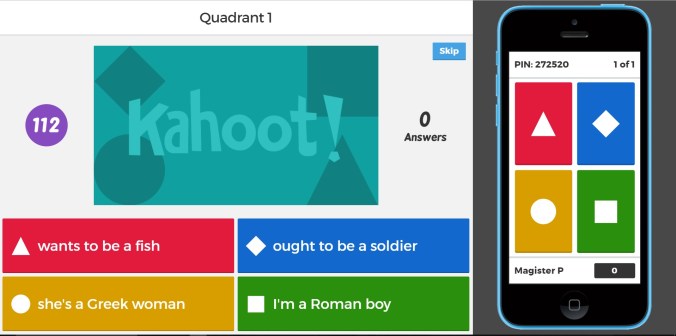
The more-tech version is to take 5min and make a Kahoot quiz for the whole class, or teams. On Kahoot, students earn more points the faster they answer, so you’ll get a whole class/team winner (vs. the 1 winner per pair in the low/no-tech paper version).

kahoot 1

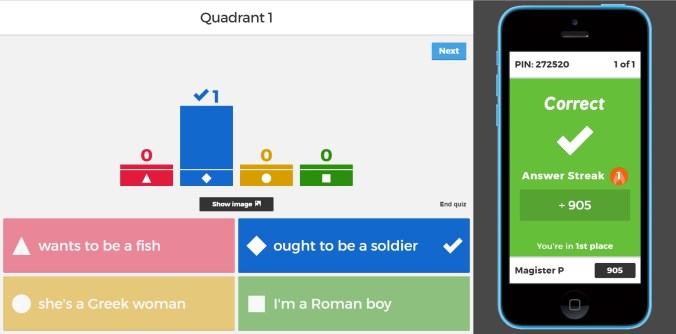
The process is the same—just read slowly in the target language, and when students hear you say one of the options, they choose it on their smartphone/computer.

kahoot 2

Sheltering Vocabulary: Caesar & Piso Fun Facts

Fun Facts:

  • Caesar’s Dē Bellō Gallicō, Liber V (i.e. just book 5, though there are 8 total) has 2900 unique words, and is 7400 total words in length.
  • All 4 current “Pisoverse” novellas combined have 233 unique words, and are 8445 total words in length.

Observations:

  • Regardless of any definition of “reading” that could possibly exist, successfully reading one of the above is an impossible task for nearly all high school students, and extremely unlikely for the remaining handful.
  • The unique word count of 108 in Pīsō Ille Poētulus—the highest of my novellas—is too high for some students to read easily. That’s with just 108 words, let alone 200, let alone 400, let alone 800, 1600, or the 2900 in Caesar.
  • Most students will fail to read anything close to this excerpt of just one ancient author (traditionally considered “easy Latin!”) that has 26x the vocabulary of a novella some students can’t yet read easily.
  • At most, high school students receive 4 years of input (5-6 if middle school Latin?). Given that some students in years 1 and 2 might not be able to read Pīsō Ille Poētulus easily, it’s clear that realistic expectations for reading are much, much lower than we think.
  • Students will be more successful reading copious amounts of Latin containing words they are familiar with.
  • Sheltering vocabulary has the greatest impact on providing contexts with more familiar words.
  • Students would benefit from reading more novellas under 100 unique words.


Why novellas? Read more, here.

A- in Conjugating, D in Comprehending

**UPDATE 9.28.17** Episode 65 of Tea with BVP, entitled “Does Instruction Speed Up Acquisition,” confirms much of what’s in this post.

I just looked up the 3rd person plural future active indicative form of habēre—or—expressed in a more comprehensible way, I just looked up how to say “they will have.” Before I looked it up, though, habēbunt didn’t sound right in my head. It didn’t sound right because I haven’t received enough input of that word. I also haven’t received enough input of other words with the same ending in different contexts. If I did, I’d have a better chance of being able to extract the parts during my parsing (i.e. moment-by-moment computation of sentence structure during comprehension), and wouldn’t have had to think about how to express “they will have.”

No one dare say that I didn’t study my endings, because I totally did. I got an A- in paradigms. I knew them forwards and backwards, UK and North American order, too! That was after I got a D in comprehension the first time I took Latin because the pace was too fast, and my memory insufficient to learn Latin. Or so I thought…

Continue reading

Writing for the Novice: Parsing

On Episode 64 of Tea with BVP, Bill mentioned a couple things we’ve heard before, only this time through the lens of parsing (i.e. “moment-by-moment computation of sentence structure during comprehension”). You’ll note immediately that this definition is different from the Grammar-Translation method teacher prompt of “Student X, would you please parse the main verb found in line 2?” in which the pupil gives the person, number, tense, voice, and mood of the verb, which we all know the diligent student can do, though has nothing to do with the psychologically real comprehension of the sentence in which it was parsed.

First Noun Principle
Novice students* of most languages process the first noun they come across (e.g. “Caesarem” in Caesarem canis mordit) as the agent (i.e. one acting, but not necessarily grammatical subject). The savvy language teacher aware of language-learners’ first noun strategy could respond to this by using word order that avoids the misleading tendency.

Continue reading

Latin Stories Videos Series: Pygmaliōn

Pygmaliōn is the second video in the series after Mīnōtaurus. I wasn’t familiar with this myth until reading* Ovid with last year’s students. They voted to read it before Daedelus & Icarus, Pyramus & Thisbe, or Orpheus & Eurydice. My personal contribution here is calling Pygmalion “creepy” (i.e. infestus), which was inspired by student comments. I begin retelling the myth after the point when Ovid gives us Pygmalion’s reason for living alone, which downright bothered my students. Misogyny is completely unacceptable, and at an age when image is a sensitive topic, students weren’t comfortable with what the Pygmalion (i.e. Ovid) had to say about the nature of women, as well as how he sculpted a figure “more beautiful than a woman possibly could be.” Go ahead and add that part if you welcome the discussion, which could easily be connected to contemporary advertising industry and its use of Photoshop, as well as the negative social affects, but I kept the story more focused. Here’s Ovid’s Pygmalion myth retold using 31 unique words. The story is 221 words total in length.

1) Class
2) Story (link to Google Doc text found in YouTube video description, but also here)
3) Questions

*I say “reading,” but I definitely wasn’t reading Ovid with ease. I was certainly interacting with the text, reading the notes to establish meaning, consulting the L & S when necessary, and analyzing it closely for themes. After doing all of that in order to create simplified tiered versions for students, I will say that I had a better understanding, yet, as I “read” the poem now, I’m not sure I’m even reading still! Instead, I’m remembering what I translated during the interaction. I think this is what most Classicists do—recall what they’ve already translated, or discussion (in English) in the past.

4th Class, 1st MovieTalk

This has been the 3rd year in a row that I’ve wanted to start the year cold with a story on Day 1, but have bailed. I was even close this year with Von Ray’s No-Travel story script, but it still didn’t happen. I’m thinking that it’s just not my style, which is fine, but it’s already clear to me that my students need to experience something new besides Total Physical Response (TPR), Personalized Questions & Answers (PQA), and subsequent reading activities. Still, a class story via Teaching Proficiency through Reading and Storytelling (TPRS) doesn’t feel like it’s going to be a home run for us right now, so I need a solution.

MovieTalk.

When I saw Von Ray last winter, he mentioned that MovieTalk is the easiest first step to storyasking. He’s right. Even if you have absolute novice students, just narrate at their levelI’d normally wait for more TPR, or Discipulus Illustris to establish a solid foundation of familiar words, but I’ve decided to do a MovieTalk for this 4th Latin class of the year, which is the 4th week of school (i.e. Latin 1x per week).

The Present is one of the 9 animated shorts used in TPRS Books’ Look, I can MovieTalk! available in Spanish, French, and soon—with hope—Latin! I already know that after just 3 classes my students won’t be able to read even the simplest versions of any MovieTalk readings out there, so I’ve created a super simple Embedded Reading for The Presentretold in 3 versions. 

The text doesn’t limit, or represent exactly what I’ll narrate and ask in class, but it does represent a safe amount of language that my students will understand as a follow up reading. I wouldn’t go as far as to call this a parallel reading, but I’ll likely ask Personalized Questions & Answers (PQA) that stray from the script. That’s a good thing.

You’ll notice that while the word count increases from 13 to 25 from Version 1 to Version 3, the total words figure drops from 71 in Version 2, to 63 in Version 3. Why? There’s less of the recycled exposure to words found in Version 2 because there’s more new information in each version, not just longer sentences, or more sentences about the same information. By the time the student reads the last version, they will have been exposed to the recycled language enough to make repetition less important. I’ve also deliberately used more transparent cognates to support comprehension, and kept the word count low, replacing the classic “there’s a problem” phrase with an already known interjection, “oh no!” I’m still using Picturae images whenever possible, and establishing meaning with English for more abstract words, or possibly ambiguous images (e.g. I couldn’t find a clear image for a generic ball). You’ll also notice that Version 3 has a more typical Latin word order, which students are more likely to be able to read once they’ve understood the meanings of the words in an order similar to English. This is a deliberate strategy for making Latin more comprehensible, and shouldn’t be seen as negative, or damaging. See a February post on Input Processing for more.

The 2 class day (for me, 2 week) plan:
Day 1 = MovieTalk, then Choral Translation of Version 1.
Day 2 (a week later for me) = Choral Translation of Version 2, something else unrelated (like Discipulus Illustris), then Silent T/F Reading of Version 3.

Like Justin Slocum Bailey wrote, Choral Translation is best used sparingly, yet 7 days between classes makes comprehension even more of a priority so that students stay super confident. Also mentioned on the latest Tea with BVP, written input helps students find word boundaries that aren’t necessarily obvious when listening. Knowing these boundaries helps in the search for words, and the search for words—big content words and not their endings—is what novice through intermediate students are doing!

Silent T/F Reading is new, which I got from NTPRS 2017 (i.e. partners read silently for X minutes, then draw just 2 pics: one True, one False. Swap, then partner chooses correct. Pass to other groups, and partners choose correct. Show a few on document cam, PQA, etc.).