Assessments: Invalid Validating

If someone says that a particular teaching practice doesn’t work (sharing observations, or research), and your assessments indicate otherwise, there are 2 possibilities:

  1. The other person didn’t have your data set, making a premature claim.
  2. Your assessments are invalid.

While the former certainly occurs, the latter is more prevalent. For example, teachers typically announce tests on X ahead of time, teach X, then test X. Then, the tendency is to draw the conclusion that students know X, or do X well. This is almost never true. An assessment such as this can only show one thing for certain; who studied X for the test…

Continue reading

12 Days of CI & Wall Talk

We’re 1/3 of the way through the school year. Doesn’t that make you tingle? And why shouldn’t it? In my experience, no matter how much anyone enjoys what they do, everyone just wants to go home at the end of the day, and especially at the end of the school year! 

Here is what my Word Walls look like after 12 classes (Latin 1x/wk):

Notice the variation amongst all three, despite a core set of words used throughout. These Word Walls represent “high frequency” as a concept. Even after watching and discussing the same MovieTalk, each class has its own identity…

Continue reading

Ideas Without Labels: A Discussion Framework

It was John Bracey who reminded me that if either of us just started discovering CI right now, we’d have NO IDEA what to do or where to begin. It was very clear a few years ago when Story Listening wasn’t as popular, and Ben Slavic had yet to write his Big CI Book, let alone create The Invisibles with Tina Hargaden. TPRS wasn’t even promoting its version of MovieTalk, which is now standard practice in its workshops as the easier gateway to story asking. These all have positively contributed in some way to those teaching in comprehension-based communicative classrooms—don’t get me wrong—but the culmination has also made communicating ideas about CI more complicated. For example, the Teacher’s Discovery magazine has begun selling products branded with “CI,” regardless of actual comprehensibility, let alone amount of input, and some methods mention CI while simultaneously drawing from older methods shown to be ineffective (i.e. Audio-Lingual), and aligning practices with the latest publications from the research-lacking ACTFL. This isn’t a jab at ACTFL, it’s just the reality that most of what they promote is determined by committees, not actual research.

There were fewer teachers interested in CI, too, which meant that there were fewer opinions. In a way, it was almost easier beforehand to be dismissed by most colleagues than it has been lately, falling into debate after debate over what used to be quite simple. Professional groups have also migrated to Facebook, a more active platform. Instead of ignoring messages from a single list-serve daily digest email, folks have been receiving notification after notification on their phones, and responding promptly. There doesn’t seem to be as much time as there used to be to absorb ideas, formulate thoughts, and respond accordingly. For example, while my principles about what language is have been refined since the release of Tea with BVP in October of 2015, many teachers are just now discovering that resource, some of whom have been responding on Facebook with their ideas that haven’t had much influence since the 70’s. It’s becoming difficult to communicate ideas about CI clearly.

So, there are a lot of voices now, which is great, but just not that much support, which is not great, and not as much clarity, which is really not great at all. Many ideas I observe being discussed share no guiding principles, yet teachers go back and forth as if they’re the same thing. Most ideas aren’t, or there’s a crucial difference that one or all parties don’t see. There might be a way to move forward together…

Continue reading

Teaching Grammar without the Grammar-Translation Method

Among the many misconceptions about CI, such as some mission against the Classics, “not teaching grammar while providing CI” is probably the most-cited, yet misinterpretissimus of misconceptions.

We teach grammar, oooooooh do we, although mostly in the context of complete Latin messages since even words/phrases contain grammatical information. There’s even explicit instruction, too, though brief student-initiated pop-up grammar explanations (e.g. “Mr. P, why does that word end with nt and not t?”) comprise most of this in a comprehension-based communicative classroom.

Still, even after all that, we do give explicit instruction when students are ready, usually in years 3 or 4. That’s right—even CI-advocating teachers explicitly teach grammar, and they do so using a host of methods and method-free strategies—all grammar-translation alternatives.

Continue reading

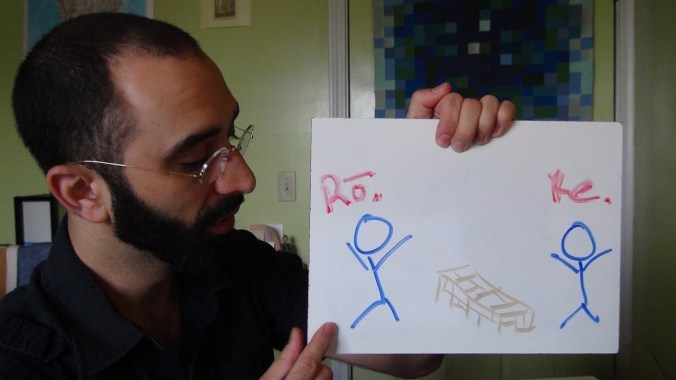
Latin Stories Videos Series: Rōmulus et Remus

maxresdefault

Rōmulus et Remus is the third video in this series after Pygmaliōn & Mīnōtaurus. This is Rome’s foundation myth retold using 37 unique words. The story is 259 words total in length.

For an improved sensory experience, play Arvo Part’s Fratres while reading & discussing the text. 3:50 could represent the surmounting conflict, and 6:05 could represent Remus’ exit and Romulus internal struggle (that is, if he even had one, right?).

1) Class
2) Story (link to Google Doc text found in YouTube video description, but also here)
3) Questions

Establishing Meaning: Confusion

Step 1 of TPRS is “establish meaning” to show what a word/phrase means in the target language (TL) before using it to co-create a story. The most efficient and effective way to do this is by using a native language (L1) common to all students (e.g. “fēlēs means cat“). In TPRS, we write the TL on the board, underline it, then write the L1 below in a different color. We refer to this throughout class by pointing and pausing.

Establishing meaning is also Step 1 for anyone providing comprehensible input (CI), regardless of the method or strategy.

If this step doesn’t occur, teachers are providing input (I) that might not be comprehensible (C). Although there’s some role that noise in the input plays (Incomprehensible Input?), it’s clear that acquisition doesn’t happen with high levels of that noise. This is why no one—NO ONE—disputes that CI is necessary; it’s the sine qua non of acquisition, which is why establishing meaning is so important.

Still, there’s been confusion over establishing meaning, and that confusion has to do with purpose…

Continue reading

LLPSI Challenge

CI is not out to destroy the Classics. On the contrary, those advocating for teaching with more CI are the professions’ biggest cheerleaders, aiming to increase interest and enrollment worldwide. How? It starts with including all students.

Still included in the included, though, are those students most like us who have always thrived in conventional Latin classrooms. We can’t leave them out. At this point, I’ve had about 10 classes with students this year, which is just around the time when it becomes clear who’s really into Romans, and/or really into learning (as opposed to everything else that interests adolescents). Since a few of these students have made their presence known in my inclusive classroom, I have a plan…

Continue reading

All You Need Is One: Text, Sentence, Word

I agree with Justin Slocum Bailey that something great can come from nothing. Most teachers fall into the habit of planning waaaay too much. Even if all that planning is enjoyable, somehow, it often results in insignificant gains in student happiness and/or proficiency. In the spirit of “no fail no burnout,” then, plan whatever you have to in order to sleep well at night, but begin class ready for any compelling diversion to take you away from those plans! Sometimes a sentence is all you need, and depending on the content, a single word (e.g. One Word Image, or One Word Drawing).

Continue reading

Communication: Definition & Clarification

Recently on Twitter, Tea with BVP caller extraordinaire, Longinus, as well as some Inclusive Latin Classroom folks, got me thinking about the definition of communication. What follows are terms I’ve been using for a while (almost entirely unoriginal), clarified by Bill VanPatten on Episode 68 of Tea with BVP.

Communication isn’t only speaking:
Communication is the interpretation, negotiation, and expression of meaning. We interpret when we read, and express when we write; no speaking necessary.

Two people are usually involved, but not required:
If I write a note (expression), and place it in a drawer, but then the apt. catches fire (yes, we have renters insurance), there’s no possible way for anyone to read it (interpretation), or ask me about it (negotiation), even if that was my intent. I most certainly expressed my ideas, there just wasn’t anyone around to interpret them.

In Latin, reading—though not to be confused with translating—is the primary form of communication. ACTFL modes of communication are helpful, here. Reading is one-way, and Interpretive (i.e. interpretation), but someone had to write what we read…at some point (i.e. two people involved). That person who wrote what we read is also one-way, and Presentational (i.e. expression). Neither of these become Interpersonal (i.e. negotiation) unless there is interaction between two people, and this interaction doesn’t have to take place in person. This is why Bill VanPatten refers to communication as “expression, interpretation, and sometimes negotiation of meaning.” Both the writer and reader engage in acts of communication, it’s just that their role is different.

Timing (i.e. real, or asynchronous) & Perspective:
Ovid wrote something (expression) a couple thousand years ago that I can try to read today (interpretation). There has been no interaction between us, eliminating the possibility of negotiation. However, if I write an adaptation of Ovid (expression), and then send it to John Bracey, a couple things could happen. John could star the email, forget, and never end up reading it (no interpretation, just my expression). Or, John could read it (interpretation), and send back some notes or questions (negotiation). This interaction between us would be delayed, but still the same process communication-wise as if we were in person. Now, if I also star and forget about that latest correspondence from John, however, neither negotiation nor interpretation occur. This doesn’t change the fact that John expressed ideas and attempted to negotiate with me. That is to say, from John’s perspective, he still engaged in communication, but it was only one-way without my involvement.

Communication as a concept, not as verb “communicate:”
Although I’m engaging in the act of communication by trying to read Ovid (interpretation), one could hardly say that I’m “communicating with” Ovid anymore than Ovid is “communicating with” me, or us as a society. Ovid certainly expressed meaning, itself communication by definition, but in the absence of real time interaction and negotiation, or even delayed negotiation of meaning over letters, we are not “communicating with” each other.

Someone correctly brought up the fact that the idea of “communicating with the ancient world” isn’t possible. Classicists use this phrase, referring to relating to [certain] ancient people’s ideas (expression) by learning more (interpreting) about the past, and making connections to our own lives, but this ends there as far as communication goes. There is no possibility of interaction (negotiating) with ancient authors. When we read about the past, communication is one-way.

Partially- or fully-communicative:
Things get more complicated from here, but the definition of communication still holds up. An activity lacking a purpose yet focusing on meaning is partially-communicative. Most teachers spend their time doing partially-communicative activities in preparation of a few fully-communicative tasks along the way. Personally, I don’t bother with tasks/Tasks, and find them awfully close to performance-based assessments, the juice of which tends not to be worth the squeeze.

Writing for the Novice: Fewer Words, Shorter Sentences

When it comes to writing for the novice, nothing is more important than using words students know, and keeping sentences short. The use of fewer words is self-evident. Shorter sentences, however, help reduce cognitive demand, and likely result in more repeated words from restating the subject, and clearly separating contrasting ideas instead of piles of subordination.

Magister Craft’s latest October Equus is the most understandable novice-categorized Latin video out there that doesn’t establishing meaning in the video itself (though complete subtitles in English are available). There are 127 total words, and 86 unique. If we exclude names, and a handful of words with different forms, that brings it down to about 60 words. The most frequently repeated words are est (6), in (6), et (5), caput (4), and equus (4), with another 5 words repeated 2x. Even this most-likely-to-be-understood video is nowhere near comprehensible to my first year students, or any other students who aren’t familiar with about 58 of those particular words.

How to make this more comprehensible for my students? The first step, without reducing the word count, is breaking up sentences (the longest sentences are 10 words in length). This allows us to restate the subject, or verbs with multiple subjects, and then add one or two words from the original longer sentence. As a result, the novice student has more exposure to the big content words that hold meaning, and increases the chance that any new words are comprehended instead of part of a string of new words all at once. Here are examples:

Continue reading