The 1-Class CALP & Comprehensible Content-Based Instruction (CCBI)

At iFLT 2019, Martina Bex presented on content-based instruction (CBI), only with an important caveat you’d expect from the conference: a focus on comprehension, hence CCBI. I was delighted to see how similar her three steps were to the framework I’ve been developing with John Bracey, David Maust, and John Piazza, which we presented at ACL’s Centennial Institute. Martina uses slightly different terms taken from Bloom’s Taxonomy to describe the same process we’re using (hers on the left, ours on the right):

Knowledge = Connect
Comprehension = Explore
Analysis/Synthesize = Create

Martina’s presentation showed how simple the process can be, making the concept of teaching Roman content in Latin more approachable. How? The format she shared was for a single class. Of course, the idea is not to teach random new content every day, but instead to have each day’s content within a larger unit, but still, this “bite-sized” approach feels more manageable for anyone looking to teach content in the target language. So how does that differ from the unit template the John’s and I shared at ACL?

Continue reading
Communication Breaks: Air Spelling, Two Second Turn & Talk, and Cloze

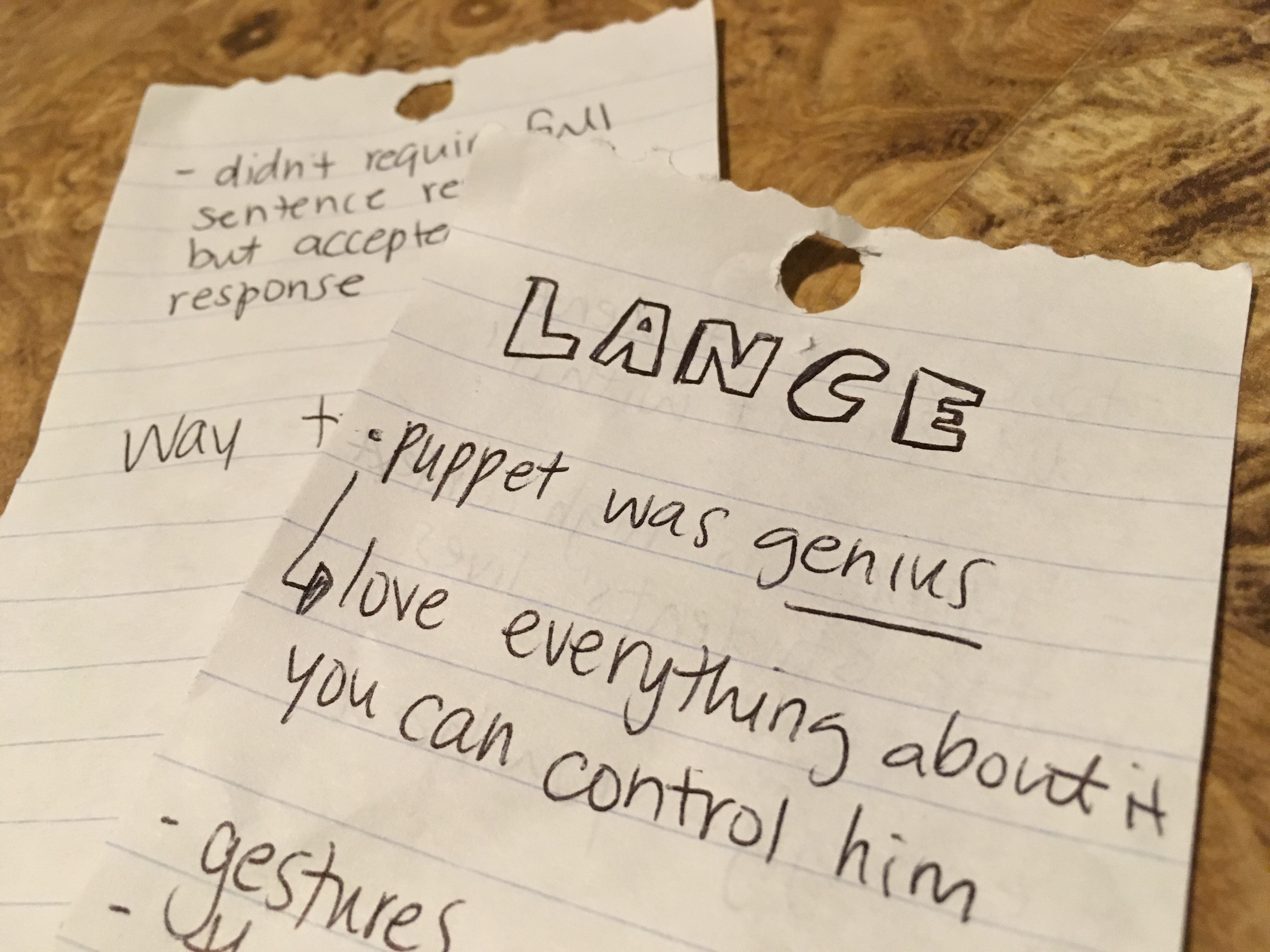
At iFLT 2019, Grant Boulanger paused to have had students close their eyes and spell a word in the air, syllable-by-syllable as he repeated it slowly. Students opened their eyes, and Grant wrote the word on the board, and continued with class.

But why?

Quite simply, this gets students to focus on listening, which Grant mentioned is important since most of what goes on in school makes use of other senses. Also, once the word is written on the board, any “mistakes” literally disappear into thin air. It’s like a fleeting dictātiō!

Consider using air spelling before establishing meaning of a new word/phrase when the class flow could use a short break from the input. In fact, this strategy is part of what I’ve been thinking of as Communication Breaks. These breaks pause or reduce input, allowing students either to think, or briefly interact in ways that lack a communicative purpose. Between these breaks and Brain Breaks, class should be over before students even know it!

Continue reading

Novellas: Mira Canion’s Quick Read

Mira Canion just presented at iFLT 2019 on how to read novellas quickly. Why quickly? Mira had many reasons; one being if the level is a little too hard for your slowest processors; another if the book is starting to drag out. This latter option is good for anyone who tried to teach a novella over the course of a few weeks or more. I can also see how for most Latin teachers, there still aren’t enough titles available that perfectly match the reading level of the class. Mira’s “Quick Read” stuck out in my mind…

Continue reading

2018-19: Timed Write Stats

For years, my go-to teacher eval goal has been for students to increase their timed write word counts by X% (like 20%, which always happens), which includes selecting one or two practices to improve that allow CI to be provided, and contribute to the goal (e.g. establishing rules & routines, consistently using brain breaks, writing more embedded readings, etc.). In my experience, it’s not necessarily the results that lead to good evaluations, it’s how everything is analyzed. That is, a thorough analysis is more important than every student meeting the eval goal. Thus, this post. Hey Principal HD, #shoutout!

Next year, I’m looking forward to a new goal of increasing the input I’m providing, but to wrap up this year’s analysis, here are some stats and insights…

Continue reading

Tiberius et Gallisēna ultima: Published!

Here it is.

This slideshow requires JavaScript.

“Tiberius is on the run. Fleeing from an attacking Germanic tribe, the soldier finds himself separated from the Roman army. Trying to escape Gaul, he gets help from an unexpected source—a magical druid priestess (a “Gaul” in his language, “Celt” in hers). With her help, can Tiberius survive the punishing landscape of Gaul with the Germanic tribe in pursuit, and make his way home to see Rufus, Piso, and Agrippina once again?

Tiberius et Gallisēna ultima is over 3200 total words in length. It’s written with 155 unique words (excluding different forms of words, names, and meaning established within the text), 36 of which are cognates, and over 75% of which appear in Caesar’s Dē Bellō Gallicō, making this novella a quick read for anyone interested in the ancient text. Tiberius is available…

1) Just 3 weeks away in-person at 2019 ACL’s 100th Institute June 27-29 (discounted copies, any 5 for $25)!!!
2) Amazon
3) Free Preview (first 6 of 12 chapters, no illustrations)

“The message of avoiding grammar is a good one…”

This is the fourth year I’ve been writing about classroom practices that make languages more comprehensible for all students. Recently, one of my replies got quite a bit of support. I’m a little surprised because I haven’t changed my tune, but something in the following simply clicked for people. Perhaps the message contains enough of everything all in one place. I’m not sure. Regardless, I’m sharing it here in case it gets lost in the ether. For context, I replied to comment about both teaching grammar, and providing input:

“Yes it is possible to do both, but you just have to recognize what’s happening when you do. If you like to teach grammar, teach grammar, just don’t expect it to cause acquisition. Input does.

They are two different data sets. In very specific conditions, we can use the grammar data to help communicate. Most people never do. Some people like that. Some hate that. No one actually needs it.

The “grammar is evil” or related message refers to teaching in a way that excludes students, like grading on that separate data set that isn’t necessary for all (but maybe enjoyable for some). Grammar itself isn’t evil, but many teachers unknowingly exclude students because of it.

So, if you include everyone you can, and teach grammar, and they get it, and they’re acquiring, go ahead, please! The message of avoiding grammar is a good one for most teachers until they get to a point of providing enough input and focusing on meaning.”