One issue that makes Choral Translation boring is the slow, drudging nature of translating word for word. When overused, you can actually hear students dropping out of unison responses. Rather than pulling the “c’mon, guys” pep talk that fails nearly every time, try Fill-In Choral Translation instead…
Continue readingFirst Text: A Year To Year Comparison
After the first orientation day of just 12 minute “classes,” I typed up statements using the drawings students did while responding to “what do you like/like to do?” Even though I followed the same plan for the first day as last year, the higher execution of it this year has been…well…crazy.
Last year, each class section read just 50 total words of Latin (10 unique words). This year? There’s 520 total words using 54 unique (17 of which cognates)!!!! Yeah. That’s how much Latin I’ll be able to provide this week after just one very brief meeting, and a decent number of hours writing/typing. Oh, and I’m not keeping track of that kind of work at this point in the school year, doing what I need to do to start off in a calm and confident manner, putting in any extra time beyond the school day I need.
So, how does this year end up including SOOOOO much more input?! First of all, I made sure every 9th grade student was included in the text, clearing the time needed to write about them. Otherwise, I updated a few things. This post looks at those changes…

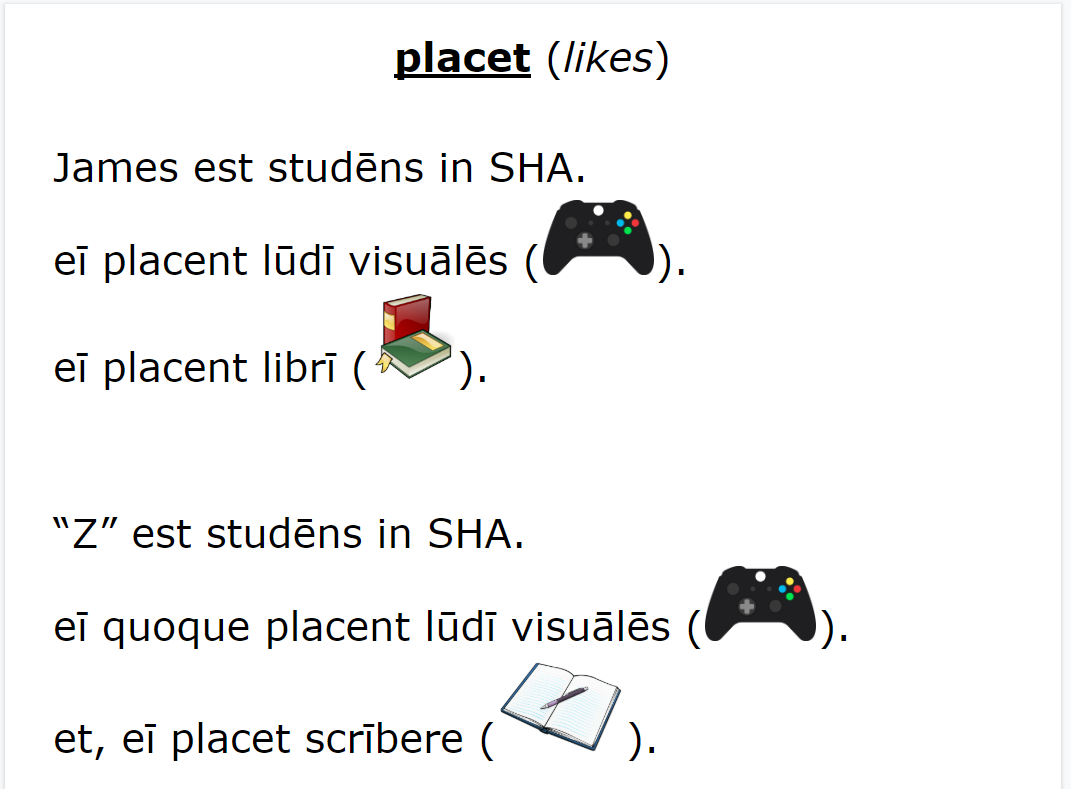
The differences you can probably see between the two comparison pics are the following…
Continue readingHere…We…GO!

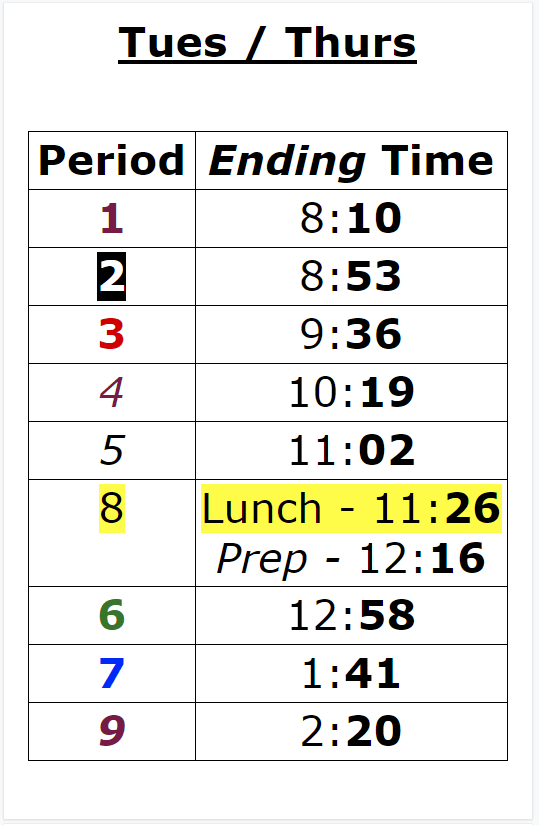
For all my tips, tricks, and sneaky systems, I do a LOT of scripting and detailed planning the first weeks of school in order to feel prepared. Last year, I wrote about “annual amnesia,” and this year is no different. Granted, I’m reaaaaally on top of certain things, like creating a giant colored-coded poster with class END times near the clock to reference while teaching, and other odds ‘n ends. But then there’s Monday…
“What the HELL am I actually going to DO in class?!”
OK OK, it’s not that bad. However, I did need to set aside time to think things through, all outlined in this post…
Continue readingLine Breaks & Comprehension
Those familiar with tiered versions and/or embedded readings will know that the difference between two of the first levels is often putting double-spaced sentences into paragraph form. I always knew this was to help the eye with clarity, and avoid intimidated by a giant block of text. However, I just discovered something else…
Continue reading2019-20 Classroom Updates
In anticipation of wrenches being thrown at us next week when teachers are officially back, I went into school one morning to set up my room again. Here are updates…
Continue readingSyra et animālia: Published! & The Pisoverse FVR Readers
The companion text to Syra sōla is now available on Amazon.
Rūfus lutulentus, Rūfus et arma ātra, Agrippīna: māter fortis, and now Syra sōla all have companion texts, either as collections of additional stories via Expanded Readings (i.e. Rūfus et Lūcia: līberī lutulentī, Syra et animālia, and Rūfus et gladiātōrēs), or a parallel novella via Choose-Your-Own-Level Readings (i.e. Līvia: māter ēloquens). These books have a colored border, and more than one unique word count button to show the range throughout (depending on the level one reads), which corresponds the other Pisoverse books (i.e. light blue <50 words; dark blue 50-100 words; purple 100+ words). This word count button is intended to inform teachers of relative reading level, and help learners choose a book during Free Voluntary Reading (FVR). Thus, I refer to all these companion texts as “FVR readers.”
N.B. Even though the companion texts are all based on existing novellas, learners don’t need to have read the originals! They can exist independently as FVR reading options.
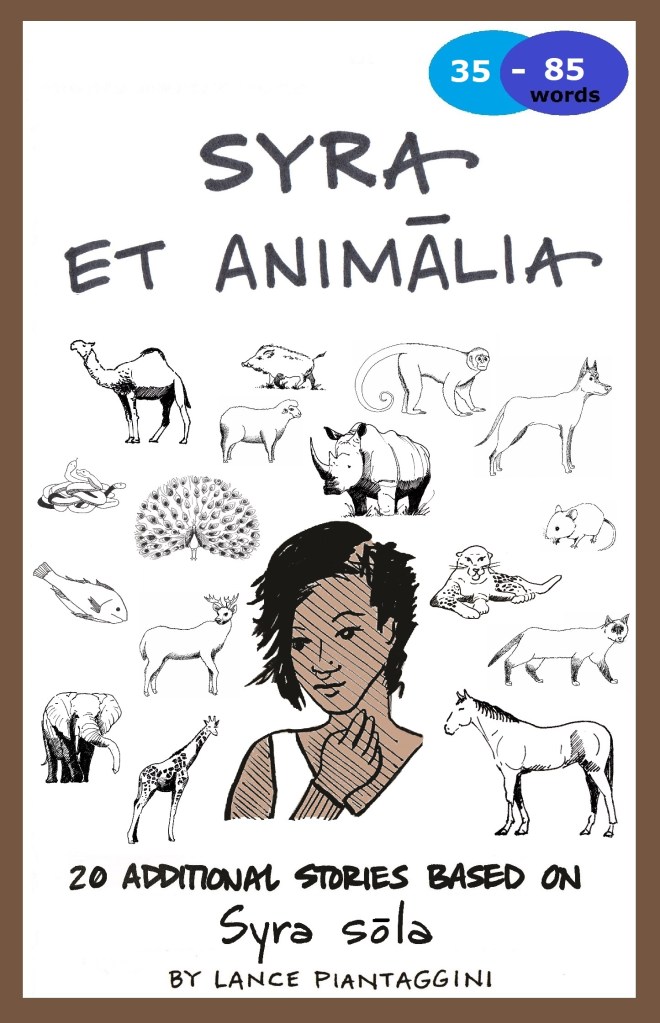

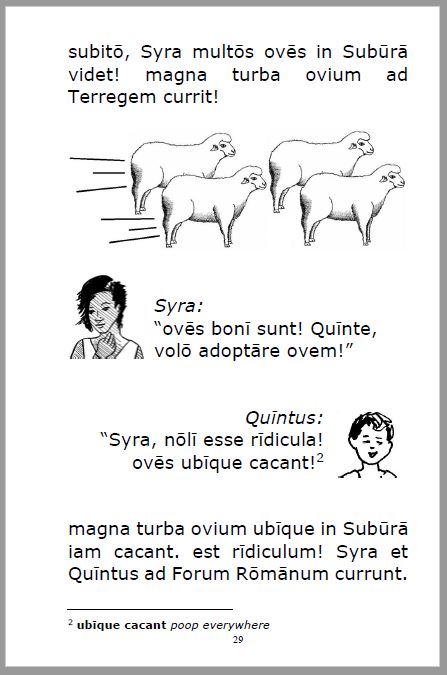
Syra et animālia is the latest addition to the FVR readers. The new companion text to Syra sōla features the most super clear cognates in a Pisoverse novella to date, with 60! In this book, Syra encounters various animals around Rome on her quest for a pet. Familiar Pisoverse characters make appearances throughout, such as the arrogant Terrex, who we learn has a pet ape he doesn’t like and never named, and a pet peacock he adores, named Pāvopapī!


Here’s how the FVR readers work, and can be used…
Continue readingThe 1-Class CALP & Comprehensible Content-Based Instruction (CCBI)
At iFLT 2019, Martina Bex presented on content-based instruction (CBI), only with an important caveat you’d expect from the conference: a focus on comprehension, hence CCBI. I was delighted to see how similar her three steps were to the framework I’ve been developing with John Bracey, David Maust, and John Piazza, which we presented at ACL’s Centennial Institute. Martina uses slightly different terms taken from Bloom’s Taxonomy to describe the same process we’re using (hers on the left, ours on the right):
Knowledge = Connect
Comprehension = Explore
Analysis/Synthesize = Create
Martina’s presentation showed how simple the process can be, making the concept of teaching Roman content in Latin more approachable. How? The format she shared was for a single class. Of course, the idea is not to teach random new content every day, but instead to have each day’s content within a larger unit, but still, this “bite-sized” approach feels more manageable for anyone looking to teach content in the target language. So how does that differ from the unit template the John’s and I shared at ACL?
Continue readingCommunication Breaks: Air Spelling, Two Second Turn & Talk, and Cloze
At iFLT 2019, Grant Boulanger paused to have had students close their eyes and spell a word in the air, syllable-by-syllable as he repeated it slowly. Students opened their eyes, and Grant wrote the word on the board, and continued with class.
But why?
Quite simply, this gets students to focus on listening, which Grant mentioned is important since most of what goes on in school makes use of other senses. Also, once the word is written on the board, any “mistakes” literally disappear into thin air. It’s like a fleeting dictātiō!
Consider using air spelling before establishing meaning of a new word/phrase when the class flow could use a short break from the input. In fact, this strategy is part of what I’ve been thinking of as Communication Breaks. These breaks pause or reduce input, allowing students either to think, or briefly interact in ways that lack a communicative purpose. Between these breaks and Brain Breaks, class should be over before students even know it!
Continue readingOpen Coaching Feedback
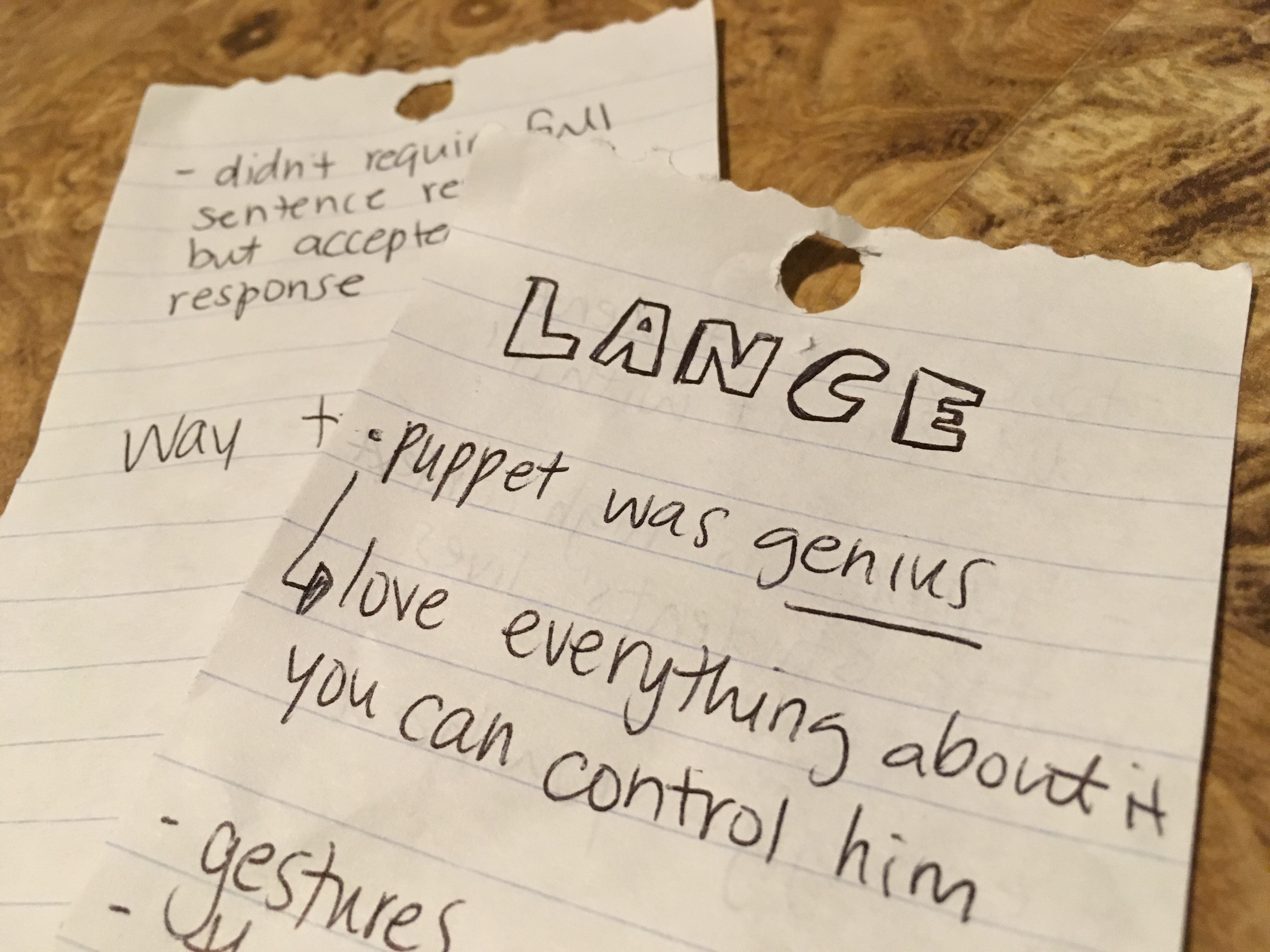
The Open Coaching session I attended at iFLT 2019 led by Michelle Kindt was among my top experiences. If you’ve never participated…
Continue readingCollaborative Storytelling: Embedded Readings
At iFLT 2019, Michele Whaley shared a way to write bottom-up embedded readings together as a class. While many fun collaborative storytelling methods and strategies involve dramatic participation, I’m always searching for new ways to ask a story that doesn’t involve acting. Michele certainly delivered with this new take on an already very familiar process…
Continue reading Magister P.