Inequitable Grading Practices: Vocab Quizzes

Other Posts In This Series:

I followed the same format of polling a large Facebook group of 12,600 language teachers on things-inequitable and grading. Of 144 participants, the overwhelming majority grade some kind of reading comprehension without a focus on individual vocab terms. Quizzing vocab (full-out or vocab section of another assessment) isn’t something I recommend doing, especially not grading it. This holds true across all content areas, not just languages. Why? That kind of focus is on the micro level isn’t necessary, and it might just be measuring a student’s short term memory. We don’t need to document any of that, nor is it particularly helpful to know. In Wormeli’s 2018 update to Fair Isn’t Always Equal, one of his principled responses is “avoid test questions that ask only for basic recall of information” (p.14). That makes sense. We can skip insignificant acts of recall and go straight to whatever the vocab is used for—the greater purpose—presumably to read or interact in the target language. That word knowledge is embedded in the greater, more-purposeful task. Why bother with both?!

Continue reading

Latin Criticism: Two Broad Categories

Two years ago, almost to the day, I wrote about Latin shaming in what’s turning out to be a quasi-annual public discussion on Latinity (i.e., quality of Latin). In 2020, the discussions concerned Latin spoken in the classroom as well as published works. This year, I’m told the focus is on novellas, which might have something to do with their proliferation. After all, in February of 2020 there were 52 books. Having doubled that number to 113 as of last week, and going from 18 author voices to 26, there’s a lot more different Latin being written now. Different Latin must lead to more opinions about that Latin. Granted, I haven’t been a part of these public discussions myself, but word gets around. Perhaps the 2023 panel on what it means to teach students to actually read Latin has spurred the latest round of things-Latīnitās. I have no idea for sure. Suffice to say that Latin shaming still plagues the profession. Instead of full-out shaming, though, this post sticks to general criticism. In my experience, there are two broad categories of criticism: that which matters, and that which doesn’t…

Continue reading

mȳthos malus: convīvium Terregis: Published!

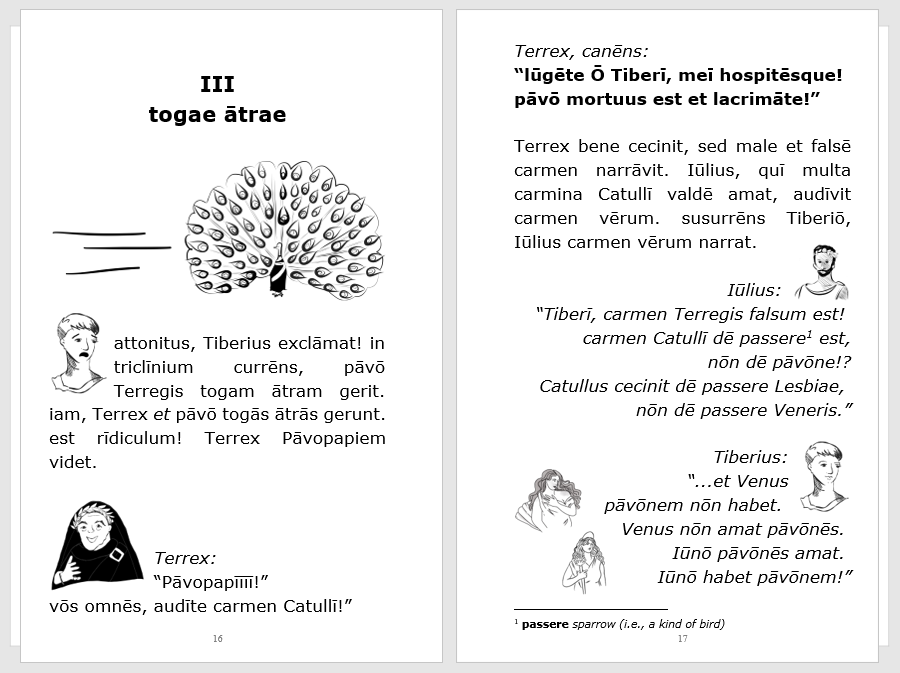
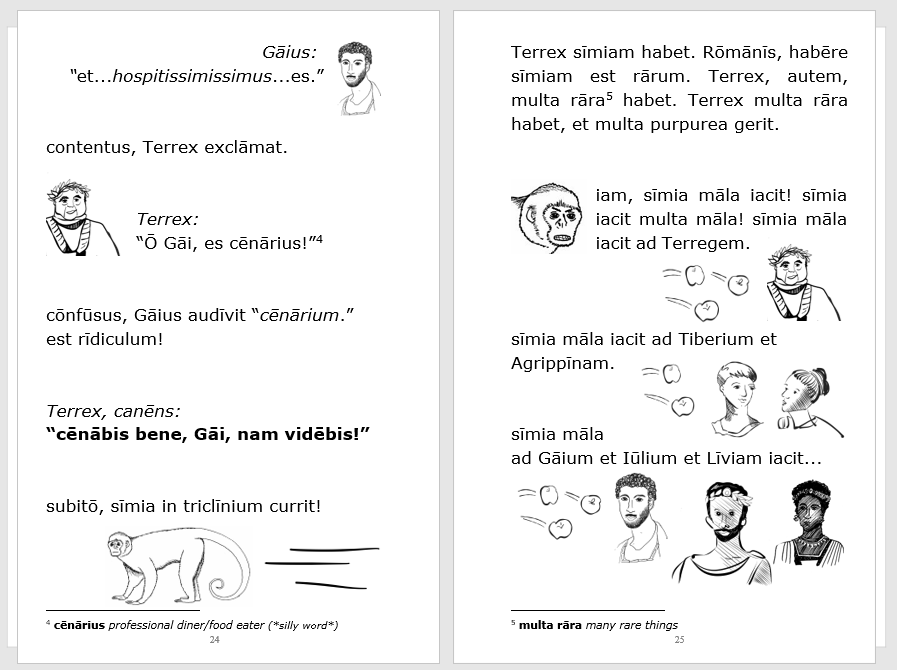
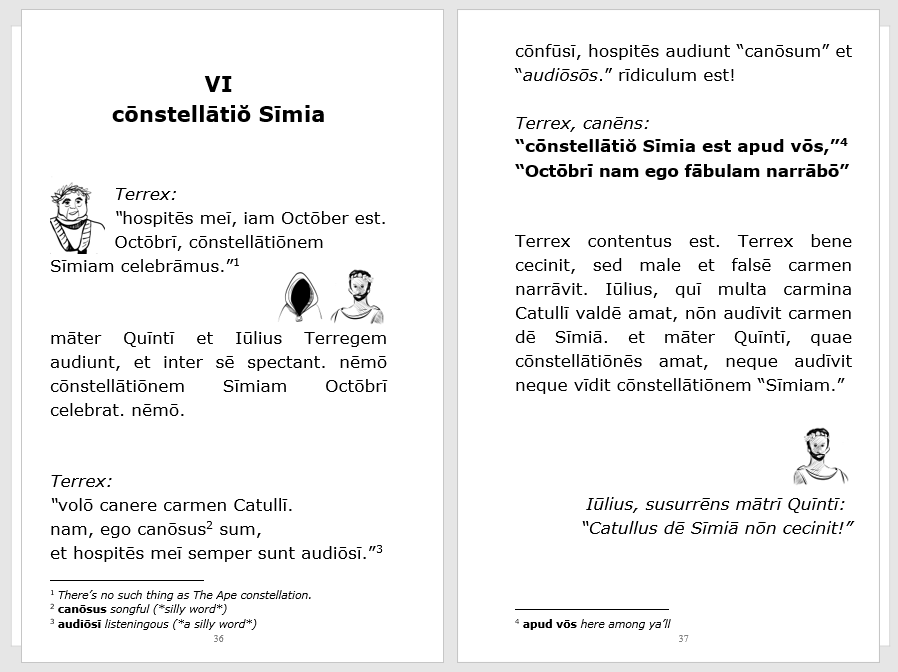
An obvious nod to Petronius’ Cena Trimalchionis, yes, but this is not an adaptation, by any means. In this tale, Terrex can’t get anything right during his latest dinner party. He’s confused about Catullus’ carmina, and says silly things left and right as his guests do all they can to be polite, though patience is running low. With guests fact-checking amongst themselves, can Terrex say something remotely close to being true? Will the guests mind their manners and escape without offending their host?


41 cognates, 56 other words
2600 total length

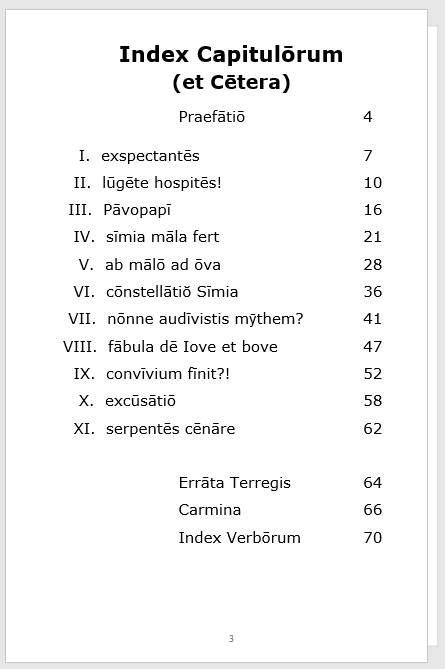
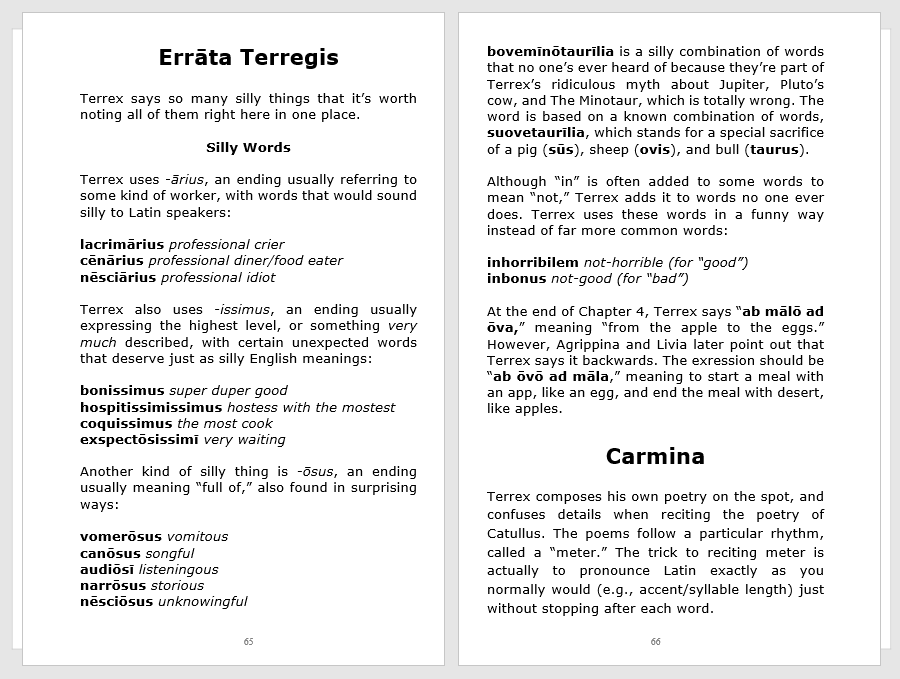
I cannot say this is my last book for good, but it’s the final Pisoverse novella I have planned. It’s probably my most comical book, too, which feels like a nice way to wrap up the series. The novella also fills a gap between the highest word counts of my Beginner level and the few narratives at Low Intermediate. Wordplay is certainly a highlight as Terrex makes up words, though still within conventions of Latin word-formations (see Errāta Terregis screenshot in the slideshow). Anyone with some familiarity with Catullus should get a kick out of Terrex’s blunders, too. In sum, this book is entertaining, for sure.

  1. For Sets, Packs, and eBooks order here (especially featured in Top Picks pack)
  2. Amazon
  3. eBooks: Storylabs

Inequitable Grading Practices: Averaging

Other Posts In This Series:

For my third poll in a large Facebook group of 12,600 language teachers in this mini-series on inequity and grading, I asked about averaging. A FRACTION of teachers responded this time, with a total of just 80. Compared to the previous poll participants of 585 for late work penalties, and then 625 for homework, I wonder if this is because averaging is something teachers let the gradebook handle without giving it much thought. Most teachers don’t question homework, but they still play a more active role in creating and assigning it, right? Even setting late policies is something teachers…do. Averaging, though? Looks like we might be in a “set it and forget it” situation. The thing is, the gradebook only does what we tell it to (or its default setting), so if we’re not thinking about that, well…

Poll results had the majority (60) doing some kind of averaging. Let’s unpack all that.

Continue reading

Pisoverse Novellas: Author’s Top Picks

**Updated 1.21.23 with Quīntus et īnsula horrifica**

Not every book is a home run, and that’s fine. As educators, we can’t please everyone, nor should we aim to. Those who do tend to spend very little time in education, anyway. They burn out, and so do students. This concept applies to novellas for sure, and how I’ve come to let go of trying to write (and find) the most-compelling texts in existence. Instead, and more importantly, most novellas available provide lots of reading options for the beginning Latin student, below- or at their reading level, on a range of topics. This is the point, and this is sustainable. Of the 113 novellas on my list, probably half realistically can be read by most students in years 1 & 2, half of the rest in year 3, and the remaining ones in year 4+. They’re not all home runs, and that’s fine. With a strong independent reading program in my school for the past years, I’ve observed that there will be at least one book that each student really gets into, and the rest is input they have mild to strong opinions about. That’s a victory.

But what books tend to appeal to all?

Continue reading

Inequitable Grading Practices: Homework & Zeros

Other Posts In This Series:

Like grades, homework in school is just as expected as yellow buses, questionable cafeteria lunch, rank & file desks, band, and of course, football. Homework is such a part of school culture that it’s hardly given a second thought by the teachers who assign it. I’m sure there’s the following definition somewhere, too:

teacher (n.) = Overqualified and underpaid professional who assigns homework over vacation

Unlike using the lens of standards-based grading (SBG) to illustrate the inequity of late work, the inequity of homework should be self-evident: we cannot monitor student learning, and the home environment—if there is a home—differs from student to student. Some of those environments are conducive to learning, and others not so much. When teachers grade homework, they contribute to keeping those with privilege soaring high while those without get hit with more obstacles. Most teachers not giving homework much thought at least understood how to play the school game (whether or not they did it as students, themselves). Therefore, I’m guessing that the thought of not having a quiet space to do homework, the freedom of not needing to take care of family members, or responsibility of working at the family’s restaurant is questioned by probably just 1% of teachers assigning it. And it’s quite possible that in some communities these situations are completely unheard of. Or, they’re just lurking in the shadows, still there.

For the second week, I polled a Facebook group of 12,600 language teachers, this time on their homework grading policies. After about a week, 625 responded. A little under a quarter (139) grade homework one way or another (e.g., completion, rubric, etc.), with the majority of them (109) dropping a zero in the gradebook if not done.

Continue reading

Low-Prep Doesn’t Always Mean EZ

Like usual, it took me a matter of minutes the other day to create the next day’s class agenda. Oh, you wanna know the trick to that? There are lots of them, but it all starts with a good grading system and ends with the basic Talk & Read format. Then, I try not to plan too far out knowing that something ALWAYS changes last-minute, and about 20% of our weeks aren’t even the typical schedule to begin with. I have a rough idea what’s coming up in following weeks, but never anything set in stone. Printing much ahead of time? Forget it. I’ve recycled WAY too many reams of no-longer-relevant activity sheets to know better. Anyway, I felt good about the time spent during my planning period, and had a solid idea of how class would go. The plans were simple and straightforward.

Yet, why was I exhausted by the end classes today?!

It turns out that low-prep isn’t always as easy as it seems to carry out. The good news is that it doesn’t take much more effort to avoid a draining class. In this post, you’ll find a list of the best low-prep AND low-energy-demanding activities generated from my input-based strategies & activities and how to get texts lists. Those lists have also been updated with the “EZ” code showing low-energy-demand typically required to carry them out.

Continue reading

Inequitable Grading Practices: Late Work Penalties

Other Posts In This Series:

I polled a Facebook group of 12,600 language teachers on their late work grading policies. After about a week, 585 responded. A little under half (255) apply some kind of penalty, whether work is accepted through the entire grading term, within some window or not at all after its due date. If we look at this practice from the perspective of grading standards (vs. completion, or whatever else), it can shed light on how inequitable late work penalties are…

Continue reading

Abbi Holt’s Wisdom On Sustainable & Equitable Teaching

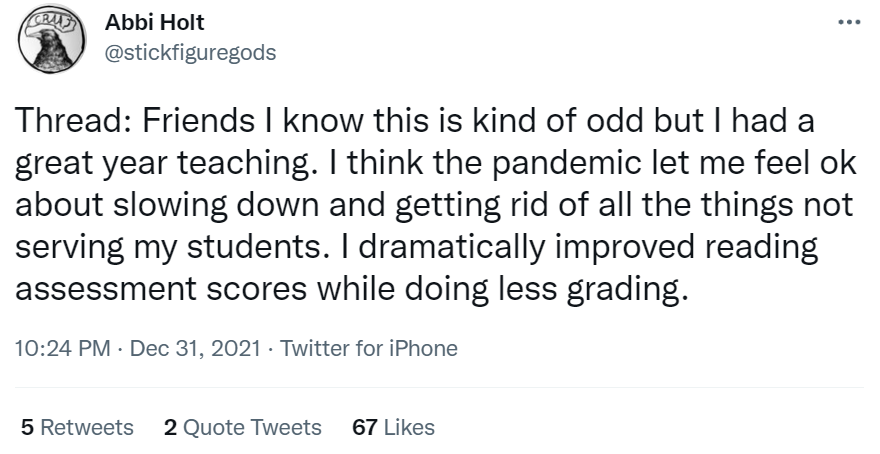
Abbi Holt had a great thread sharing a 6-year progression of practices that have made even teaching through a pandemic tolerable! Here it is with some commentary on why you should look into doing similar things, if not the very same…

Why This Works? #1
Not only is moving slowly and steadily a more responsive approach to teaching learners in the room, but reducing grading is crucial in carving out space for everything that positively impacts teaching and learning.

Continue reading