How Comprehensible Must Reading Be?

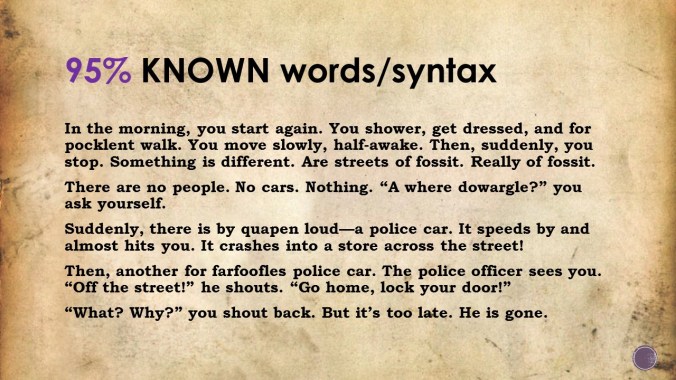
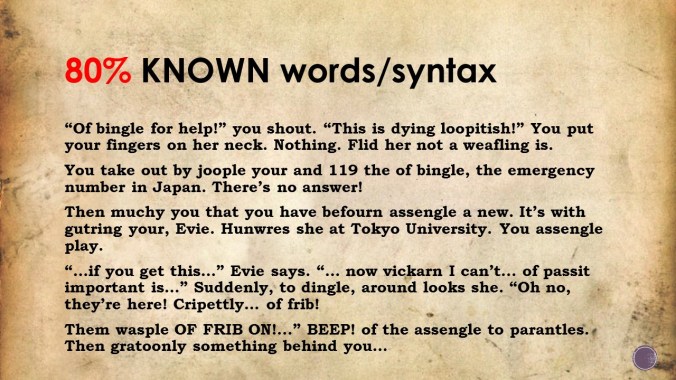
Marcos Benevides’ Slideshare PPT has been floating around for over a year now. It’s a powerful illustration of how unknown words affect reading fluency (speed + accuracy), especially for anyone who thinks students will be OK reading anything that’s less than 98% comprehensible.

Still, the syntactical clues in Marcos’ PPT helped native speakers. In order to simulate a student’s reading experience more accurately, I removed those clues. Here’s the result (download, here, for sharing):

Slide1Slide2Slide3Slide4Slide5

Negligent Motorist = 1, Lance = 0

Yesterday, the following events unfolded while riding my motorcycle:

  1. I notice a car rolling towards towards the road at a TD Bank exit driveway—the driver isn’t looking left (i.e. my direction).
  2. The driver doesn’t look my way, keeps rolling, then suddenly turns left into the road directly in front of me.
  3. I stop short. The momentum sends my motorcycle down on its right side, and me forward, also on my right side.
  4. I’m on the ground now and can’t move, but it’s for an OK reason—I realize that my helmet is stuck between the pavement and bumper of the driver’s car.
  5. The driver gets out of the car and tries to move me (idiot!).
  6. I take some time to watch horrified rubberneckers looking downward at a motorcycle on the ground and its rider partly under a car.
  7. After the disorientation dissipates, I get bored not doing anything under the car, extract myself, take off my gear, and take in the situation.
  8. Motorcycle doesn’t start (it won’t shift BELOW 3rd gear—the one it was in before going down).
  9. I wrap things up with the officer, get the moto towed, start calling insurance companies, and text Bob Patrick. No, Bob is not my emergency contact, but he just happened to have caught a typo in Discipulus Illustris, which led to a nice suggestion (i.e. Quō in annō es? for Quō in gradū es?)

Continue reading

“Classically Attested” & “Latinity”: The Latest Buzz

**Updated 5.19.18** I forgot about this post until a comment came through just now. Was I really not using http://latin.packhum.org in 2016?!?! Sure enough, Perseus is utterly unhelpful, still showing no hits even when “different forms” is checked or if they are there, it’s not in Latin, and it’s buried deep within the pages. Packhum, however, has 60 hits, instantly. 60?!?! There I was this fine night in 2016 thinking I had to defend myself for using “magis placet,” yet look at all those beautiful instances right there! Anyway, the particular phrase, then, is a proxy for any phrase we actually DON’T have. I’m not editing this post.

Teacher-written reading material for Novice & Intermediate language learners is not new, at least for modern languages. TPRS Publishing and TPRS Books frequently add more to their roster, so teachers have their choice of topic. 2015 saw the publication of the first two of these novellas in Latin, [self-]published by Pomegranate Beginnings (i.e. Pluto & Itinera Petri). Since then, there has been a wide range of reception amongst Latin teachers (or Classicists, or Linguists, or Scholars, etc.). The general consensus regarding the positive reception has been something like  “this is helping our students feel successful and have a positive experience in Latin class. If you don’t like it, you don’t have to use it.” Regarding the negative reception, most of it revolves around two buzzwords:

Continue reading

NTPRS 2016: More Changes, More Thoughts

After attending iFLT, I spent another week in Reno at NTPRS. While iFLT offered more opportunities to observe teachers teaching students, NTPRS offered more opportunities to actually BE a student for those of us in the Experienced track. I appreciated the short demos that most presenters gave, even when the workshops were not titled “___ language demo.” There are some game changes here that warrant their own posts  (e.g. embedded readings straight from the source, Michele, Whaley), but I have much  else to report on. Like last week’s iFLT post, this one includes more of what I intend to think about and/or change for 2016-17. They’re organized by presenter:

Continue reading

Using the New Curriculum Map

**New iteration of the Curriculum Map as the Universal Language Curriculum (ULC) Updated 2.4.18**

For many teachers, the New Curriculum Map is just what they need to to articulate what it means to teach for language acquisition. For others, it isn’t structured enough, and falls short of what they’re accustomed to using. Surprisingly, a few even consider this curriculum format TOO restrictive with its high frequency words and suggested structures and topics. If you are in the first two camps, this post will help you see the big picture of how simple it is to teach without a grammar syllabus and instead focus on high frequency vocabulary, just like the Sample CI Schedule for the Year:

Continue reading

Assumptions & Definitions: Establishing Meaning

1) Our goal is reading Latin via acquisition (universal to humans).
2) Comprehensible Input (CI) is necessary for acquisition.
3) Teaching with CI means providing understandable messages in [Latin].
4) Receiving understandable messages as a student means listening and reading—not being forced to speak [Latin]. N.B. Single word/phrase responses are not considered “forced speech.”

This was the opening slide to my recent CANE presentation on how to continue Teaching with CI after discovering it, largely influenced by the 13-post series on a CI Program Checklist containing many resources and support materials for people just getting into this way of teaching. #3 above deserves more attention. How do we actually make something understandable?

Continue reading

5.5.16 Tea with BvP Takeaways

Today on the show, Bill did not give the same definition of Forced Output from Episode 18 when he told a caller that anything more than one word responses (e.g.yes/no, either/or, fill in blank) was considered “forced” (listen to that brief definition, here). Why? He was thinking about that term in a new way, referring to what happens when you make someone speak in an activity or task, which may not have anything to do with what has been acquired (e.g. “I am teacher, you are student, do this.”). The definition of Forced Output was expanded by Karen Rowan on Mixler to include any “Output beyond the level of acquisition.” Bill’s previous definition along with Karen’s mean that although acquisition rates vary, all students can give a single word response, so it is the only thing we should expect. Anything else is a bonus.

We also got a definition for Output as “any learner production that is embedded in the communicative context/event.” Martin Lapworth noted that this immediately rules out  a lot of what’s been going on in classrooms involving certain acts of speaking and writing, which some teachers have misunderstood as Output for the sole reason that something is coming OUT of their head that other people read, see or hear. Here’s how we can categorize Bill’s take on some examples of exercises, activities, and tasks within the context of Output…

Continue reading

4.28.16 Tea with BvP Takeaway

The show on Focus on Form, though helpful on many topics, somehow left me missing a major point of Bill’s Principle 6. Yes, I was part of the Mixlr crew who wanted more examples, but I wanted more examples for the wrong reasons. The major takeaway is:

There still isn’t enough evidence to suggest students need a focus on form at all. Even if it were beneficial in some way, it’s still not necessary to focus on form.

So, although Principle 6 states that “any focus on form should be meaning-based and input-oriented,” it’s not clear whether students benefit from it. I wanted examples because I was concerned that I SHOULD be using meaning-based input to highlight language features (via Recasts and Textual Enhancements). It was a relief, then, to realize that such effort isn’t necessary, and might not be of any benefit whatsoever (at least while students are acquiring the language).

For teachers who prefer to focus on form (expect only short-term gains), or have a  required test to prepare students for, you should focus on form by keeping things meaning-based and input-oriented.

A New Curriculum Map

**New iteration of the Curriculum Map as the Universal Language Curriculum (ULC) Updated 2.4.18**
**More recent post on USING the New Curriculum Map**

As stated in its introduction, this New Curriculum Map is designed to reconcile Second Language Acquisition (SLA) principles with planning demands that exist within the current educational landscape. It is part theory but 100% practical. I hesitate to call it a “CI Curriculum” because I agree with Bill VanPatten from Episode 23 of Tea with BvP that some people think that CI is a strategy used to teach the stuff they’ve been teaching all along (e.g. explicit grammar rules, cultural facts, purposeless paired activities, dialogues, etc.). This is wrong…totally wrong, in fact. In an age when educators prefer an “eclectic” batch of “tools for the toolbox,” CI can’t be considered one of them along side others. CI is an absolute requirement for language acquisition. The only thing that’s debated is exactly how much of a role output plays in language acquisition, and for some, it’s null. No theory of language acquisition disputes the need for understandable messages (= CI).

Furthermore, a call from Ellie Arnold during this past week’s Episode 24 of Tea with BvP was right on topic, and Bill confirmed that a curriculum based on targeted structures (i.e. phrases that contain parts of the language’s grammatical structure) will lead us “off track.” That doesn’t mean we can’t plan for a class with targeted structures in mind; it means that we don’t want to write ourselves into a corner by prescribing targeted structures as part of a curriculum.

Without further ado, you can access the New Curriculum Map here. If you have another idea for the organization of Latin vocabulary Tiers, either based on frequency or preference, treat the document as a template and add your own vocabulary. If you teach another language, use your own frequency lists and/or the English equivalents as a guide. Enjoy!