I’m taking the first of four courses towards Harvard’s Instructional Leadership Certificate. It’s relatively affordable. Plus…it’s pretty good! Although my own interests have moved towards grading and working with educators, teaching a second language is my anchor. No doubt I’ll be working with second language teachers in the future as well, so here’s one managing routine from the Harvard course that somehow flew under my radar all these years…
Continue readingStrategies & Activities
Basics: Summary of Recurring Ideas & Posts
After 10 years of teaching, I left the classroom in 2023. I’ve earned an Ed.S. and passed comprehensive exams in the fall of 2025, making me a Candidate for a Ph.D. in Teacher Education. I research grading and classroom assessment, and work with pre-service educators. Here are my most up-to-date practices—frozen in time like Pompeii or Herculaneum right up to my last day in the classroom—that were fundamental to my teaching, making all the daily activities possible…
Continue readingLower Book To Read, Higher Book To Translate
Since translating, per se, isn’t the problem, and I’ve had success with Read & Translate alongside Read & Summarize (see input-based strategies & activities), my next update to the book-club-like “Novella Month” (now in May) will distinguish between reading and translating. Groups will choose a lower level book they can easily read over four weeks, as well as a higher level book they’ll plug-away at as a group (i.e., not to finish).
This serves two purposes. The first illustrates the different experiences to help students determine when they’ve chosen a book too high above their level, and the other gets at “schoolifying CI.” Whereas the first years of Novella Month included end-of-class prompts to respond to as some kind of low stakes “accountability,” this year’s products will be the translations of the higher level book (added to their portfolio as learning evidence). So no, there will be no product for the lower level book they’re reading, but that might help the cause of creating learners who read because they want to, and not because they have to. Also, several of those end-of-class prompts (choose 4?) are going to be used as a way to wrap up Novella Month along with comparing the two experiences of reading & translating.
Practically speaking, Novella Month will take place twice a week during the second half of every Monday/Wednesday (or Tuesday/Thursday) class. What goes on during the first half? We’ll be reading a books as a whole class: two weeks of The Star Diaries, a week of The Cognate Book, and two weeks of trēs amīcī et mōnstrum saevum. Fridays will be more free reading and a game based on the whole class text we’re reading. Almost done.
Quīntus et īnsula horrifica: AUDIOBOOK Release!
I teamed up with Michael Sintros (Duinneall) to create one last audiobook accompanying Quintus’ scary nights in the apartment (i.e., the prequel novella published last winter).
The total running time for this audiobook is about 20 minutes, meaning you could listen to the whole book in one go, then do some follow up activity, such as comparing this prequel to nox horrifica if students have read that one already. We’ll be doing that next week for an off-season thriller filler, perfectly timed for dealing with end-of-year testing madness that makes consistency this time of year quite difficult. In other words, more one-off activities are needed. I’ll add a listening challenge to listen for meaning, then look at the book and check for any pictures, footnotes, and/or clarification as we go. The narration is slower and has enough pauses to do so. The idea is that since my first year Latin students are well-beyond this book’s level, the additional task of purely listening (but having support if needed) should bring the activity up to “their speed.”
So, this audiobook is available on Bandcamp. If you’re not familiar with that site, it’s basically a donation-based way of musicians getting their music to fans. There’s a suggested cost, usually much lower than its value, so fans can choose to throw a few more dollars towards the musicians if they want to support them a bit more. One great feature is that you can stream the tracks a few times before Bandcamp gets sad. That means students can listen to this Latin without any cost to them whatsoever! For use in class, though, you might want to have the audio downloaded so you always have files ready to queue up. Enjoy!
Chapter 1 Excerpt:
Chapter 2 Excerpt:
Chapter 6 Excerpt:
ALIRA: “All Your Datum Are Belong To Us…Plz?”
In the original draft of this post, I compared two data sets of students taking the ALIRA. However, I’m not really comfortable publishing that. I really don’t need anyone trying to play the victim when it’s been me going on a decade now defending my teaching practices and the kind of Latin that I read (and write) with students. It’s too bad, too, because the data are quite compelling. Some day, I’ll share the charts. Until then, you’ll have to take my word on it. You probably already know that I don’t fuck around, either, so my word is solid.
In short, the charts will contradict the claim that reading non-Classical Latin leaves students unprepared for reading Classical Latin. They will suggest that reading non-Classical Latin texts, such as those rife with Cognates & Latinglish via class texts and novellas, is of no disadvantage. They will also suggest that reading Classical texts is of no advantage. That’s all I’m prepared to share, for now.
Once a lot more data like these will be presented, though, the jury will start to come in on the matter of what kind of Latin prepares students for any other Latin. From what I’ve seen so far, it looks like A LOT of any Latin can prepare students to read other Latin, and that’s a good thing. These emerging data show that concerns and claims over certain kinds of Latin don’t play out in reality. Still, it’d be good to have more scores, not just the 532 ones currently submitted to that ALIRA form. If this all seems mysterious, it kind of has been. I haven’t shared the spreadsheet yet for viewing. That changes today!
Continue readingBethany Sawyer’s Table Qs
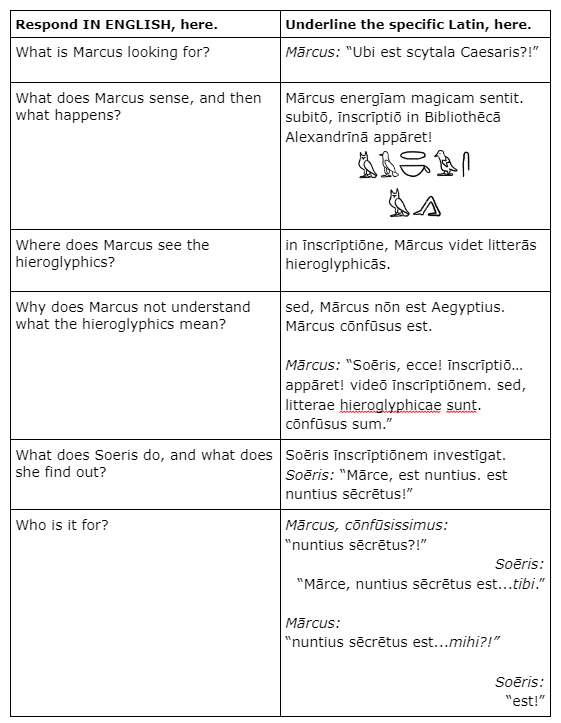
At CANE’s Annual Meeting last week, Bethany Sawyer shared a reading comprehension strategy “in chart form” that I’m calling Table Qs. This EZ format breaks up a text while giving students something specific to do while reading that focuses their attention. I think of this as giving students’ minds a job to do. When I brought this idea to our Director of Curriculum & Instruction, she (also an ELA teacher) found it similar to when they first do annotations. Instead of just “hey, annotate,” there’s always an “annotate for ____” prompt to guide students. It follows, then, that a “hey, read” prompt very well might result in students looking at the text, and maybe registering certain words, but something short of processing the Latin and really comprehending. Table Qs is one support for that. This kind of structure is also a great example of schoolifying CI. In short, students answer a question in the left column, underlining/highlighting its Latin in the right column. All you gotta do is drop text into a Doc, and make some Qs.
The key?
Don’t make obvious questions that allow students to avoid reading altogether! That would defeat the whole purpose. While it took me about 15 minutes to put a front/back Table Q page together, I’d consider it wasted time if all students were to do would be skimming the Latin to answer a question. While making these Qs is certainly a skill, consider rephrasing ones that call for a single word that’s basically already given in the question. Also consider avoiding “who?” Qs when there’s only one proper noun in the selected text. If that’s the case, at least add a follow up (e.g., “who ____ and then what do they do?”).
Check out the fourth Q in the screenshot below. That could’ve been “Marcus is what?” or “Is Marcus confused?” However, the Q allows for a number of responses that all indicate comprehension, such as “he’s not Egyptian” or “he doesn’t know hieroglyphics,” and encourages reading the whole segment (i.e., NOT just picking out only the Latin needed to answer a poorly formed Q). As a confirmation of understanding and to support their answer, students underline (or highlight if a digital Google Doc) the specific Latin. The following screenshot is from the second chapter of Mārcus et scytala Caesaris:
Read & React + Read & Reflect
As part of “schoolifying CI,” here are two more follow-up activities in addition to Read & Summarize and the ole’ standby, Read & Translate:
Read & React (or Listen & React)
Students react to narrative events. You could choose a variety of prompts, having students respond to a certain number, etc. based on your class needs. Here’s a selection from Novella Month, which for me is now going to end the school year instead of occupying the February weeks before break. I’ve selected 5-8 of these, and given “respond to 2” etc. instructions depending on scope of text and time:
- What could make the story better for you? Is there anything missing?
- What other story does this remind you of? How did that connection help you understand the story better?
- How are you alike, or different from any of the characters in the story?
- How does this story make you feel? When have you felt that way in your life?
- What is a message, or lesson in this story? Could it help you, personally, in life?
- What can you figure out that isn’t directly in the book? What clues did you use to figure that out?
- Why do you think the character(s) acted the way they did?
- What do the character'(s)’ choices, or actions tell you about them?
- What is the mood, or tone of this story? What makes you say that?
- How did the character(s) change during the story?
- What traits do the character(s) have? What clues in the story make you believe that?
- What questions do you still have? What are you wondering? What would you like to know more about?
- What would you like to ask one of the characters?
- If you were to reread this, what would you be trying to figure out the second time?
- What are the most important parts of the story [so far]?
- What do you want to remember after reading this story?
Read & Reflect
Unlike responding to prompts about the narrative, this reflection focuses on the reading experience itself:
- Describe how easy or hard it felt to read the text. Why do you think it felt that way? What was it about the text or your reading that made it easier or harder for you?
- How many times do you think you flipped to the glossary in the back?
- Did you look up the same word more than once?
- Which kinds of words do you think you looked up the most? Were they names of places? Were they tiny words that can’t really be drawn, like the word “however?” Were they shorter words? Longer? Actions? Descriptions?
- What might be a way that today’s reading has made you a better reader? Is your mind making new connections? Did it strengthen ones already formed? Did you notice anything different?
- Were there any signs today that your reading has improved? What might they be?
- Did you accomplish much during reading today? Why or why not? What might have caused that?
Listen & Reflect
For listening, the prompts can be slightly different, recognizing that a lot of the experience is out of the student’s control (vs. reading):
- Describe how easy or hard it was to listen and follow along in the text. Why do you think it felt that way? What was it that made it easier or harder for you?
- How often did you have to skip reading words/phrases you didn’t understand in order to not get behind with the audio?
- Did the same kind of unknown words come up more than once?
- What might be a way that today’s listening has made you better at understanding Latin?
- Were there any signs today that your understanding has improved? What might they be?
If Only It Were That Simple: Schoolifying CI
It’s all there. All the evidence that humans baaaaaaasically need to hear/view/read language (i.e., input) that they understand (i.e., comprehensible) is at this point un-questioned. N.B. While the second language acquisition (SLA) field has dropped the word “comprehensible,” now referring to “input” only, teachers are far more likely to identify these researched practices under the broad “CI” term. Bottom line, CI-based practices cannot be dismissed. They can’t really be expected to cause a stir anymore. Instead, it’s discussion involving a mix of opinion and research about “the X amount of Y beyond input” that causes a stir these days. However, let’s recognize the outcome of that discussion is not nearly as important as providing input. It’s not equal. It’s not even 3/4ths. Focusing on input gets us probably 90% there. Add some interaction and purpose for hearing/viewing/reading input, and that’s like 99%.
If only it were that simple.
Continue readingNo More Stories
After a most terrible teaching experience (i.e., remote year 2020-21), I wrote about wanting to double my storytelling efforts for the next year. In 2021-22, it didn’t really happen, with us creating only 10 class stories total, all very short, amounting to something like 700 total words of Latin. Come this year, we made just four (about 300 total words) up until November. This is not much Latin at all, and I’ve come to question its value in my classes.
Besides, I don’t miss it one bit, not really enjoying the storytelling process as of late. Did I ever? Not sure. The learning curve for collaborative storytelling is real steep. It’s hard to tell what might have been productive struggle or just stressful struggle. I certainly loved being a student in storytelling demos—what a friend dubbed “Workshop CI”—but I can’t say for sure that I loved asking stories to a classroom of actual teenage kids who were neutral at best, but who usually couldn’t care less. I know I know, the key is to bank on interests and personalize and make class fun and memorable and make students forget they’re learning a language, blah, blah, blah, but that just doesn’t match my reality. It never has (though it was much closer when teaching middle school). Such a magical storyland context certainly exists for some teachers in some schools teaching some languages to some students. Not mine.
So, I’m getting rid of storytelling.
No worries, though. We have plenty of other activities, and plenty of texts since I began writing these for the absolute beginner. Granted, we still need MORE low level books for independent reading options, yet we’ve reached a point where the number of books exceed what could be read as a whole class for the year (which would be boring, anyway, only reading these books by just one author). In terms of novellas (and now novellulas Pīsō… & Quīntus…), we really do begin reading a book the first week. No need to wait until the spring. So, books are a significant part of class content. They’re anchors we use to explore Roman topics. Aside from those anchor texts, we actually have enough sometimes feels like content overload:
- MovieTalk texts (do I even like playing and pausing these anymore instead of just watching then reading the text, either?! Hmm…)
- Discipulus Illustris student interviews
- end-of-class Write & Discuss (Type ‘N Talk)
- Monthly zodiac myths
- one-off activities like The Game, and mystēria
I do, however, want to keep the idea of students-as-content. In my experience, this has helped build a safe learning environment and sense of belongingness right from day one of school. Our class stories were always based on something the student liked. Therefore, this new idea just eliminates the story…
Continue readingThe Fair Game
My classroom days are certainly numbered. Just yesterday, the Unfair Game backfired tremendously, with a kid actually thinking I was picking on their group, prompting them to leave the room. I understand how adolescents can be, I’m just losing interest in this kind of stuff real fast. Anyway, I decided to remove myself as much as possible from gameplay next time, though in a way that still maintains high levels of input during the activity.
In short, students (re)read together in a group, as usual, but are also tasked with creating the questions and answers. When it comes time to use these Qs in the game, check to see if the answer the original team came up with was correct. If not, -10 points. Otherwise, the wheel has only positive values. Correct response from a team means they spin. Otherwise, move on to next team.
I also wanted to leave it up to the original team as to how specific and picky the answer had to be. For example, when I asked how a character was described, the correct answer being “more suspicious,” the response of just “suspicious” wasn’t quite right. Yes, I was being picky, but its place in “The Unfair Game” made things worse. In The Fair Game, however, a team can choose to highlight something like that comparative, requiring a specific answer. It’s up to them (and not me), adding to the competitive nature, but removing myself as some kind of arbiter.
Here’s The Fair Game.

 Magister P.