I haven’t really seen grading presented as an ableist practice, but after attending a workshop at UMass, I can see how framing it that way illustrates the problems of grading in a thought-provoking way. Why ableist? Here’s an analogy: I’m certainly not *able* to contend with the top archers in the nation, but no one is forcing me to, either. It’s a choice. My lack of ability doesn’t close any doors. I just won’t win a medal. Yet elementary and secondary school is not an option for kids. Placing grading obstacles in the way of their learning and future learning is a bit like disallowing me to go to my local archery range until I were to place among the top athletes in the nation. So, consider these common characteristics of graded assignments as we unpack each one through an ableist perspective:
I’ve shared that I’m taking the first of four courses towards Harvard’s Instructional Leadership Certificate. I really do find the course almost entirely helpful, which is a big endorsement from someone who’s been mostly disappointed by gen ed PD, and I would still recommend it.
Then there’s the points…
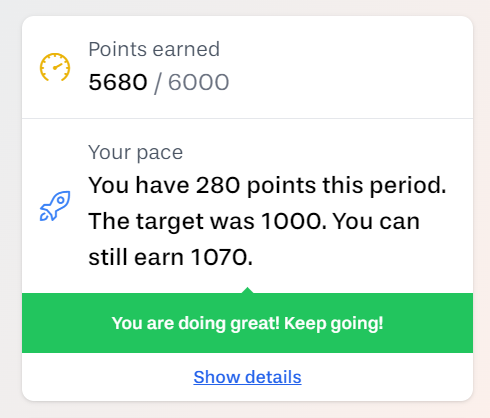
As I’ve revisited the problem with points, I also just experienced it firsthand as a student. In the course, there were optional message board activities each week with various point values for posting, replying, and/or “liking,” etc. There was a suggested minimum to “earn” over the six weeks, and a weekly maximum. But some points carried over to the next week. Not all. There was a maximum carry over limit beyond the maximum. As you see, this was not a straightforward system.
Now, I hadn’t been paying attention to the points, or perhaps better expressed, I actively tried to AVOID looking at those points. In short, when there was something to add to a topic and there were a couple replies between me and another participant, the weekly point maximum was met. Since I spent a lot of time posting and replying, I maxed out points each week.
Well, the Week 4 module didn’t really speak to me, so I did my OPTIONAL post, and didn’t really go back to look at what the other participants had to say. No biggie, right? Especially since I was nearing that six-week maximum at the end of the fourth week. What I find absolutely frustrating, though, is that I received an automated email “reminder to participate” at some point late in the week. That was just…insulting. I felt like replying “FU, bro. I’ve almost reached the limit, and these are friggin’ OPTIONAL?!” Oh, and I got another notification the following week, and a final notification after I completed the coursework. This only increased my frustration considering I had already overshot the maximum. Thanks, Harvard.
So, while the point (heh) of the message board was to encourage discussion and further learning, I was being told that I wasn’t doing it the way someone wanted me to do it. Makes me wonder how many teachers are trying to control their students in similar ways.
It’s been a couple years since I first read Grading for Equity, attended its 3-day workshop, and wrote a series of posts the in winter of 2022 on grading practices that scholars have shown to be inequitable. One perplexing thing, though, is that I do find myself around teachers who implement those inequitable practices daily, yet by all observable accounts still have high levels of equity! I’m not suggesting that the scholars are wrong. I’m also not suggesting that teachers should continue using those practices. Instead, I want to revisit why points are so bad, and then consider what else is at play in the classroom that might keep things equitable (to a limited extent). Oh, and this post doesn’t get into ANYTHING about dealing with points from a teacher bookkeeping perspective, which is enough of a hassle on its own.Even the teacher who somehow hasn’t heard of the word “equity” would benefit from ditching points altogether.
There are three broad categories of grading criteria that have the potential to unite all teachers in the effort to grade more equitably, effectively, and efficiently. Bold claim—I know—yet I’m confident there’s something for everyone. In fact, I’m dying to hear what could be missing, so leave a comment if you think of a fourth “p” or something that doesn’t fall under one of the others. Guskey’s three categories were lurking in a 1996 article (“Reporting On Student Learning…”). He opens with a quote that sounded like it could’ve been written by a contemporary scholar, yet on the next page reveals that it was from 1933! Confirming my own experience with reading studies dating back to the early 1900s, Guskey saw consistent findings 60 years before his article, which now is approaching 30 years old. We’re talking about nearly a century of consensus on some things. One of those things is that everything teachers grade can fall under the following three broad categories of criteria:
Product – Grading what students know and can do at a certain time Process – Grading how students get there Progress – Grading how much students gain
These categories support my use of—and advocation for—grading process, and I’ve had an interest in grading progress, or what I’ve been calling “growth.” I’ve avoided grading product entirely. Why? My experience has been that learner differences seem far too amplified in a second language class for us to grade language ability in that way. In addition, recent discussions about grading performance & competency (i.e., product) do suggest there’s litte reason to do so. Regardless, we don’t have to go ahead and nix grading product altogether, especially if that’s what most teachers need to hold onto to get on board. Therefore, let’s look into how grading any one, or all three categories of product, process, or progress could unite teachers in a common pursuit of equitable, effective, and efficient grading (or ungrading)…
After 10 years of teaching, I left the classroom in 2023. I’ve earned an Ed.S. and passed comprehensive exams in the fall of 2025, making me a Candidate for a Ph.D. in Teacher Education. I research grading and classroom assessment, and work with pre-service educators. Here are my most up-to-date practices—frozen in time like Pompeii or Herculaneum right up to my last day in the classroom—that were fundamental to my teaching, making all the daily activities possible…
In my continued grading research, most systems I come across do seem to be a step in the right direction, but don’t quite go far enough to address the problem of grades taking away focus from learning. Contract grading is one of the systems that misses the mark because it tends to actually bring all the focus to a grade.
Someone in my grad program recently mentioned how grading should be completely based on what students can do. This idea was challenged by another who said that it certainly makes sense if you’re “the last step” before a career (e.g., administering licensing tests, or proving you can do an actual job via some performance), but what about when students are still in the learning phase? This was a good point. How long does a typical learning phase last before you’d expect, or even need to grade performance & competency? What if you—the person ultimately responsible for that grade—are not “the last step?”
What if you’re a college instructor for a 100-level survey course? What if you’re a 10th grade math teacher? What if you’re a middle-school science teacher? What if you’re an elementary school reading specialist? Surely, a high-functioning society doesn’t rely on any of these people giving summative grades based on performance & competency as if it were “the last step.” Placing these kind of obstacles during the learning process long before the rubber hits the road isn’t something we should be doing.
In the original draft of this post, I compared two data sets of students taking the ALIRA. However, I’m not really comfortable publishing that. I really don’t need anyone trying to play the victim when it’s been me going on a decade now defending my teaching practices and the kind of Latin that I read (and write) with students. It’s too bad, too, because the data are quite compelling. Some day, I’ll share the charts. Until then, you’ll have to take my word on it. You probably already know that I don’t fuck around, either, so my word is solid.
In short, the charts will contradict the claim that reading non-Classical Latin leaves students unprepared for reading Classical Latin. They will suggest that reading non-Classical Latin texts, such as those rife with Cognates & Latinglish via class texts and novellas, is of no disadvantage. They will also suggest that reading Classical texts is of no advantage. That’s all I’m prepared to share, for now.
Once a lot more data like these will be presented, though, the jury will start to come in on the matter of what kind of Latin prepares students for any other Latin. From what I’ve seen so far, it looks like A LOT of any Latin can prepare students to read other Latin, and that’s a good thing. These emerging data show that concerns and claims over certain kinds of Latin don’t play out in reality. Still, it’d be good to have more scores, not just the 532 ones currently submitted to that ALIRA form. If this all seems mysterious, it kind of has been. I haven’t shared the spreadsheet yet for viewing. That changes today!
I’ve written about sneaky quizzes in the past. Originally, they were intended to get a grade for the gradebook (I had not discovered ungrading) while being another source of input. I called them “quick quizzes,” rebranded as “comprehension checks,” and then went back. Call them whatever you like. This update is a new way to go about them, scaled to whatever you need, like breaking up a long class with a 5-minute quiz, or adding group collaboration to get a 20-minute activity. In a nutshell:
Collect quiz content from each student.
Use those for the quiz.
Go over the quiz.
About quizzes…I haven’t been putting a single score on anything this whole year, and I’m not going back. If you do, though, have students score their own work. I also haven’t assigned any specific work to turn in this whole year (see portfolios), and I’m not going back. If you do have specific assignments students are expected to turn in, though, report these scores in the gradebook like you would anything else. Here’s more detail…
My classroom days are certainly numbered. Just yesterday, the Unfair Game backfired tremendously, with a kid actually thinking I was picking on their group, prompting them to leave the room. I understand how adolescents can be, I’m just losing interest in this kind of stuff real fast. Anyway, I decided to remove myself as much as possible from gameplay next time, though in a way that still maintains high levels of input during the activity.
In short, students (re)read together in a group, as usual, but are also tasked with creating the questions and answers. When it comes time to use these Qs in the game, check to see if the answer the original team came up with was correct. If not, -10 points. Otherwise, the wheel has only positive values. Correct response from a team means they spin. Otherwise, move on to next team.
I also wanted to leave it up to the original team as to how specific and picky the answer had to be. For example, when I asked how a character was described, the correct answer being “more suspicious,” the response of just “suspicious” wasn’t quite right. Yes, I was being picky, but its place in “The Unfair Game” made things worse. In The Fair Game, however, a team can choose to highlight something like that comparative, requiring a specific answer. It’s up to them (and not me), adding to the competitive nature, but removing myself as some kind of arbiter.


 Magister P.