It’s good that my goal wasn’t to summarize and respond to every point made on each Tea with BVP show. Why? Of all the shows, the recent Season 1 Finale had treasure troves of gold to respond to. Several of those nuggets stand out for me…
Storyasking
VERBA™ Storytelling
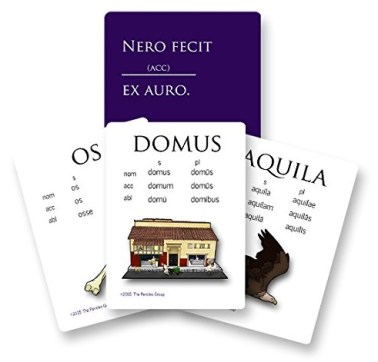
VERBA is an Apples to Apples clone game for language learners designed by the great folks who brought us the Picturae database. Aside from playing the game as-is following original rules (during which I monitor groups and deliver CI by asking students about their choices, etc.), I now use the white noun cards during storyasking/storytelling (e.g. “Once upon a time, there was a ______<reveal card>”).
What makes this different from TPRS? Vocabulary is limited to what’s on the cards, which is already in the target language along with a super clear image. You’re less likely to go out of bounds with infrequent target language vocabulary, or have to accept English details from students. On the other hand, you might WANT to accept English details from students (especially if they’re compelling). In that case, use the VERBA cards as non-examples for your students to reject, and then take their cute/hilarious/dark suggestion, etc.
What makes this different from using Rory’s Story Cubes? Story cubes contain images ONLY, no target language, so using VERBA might help keep your story more “on rails.” For an interesting storyasking/storytelling hybrid, use the white VERBA noun cards for details AND Rory’s Story Cubes: Actions set for verbs.
CI Program Checklist: 9 of 13
Classroom MGMT
✔ Rules (DEA & CWB)
✔ Routines (Routines, Student Jobs, Interjections & Rejoinders)
✔ Brain Breaks
Comprehensibility
✔ Inclusion (Safety Nets, Gestures & Question Posters)
✔ Shelter Vocab (Super 7, TPR ppt, TPR Wall, and Word Wall)
✔ Unshelter Grammar (TPR Scenes)
Camaraderie
✔ Secrets (Class Password)
✔ Students (People)
__ Stories
CI Program Checklist: 1 of 13
I have an upcoming workshop at CANE’s 2016 Annual Meeting on how to continue Teaching with CI. My abstract reads:
[…] Despite the success and enjoyment of experimenting with CI, many Latin teachers tend to abandon CI methods and strategies after a brief yet blissful period of refreshing change in favor of familiar ways. This workshop addresses how to continue using CI after the honeymoon phase ends by establishing routines, maintaining engaging activities, and having assessment systems in place to support you and your students.
These next 13 blog posts form a CI Program Checklist (emphasis on “a“), which serves as the basis for my workshop. The checklist is organized by words that begin with the letter C…they’re all the rage right now.
The Cs
Classroom MGMT
Comprehensibility
Camaraderie
Counting
Community
*Compellingness*
Let’s get right to it:
 Magister P.