sīgna zōdiaca Vol. 1: Published!

Do you like stories about gods and monsters? Did you know that the zodiac signs are based on Greek and Roman mythology? Your zodiac sign can tell you a lot about yourself, but not everyone feels that strong connection. Are your qualities different from your sign? Are they the same? Read signa zodiaca to find out!

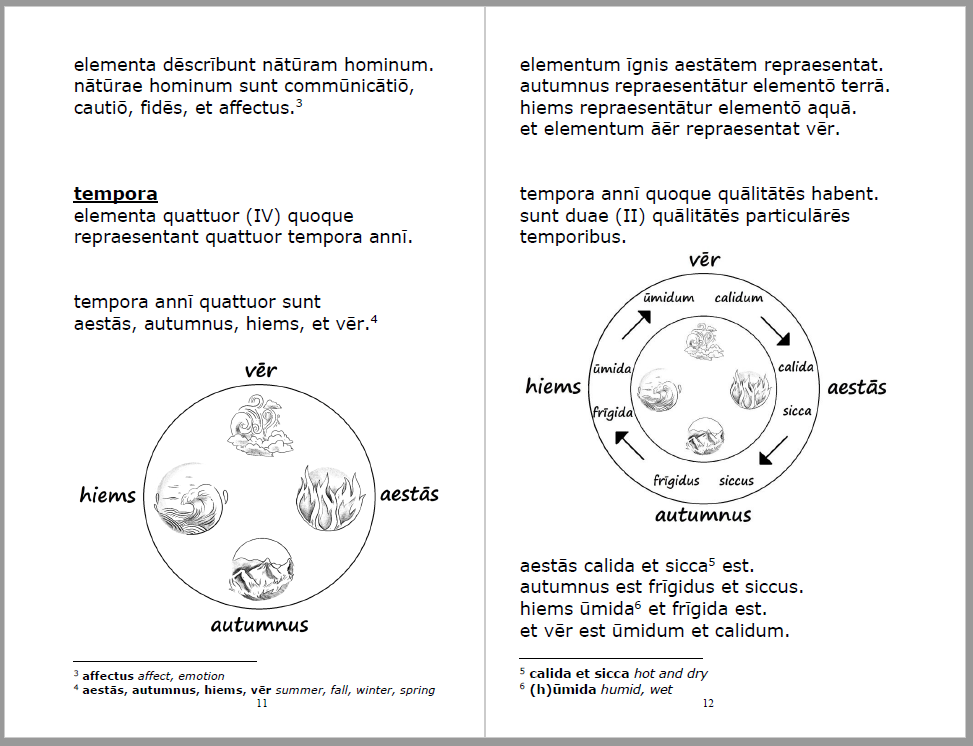
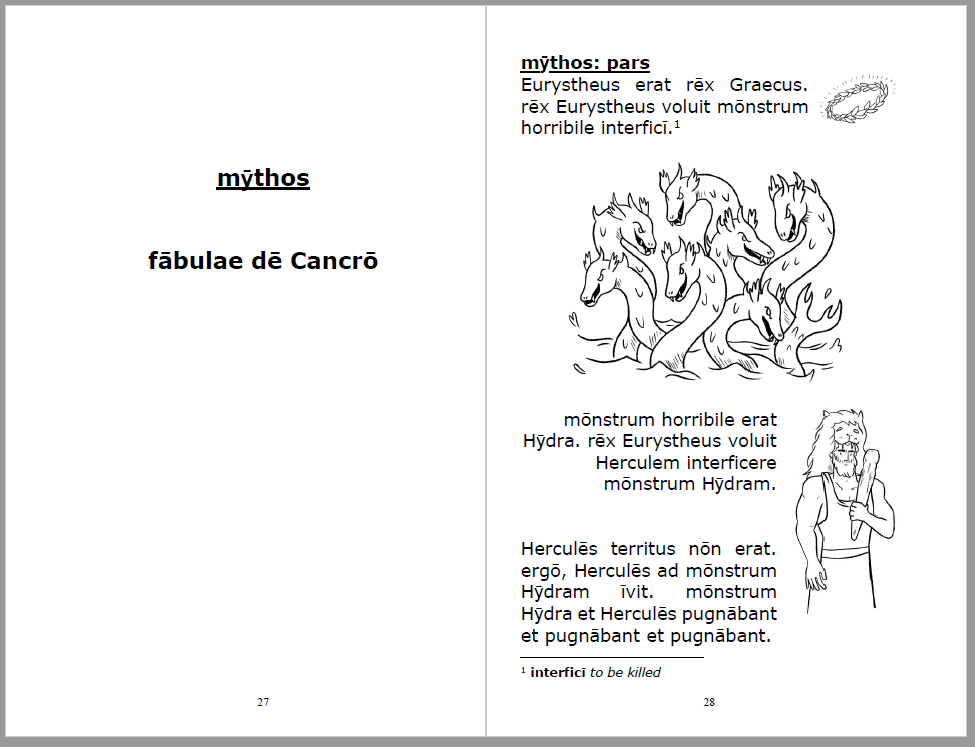
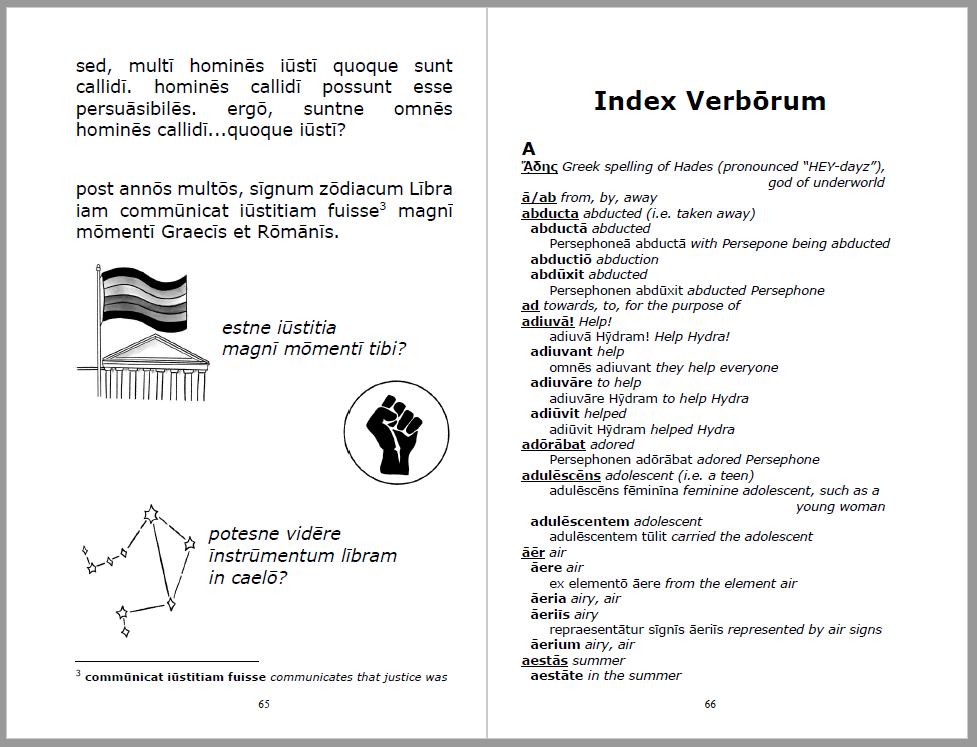
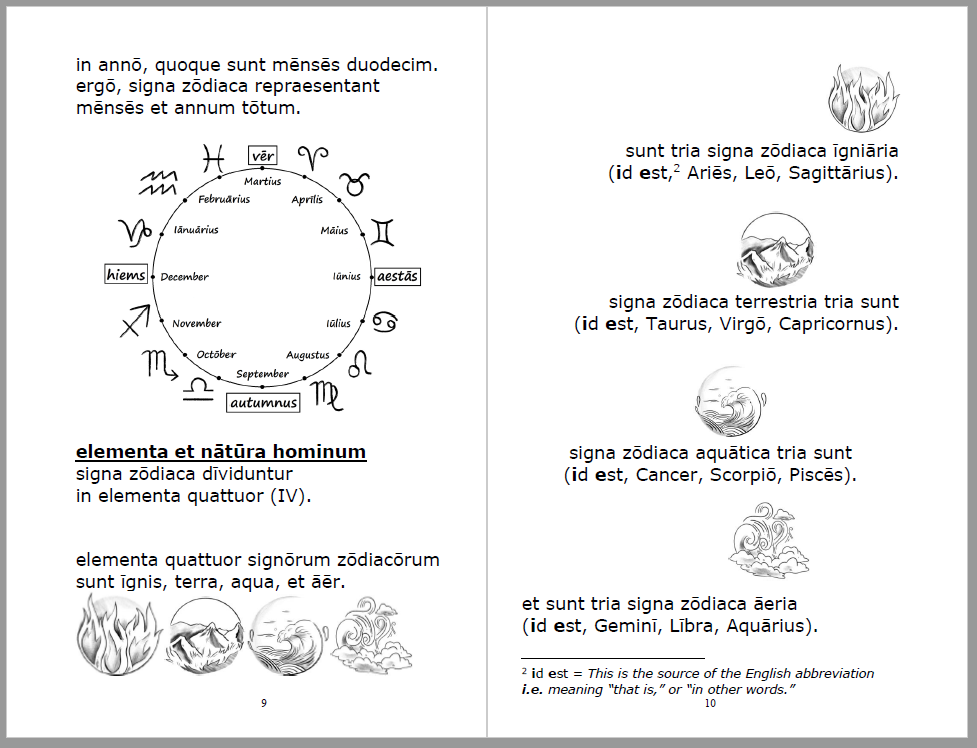
Introducing a new series: sīgna zōdiaca! These readers are part non-fiction, and part Classical adaptation, providing information about the zodiac signs as well as two tiered versions of associated myths. This book is the first of three volumes, each with four zodiac signs. Volume 1 starts hot off the heals of the summer, containing details about Cancer, Leo, Virgo, and Libra, and features two labors of Hercules (i.e. Nemean Lion, and Lernaean Hydra), as well as the Pluto and Persephone myth.

Although there’s no single continuous narrative, sīgna zōdiaca has been written just like the Pisoverse novellas with sheltered (i.e. limited) vocabulary. It contains 63 cognates and 84 other words (excluding names, different forms of words, and meaning established in the text), and is over 2,600 total words in length. Oh, and the Pisoverse texts now provide nearly 50,000 total words of Latin for the beginning student, using a vocabulary of under 740, over 43% of which are cognates!

While a growing list of how to use novellas is being shared, a couple uses are specific to this sīgna zōdiaca series. For example, read sīgna zōdiaca as part of a “monthly myth” routine to mark when the zodiac changes. Or, when a student’s birthday comes up, you can read about the details of their sign. Alternatively, if you’ve already planned to read a higher level text of any myths associated with the signs, read sīgna zōdiaca first to provide a bit of scaffolding. Who knows? Perhaps you’ll find out that your original text needs further adapting!

sīgna zōdiaca Vol. 1 is available…

  1. For Sets, Packs, eBooks, Audio, and Bundle Specials, order here.
  2. Amazon
  3. eBook
  4. Audio
  5. Free preview (abridged astrologia section, and Cancer, no illustrations)
Pisoverse eBooks Are Here!

**Updated 8.1.20 with this All-Access Pisoverse & Olimpi combo**

The world feels like it’s burning right now. Everyone should pay close attention to police brutality, those defending it, and so-called “leaders“ encouraging it and inciting further violence from white nationalists. If we can’t stand against systematic racism directly, we must be observant of what’s going on in solidarity. No one gets to tune this out, and if you do, recognize that privilege. So, this eBook announcement of mine is insignificant in comparison. Nonetheless, teachers’ attention at some point will have to shift to next year’s micro world of school and the classroom. This is what I have to offer when it comes to putting out some of those fires.

I’ve teamed up with Storylabs to offer the Pisoverse in digital form. All novellas are now available as an annual subscription for ALL your students (up to 180…and if you have more than 180, may the Olympian gods hep you!). Options include single books, packs of 3, or complete Pisoverse All Access. The eBooks are all web-based, and a school-safe certificate is on its way for a downloadable app.

Storylabs also has some tools for teachers, like tracking how long students spend reading, built-in notebooks, and the ability to create, share, and use resources other teachers have made for each book! If you have ideas, there’s a link to a Google form in each book’s Index Verbōrum. Or, fill that out directly, now. Unlike some textbook companies, we want to encourage collaboration between teachers sharing materials that support reading novellas. Just be sure to check first to see if you’re creating something that already exists in a Teacher’s Guide! Oh, and all the narration and Audiobooks I’ve recorded is included with the eBooks on Storylabs! Each student can listen to every chapter as many times as they want while reading at their own pace. There’s also built-in adorable Italian pronunciation for the few books I haven’t recorded, too!

Continue reading

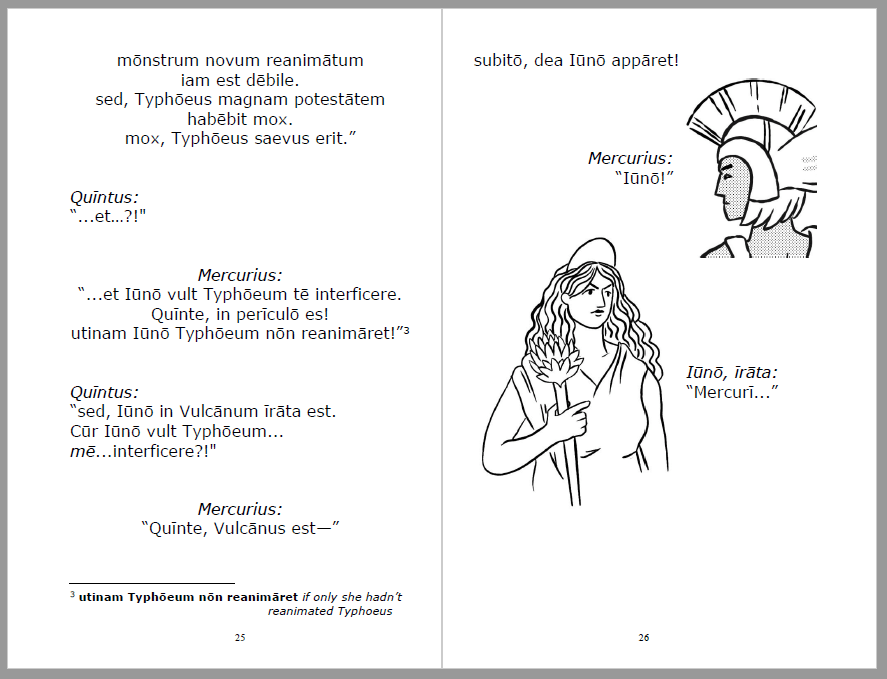
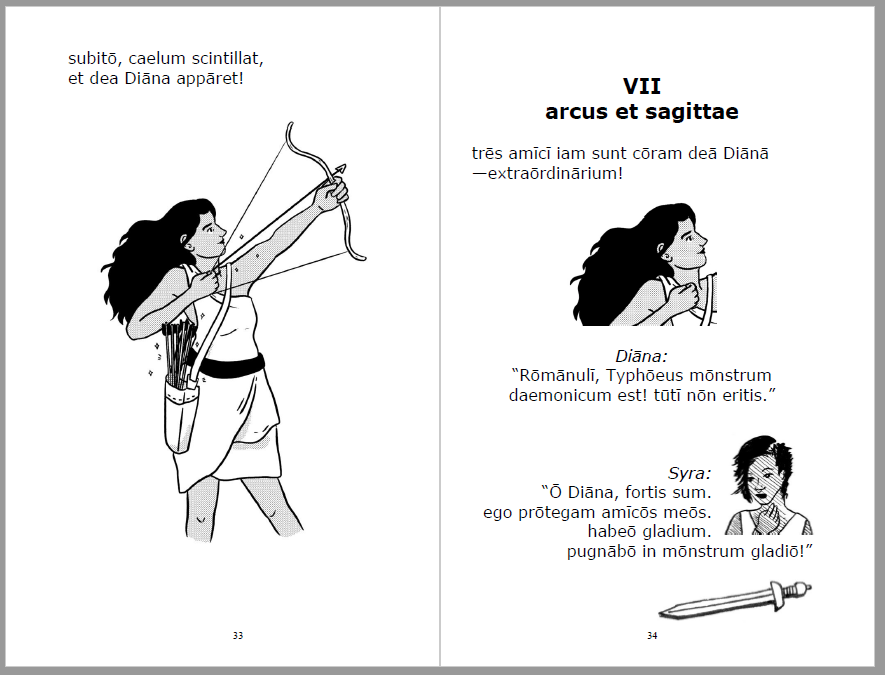
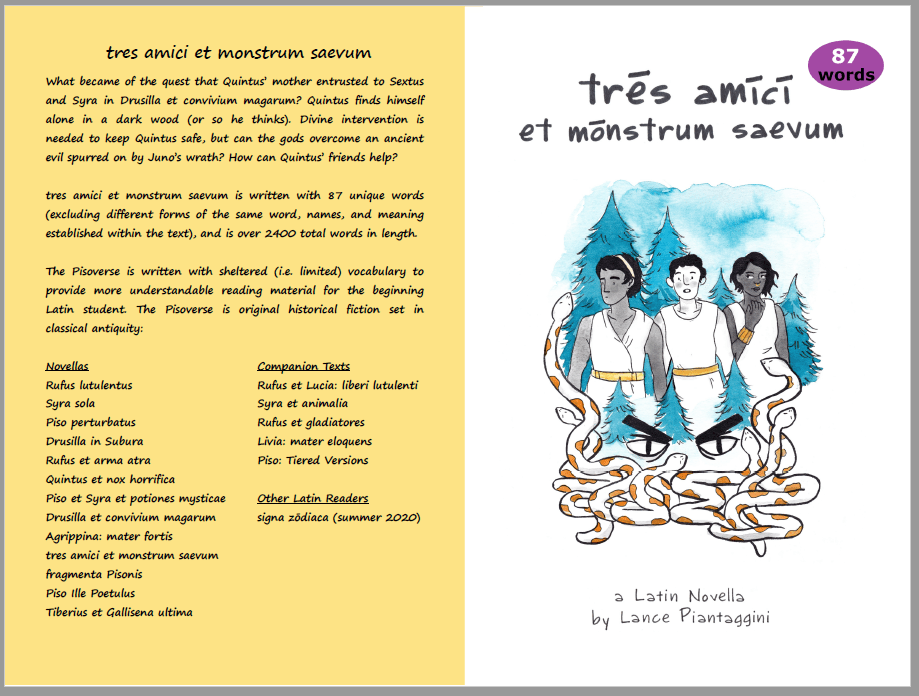
trēs amīcī et mōnstrum saevum: Published! (Oh, And eBooks Are Coming…)

Quintus, Syra, and Sextus are back together again in this tale of 87 unique words (excluding names, different forms of words, and meaning established in the text), nearly a third of which are super clear cognates, with a total length of over 2,400 words.

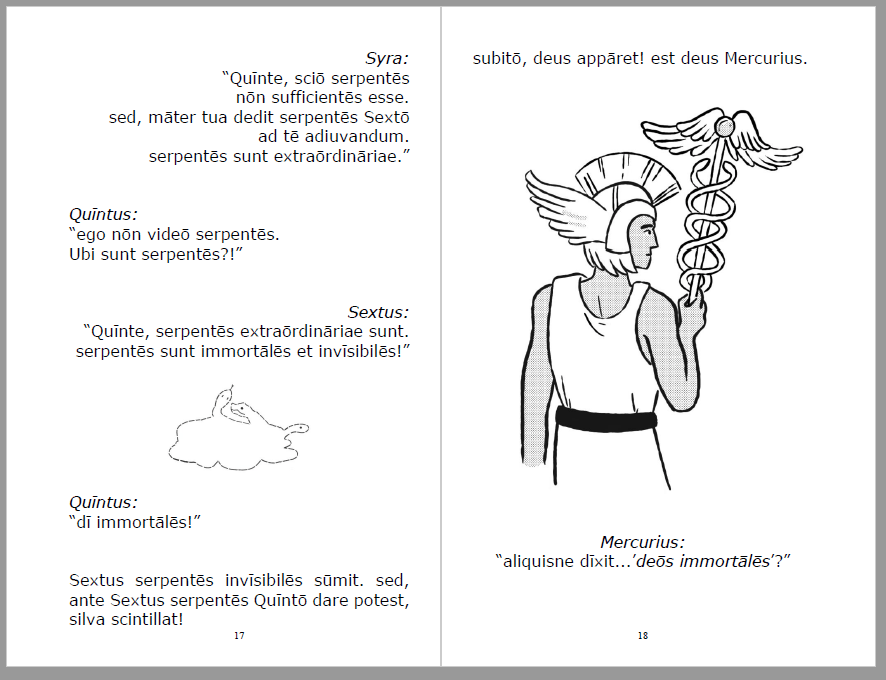
What became of the quest that Quintus’ mother entrusted to Sextus and Syra in Drūsilla et convīvium magārum? Quintus finds himself alone in a dark wood (or so he thinks). Divine intervention is needed to keep Quintus safe, but can the gods overcome an ancient evil spurred on by Juno’s wrath? How can Quintus’ friends help?

A new Pisoverse illustrator, Chloe Deeley, has updated Quintus and Sextus to show their increased age over time. Chloe has also contributed to the Pisoverse by depicting deities Mercury, Juno, Diana, and Vulcan.

This is my favorite book yet. If you find any typos in the second half of the book, it’s because each time I’ve edited, the narrative keeps me turning pages pretty fast! Oh, right. eBooks are coming for the entire Pisoverse. Stay tuned here. For now, trēs amīcī et mōnstrum saevum is available…

  1. On Amazon
  2. Free preview (first 4 of 12 chapters, no illustrations)
  3. For Sets, Packs, and Bundle Specials, order here.
  4. To instantly listen to and download the audio, go here.

*THE* Time For Writing & Adapting Texts

In the COVID-19 scramble to replace classroom instruction, many teachers are tossing anything they can at students, often using materials someone else created. This might work out fine, but it also might not. Some of the texts are comprehensible. Some aren’t.

Of course, some students will do the enrichment work, and some won’t. That’s just our reality. Yet the K (constant) in all this is us. Teachers can use this time to hone their skills while also providing input—that students may or may not receive, which is completely out of our control (i.e. what used to be problems with homework is now the entire course content!)—ensuring more productive ways to spend our time…

Continue reading

Dante’s Circles Of Latin Shaming Hell

Instances of Latin shaming (i.e. causing one to feel ashamed or inadequate regarding their use of Latin) come up every now and then. I last pondered the issue back in August of 2019 in a draft of this post, first started in 2018 after observing some kind of online scuffle. Like clockwork, there have been public discussions once again regarding Latinity (i.e. quality of Latin), whether spoken in the classroom, or appearing in published works. To be clear, I have no interest in participating in those discussions. None. However, I’d like to share a bit about what’s been going on, and give some examples of Latin shaming…

Continue reading

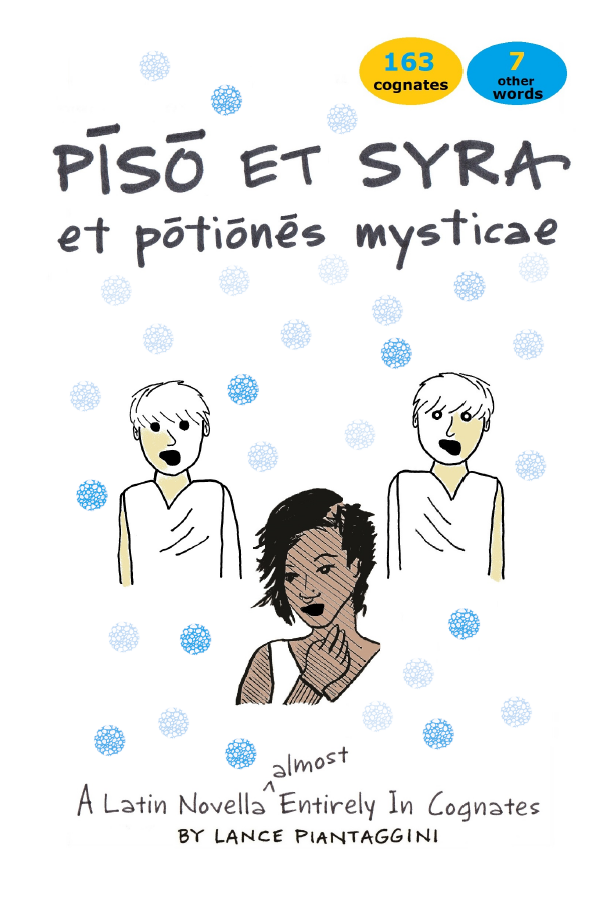
Pīsō et Syra et pōtiōnēs mysticae: The Cognate Book Published!

This novella is written with 163…COGNATES!

That’s right.

There are 163 fairly to super clear Latin to English (and even Spanish) cognates, and then just 7 other necessary Latin words (ad, est, et, in, nōn, quoque, sed) found within this tale of nearly 2500 words in length.

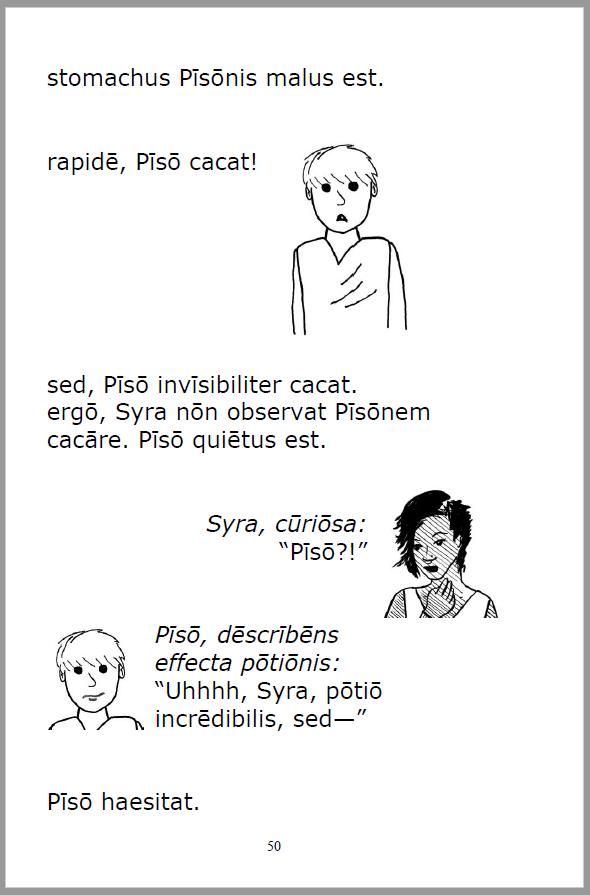
“Piso can’t seem to write any poetry. He’s distracted, and can’t sleep. What’s going on?! Is he sick?! Is it anxiety?! Has he lost his inspiration?! On Syra’s advice, Piso seeks mystical remedies that have very—different—effects. Can he persevere?”

Pīsō et Syra… is the 17th novella in the Pisoverse, the collection of Latin novellas written with sheltered (i.e. limited) vocabulary to provide more understandable reading material for the beginning Latin student. The Pisoverse now provides over 44,000 total words of Latin using a vocabulary of 645 (just about half of which—320—are cognates!).

1) Pīsō et Syra et pōtiōnēs mysticae is now available on Amazon.
2) For Sets, Packs, and Bundle Specials (up to $200 off!), order here.

Free Reading Fridays: We Need More Novellas

Last week, we started Free Voluntary Reading (FVR) in what I’m calling Free Reading Fridays, which is 10 minutes of independent reading at the start of class just before we do some kind of team game. It’s a great way to end the week. I wrote about how first year Latin students have had 143 minutes of FVR so far, but that’s been in segments of 3-5 minutes in the middle of class, with students choosing class texts from their folder. Last Friday was the first day they were able to sit in the back and choose anything from our library…

Continue reading

Q1 Stats: 39% Of Input From Novellas

After sharing the strong start to the year from just the first 12 minutes of day 1, and results of a textbook comparison from the first 4 weeks, I’ve now got some stats from Quarter 1. Having arrived at the first 10 week mark of the year (36 hours), the total words read is now 6,500. But that figure isn’t really what I find most remarkable. How about the fact that 39% of the total input was read in just these last two weeks, from novellas alone…

Continue reading

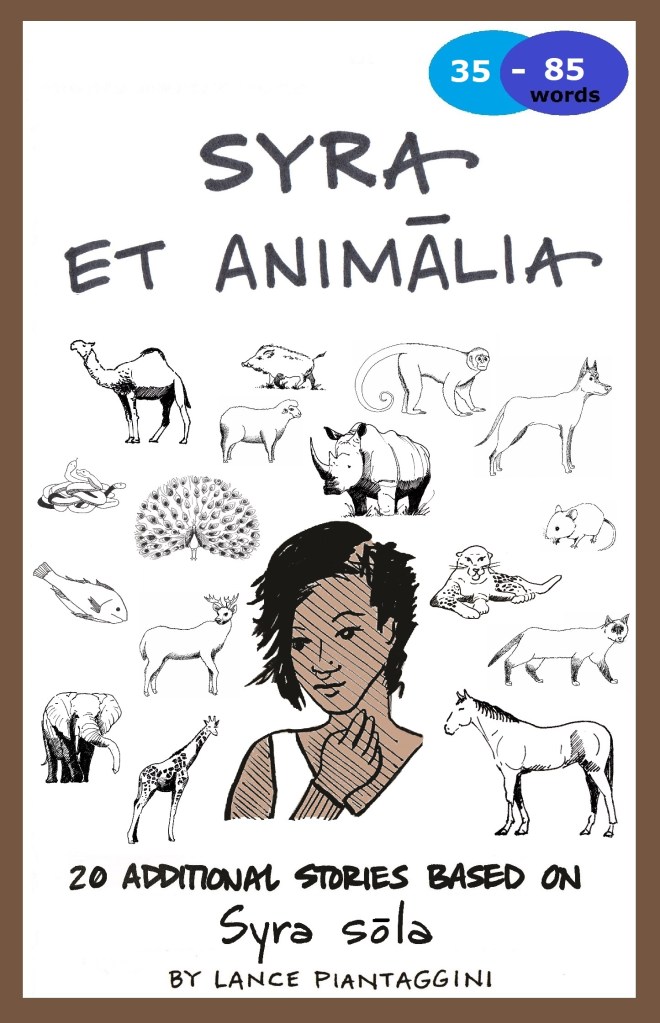
Syra et animālia: Published! & The Pisoverse FVR Readers

The companion text to Syra sōla is now available on Amazon.

Rūfus lutulentus, Rūfus et arma ātra, Agrippīna: māter fortis, and now Syra sōla all have companion texts, either as collections of additional stories via Expanded Readings (i.e. Rūfus et Lūcia: līberī lutulentī, Syra et animālia, and Rūfus et gladiātōrēs), or a parallel novella via Choose-Your-Own-Level Readings (i.e. Līvia: māter ēloquens). These books have a colored border, and more than one unique word count button to show the range throughout (depending on the level one reads), which corresponds the other Pisoverse books (i.e. light blue <50 words; dark blue 50-100 words; purple 100+ words). This word count button is intended to inform teachers of relative reading level, and help learners choose a book during Free Voluntary Reading (FVR). Thus, I refer to all these companion texts as “FVR readers.”

N.B. Even though the companion texts are all based on existing novellas, learners don’t need to have read the originals! They can exist independently as FVR reading options.

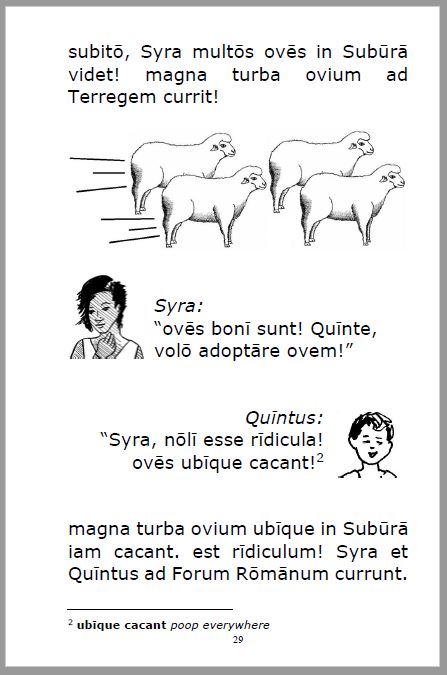
Syra et animālia is the latest addition to the FVR readers. The new companion text to Syra sōla features the most super clear cognates in a Pisoverse novella to date, with 60! In this book, Syra encounters various animals around Rome on her quest for a pet. Familiar Pisoverse characters make appearances throughout, such as the arrogant Terrex, who we learn has a pet ape he doesn’t like and never named, and a pet peacock he adores, named Pāvopapī!

Here’s how the FVR readers work, and can be used…

Continue reading

Novellas: Mira Canion’s Quick Read

Mira Canion just presented at iFLT 2019 on how to read novellas quickly. Why quickly? Mira had many reasons; one being if the level is a little too hard for your slowest processors; another if the book is starting to drag out. This latter option is good for anyone who tried to teach a novella over the course of a few weeks or more. I can also see how for most Latin teachers, there still aren’t enough titles available that perfectly match the reading level of the class. Mira’s “Quick Read” stuck out in my mind…

Continue reading