I was recently asked a very good question about how to change one’s assessments to align more with CI. By that, we’re talking about comprehension-based language teaching (CLT) that prioritizes comprehensible input (CI) in the Latin classroom. First, it helps to think in terms of what standards were being assessed beforehand, even if they weren’t explicitly called “standards.” These old standards were mostly discrete skills you’d expect to find in tests accompanying popular textbooks, like vocabulary recall, derivative knowledge, grammar identification, and cultural trivia. New standards based on CI—whatever they are—will have meaning at the core. My suggestion is to focus on assessing comprehension of Latin, because that’s more than enough to ask for. One benefit of this standard is that is that it has those old discrete skills embedded within something larger and more meaningful that you can assess (i.e., comprehension). Let’s look at how each one of the old standards is contained within assessing comprehension…
Continue readinggrammar
Basics: Summary of Recurring Ideas & Posts
After 10 years of teaching, I left the classroom in 2023. I’ve earned an Ed.S. and passed comprehensive exams in the fall of 2025, making me a Candidate for a Ph.D. in Teacher Education. I research grading and classroom assessment, and work with pre-service educators. Here are my most up-to-date practices—frozen in time like Pompeii or Herculaneum right up to my last day in the classroom—that were fundamental to my teaching, making all the daily activities possible…
Continue readingALIRA: “All Your Datum Are Belong To Us…Plz?”
In the original draft of this post, I compared two data sets of students taking the ALIRA. However, I’m not really comfortable publishing that. I really don’t need anyone trying to play the victim when it’s been me going on a decade now defending my teaching practices and the kind of Latin that I read (and write) with students. It’s too bad, too, because the data are quite compelling. Some day, I’ll share the charts. Until then, you’ll have to take my word on it. You probably already know that I don’t fuck around, either, so my word is solid.
In short, the charts will contradict the claim that reading non-Classical Latin leaves students unprepared for reading Classical Latin. They will suggest that reading non-Classical Latin texts, such as those rife with Cognates & Latinglish via class texts and novellas, is of no disadvantage. They will also suggest that reading Classical texts is of no advantage. That’s all I’m prepared to share, for now.
Once a lot more data like these will be presented, though, the jury will start to come in on the matter of what kind of Latin prepares students for any other Latin. From what I’ve seen so far, it looks like A LOT of any Latin can prepare students to read other Latin, and that’s a good thing. These emerging data show that concerns and claims over certain kinds of Latin don’t play out in reality. Still, it’d be good to have more scores, not just the 532 ones currently submitted to that ALIRA form. If this all seems mysterious, it kind of has been. I haven’t shared the spreadsheet yet for viewing. That changes today!
Continue readingAbbi Holt’s Wisdom On Sustainable & Equitable Teaching
Abbi Holt had a great thread sharing a 6-year progression of practices that have made even teaching through a pandemic tolerable! Here it is with some commentary on why you should look into doing similar things, if not the very same…
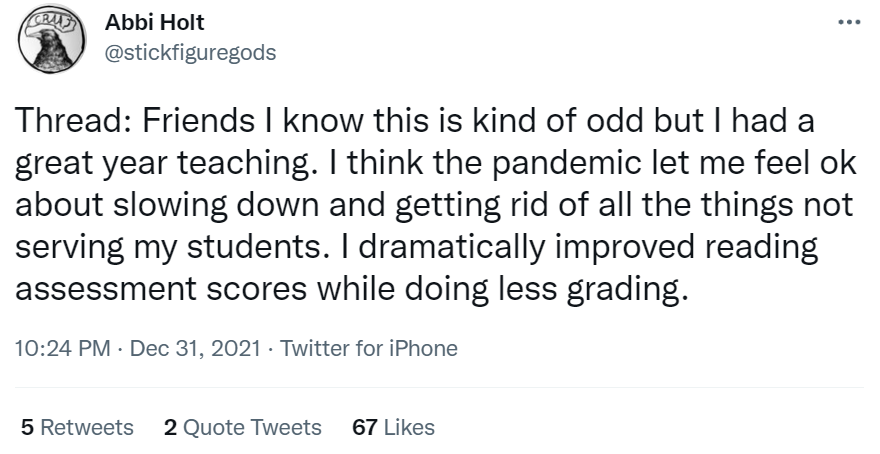
Why This Works? #1
Not only is moving slowly and steadily a more responsive approach to teaching learners in the room, but reducing grading is crucial in carving out space for everything that positively impacts teaching and learning.
The Problem Is Vocab, Not Grammar
This post is not about teaching grammar. This post is about its role in comprehension. Grammar can tell you a word’s function, but what impact does that have if you’re struggling to understand what words mean?! It’s still all about words. In fact, all words contain grammar. If you know what a word means, you’re a little bit closer to acquiring its grammar each time you encounter it. In this post, I use a language I’ve made up for other demonstrations, aptly dubbed Piantagginish, to show how vocab—not grammar—is the real problem regarding comprehension. The pedagogical takeaway is to avoid vocab overload, and shelter vocab whenever possible…
Continue readingLLPSI Challenge
CI is not out to destroy the Classics. On the contrary, those advocating for teaching with more CI are the professions’ biggest cheerleaders, aiming to increase interest and enrollment worldwide. How? It starts with including all students.
Still included in the included, though, are those students most like us who have always thrived in conventional Latin classrooms. We can’t leave them out. At this point, I’ve had about 10 classes with students this year, which is just around the time when it becomes clear who’s really into Romans, and/or really into learning (as opposed to everything else that interests adolescents). Since a few of these students have made their presence known in my inclusive classroom, I have a plan…
 Magister P.