Amazon Novella Cost Increase :(

To clarify, Amazon isn’t increasing their cost to print books. They’re just decreasing royalties paid to authors (for books listed under $9.99), which means that unless many authors agree to earning quite a bit less per book (in my case it’s over 30%), there will be an increase to your cost of purchasing novellas. The good news? It’s only through Amazon purchases…

That is, I encourage teachers to buy directly from authors and novella distributors whenever possible (e.g., my square site, or Storybase Books) since printing costs are remaining the same; whatever deals authors and distributors have struck up aren’t affected by Amazon’s royalty decrease, so you can enjoy lower-cost novellas through them. See this tab on the crowd-sourced novella document on places to get books other than Amazon.

Is there a catch? Not really. Direct purchases tend to have lower list prices than Amazon, though shipping costs added to the order might come as a surprise since they’re hidden by Prime free shipping. For example, most of my books are increasing to $10 on Amazon, but my set of 12 favorite books is $70 plus shipping ($9), not the Amazon list of $120.

On a side note, I’m also taking this opportunity to switch my covers to the glossy format since I’ve heard that the matte versions can get a little grimy over the years, making that really nice original texture end up kind of gross (eww!). Sorry it’s taken so long, JP!

0 To 170: Nine Years Of Latin Novellas

In August of 2020, I wrote 0 To 70: Five Years Of Latin Novellas. Two years later, the number of Latin novellas nearly doubled. Well, another two years have gone by and we’ve seen 40 more, which is an increase of 31%! Above all, there are now 38 authors out there writing different kinds of Latin. In this post, I want to celebrate that different kind of Latin while revisiting some findings…

Continue reading

KDP Cost Increase, Square Site Still $5/Book

KDP announced higher printing costs. As a result, my novellas on Amazon are increasing to $8. However, I’ve kept the deals on my Square site to about $5 per book to continue supporting teachers getting multiple copies for the classroom. Yes, there is a shipping cost. For everyone used to Prime free shipping, that cost might seem alarming. Yet it’s a reality I’m very familiar with having experience working at a UPS Store. Still comes out cheaper than Amazon, though.

Also, I’ll be updating my novella list over the next month to check prices. That’s about 150 books, though, so if you find a discrepancy, just contact me with the update. Thanks!

Novella Spotlight: diāria sīderum (The Star Diaries)

diāria sīderum is a personal favorite. I think this one is my best, honestly, though it appears to be an unlikely choice for the Classicist Latin teacher. Then again, they’re not the ones reading the book. Students are! The sci-fi/fantasy narrative has a bit of a “who dunnit?” feel to it, with students seeking to figure out what made the book’s ancient culture disappear. It’s in three parts using half cognates. The first part has 30 cognates and 30 other words (i.e., 60 total), and the other two parts add 20 and 20 words to that, respectively (i.e., 100 total). It was written so that my Latin 1 class could read a 1000-word long intro to “The Architects” in Part 1 to get a sense of what was going on just before their disappearance. Then, during independent reading, anyone interested could finish Parts 2 and 3 that provide more clues as to what happened.

And that might not be everyone…

Continue reading

Quīntus et āleae īnfortūnātae: Published!

Quintus is a gamester who really likes to gamble. The problem? He’s terribly unlucky and never wins! In this tale, Quintus gets himself into a dicey situation, betting all sorts of valuables he can’t afford to lose. Will he come out on top, or lose it all in the end?

16 cognates, 34 other words
840 total length

This is my third novellula written to be short, very much on purpose. Since Latin novellas first started popping up, teachers have noted that the whole-class reading experience can drag on for beginners. I’ve been finding that books under 1,000 total words seem best for a quick read at the start of Latin 1. This new tale is about gaming! I grabbed some dice-cups, dice, and knucklebones online to play as we read the book. Give it a try. Enjoy!

  1. For Sets, Packs, and eBooks order here
  2. Amazon
  3. eBooks: Storylabs

A Year Of Grading Research: 30 Articles, 8 Books, 1 Pilot Study

You’re looking at my school desk. There’s some wormwood lotion for our desert-like winter classroom conditions here in New England, some peacock feathers (why not?), one of the deck prisms my great grandfather made in his line of work, the growing collection of my ancient wisdom series obsession, and what remains of this year’s unread novella order. What’s not there is the stack of articles and research reports that had been piling up since last spring. I’ve finally read them all during my planning periods. Of course, each report itself produced at least another to read, and often two or three more, making the review process more like attacking a hydra, but those are now tucked away in a “To Read/Review” folder in Drive. My desk is clear, and that’s enough of an accomplishment for me while teaching full-time. Aside from the reports, I’ve read 8 books, too:

  • Hacking Assessment 1.0 & 2.0 (Sackstein, 2015 & 2022)
  • Ungrading (Blum, 2020)
  • Point-less: An English Teacher’s Guide to More Meaningful Grading (Zerwin, 2020)
  • Proficiency-Based Instruction: Rethinking Lesson Design and Delivery (Twadell, et al. 2019)
  • Embedded Formative Assessment (Wiliam, 2018)
  • Assessment 3.0 (Barnes, 2015)
  • Grading and Reporting Student Progress in an Age of Standards (Trumbull & Farr, 2000)
  • Punished By Rewards (Kohn, 1993)

In case you’re wondering and were to ask for my current top five, which includes Grading for Equity (Feldman, 2018) that I read a couple years ago, it’d have to be Ungrading, Pointless, Punished by Rewards, and Hacking Assessment. Beyond the books, this year I also completed a small-scale pilot study, which I’ll be presenting at the CANE Annual Meeting. While not specific to Latin teaching, a case could easily be made that *any* grading research can apply to *every* content area. In fact, it’s somewhat remarkable what researchers have found, yet the profession just doesn’t seem to know. And there’s consensus. I’m not prepared to make sweeping claims and cite anything specific, but my impression of the consensus so far is:

  • Grading does more harm than most people think. It’s one of the few relics of antiquated education still practiced today en masse, in pretty much the same way, too. Considering everything that’s changed for educators in the past two, five, 10, 20, and 50 years even, now realize that the current dominant grading paradigm predates all of that. The fact that most grading systems are still based on the 0-100 scale with a “hodgepodge” of assessment products that are averaged together to arrive at a course grade is nothing short of astonishing.
  • Schools with a more contemporary (i.e., 30-year old) approach that claim to have standards-based learning (SBL) and grading (SBG) systems are actually still in their infancy, with some not really implementing the systems with much fidelity at all, thus, giving a lot of SBG-derived or SBG-adjacent practices a bad name. It’s mostly teacher/school misinterpretation and poor rollouts of these practices that render the efforts ineffective, not the practices themselves.
  • Gradelessly ungrading is probably the only sure bet for fixing the mess that grades have gotten us into. If you’re putting all your time and effort into SBG, I recommend that the second you understand the basics, see if you can skip right on over to a) using portfolios, b) getting rid of all those points, and c) having students self-assess & self-grade just once at the end of the term. You’re gonna need to provide a bit of feedback with this kind of system, too, so maybe try Barnes’ SE2R model.

Interverbal Fan Fic

I haven’t given midterms in years. Back when I did, though, it was a self-assessed analysis of fluency writes (I no longer do any sort of timed write, either, but that’s another story). Now, aside from the infuriating last-minute “all courses must have a midterm” decision we got hit with coming back from holiday break, I had a major discovery when giving the [ungraded] midterm this year.

Continue reading

Translating Isn’t The Problem

When the updated Standards for Classical Languages were shared, one key difference was the near-omission of the word “translating” as an active task, mentioned just once under a description of advanced learners at the postsecondary level (i.e, “Learners conduct research in the target language or assist in the translation of resources for the benefit of others.”), and then appeared in one example learning scenario submitted by a university professor. Granted, these standards have been in draft form—somehow—since 2017, but Latin teachers have been lauding that lack of “translation,” preferring nowadays that students focus more on reading Latin than doing translation exercises. However, it turns out that translating, per se, isn’t the problem…

Continue reading

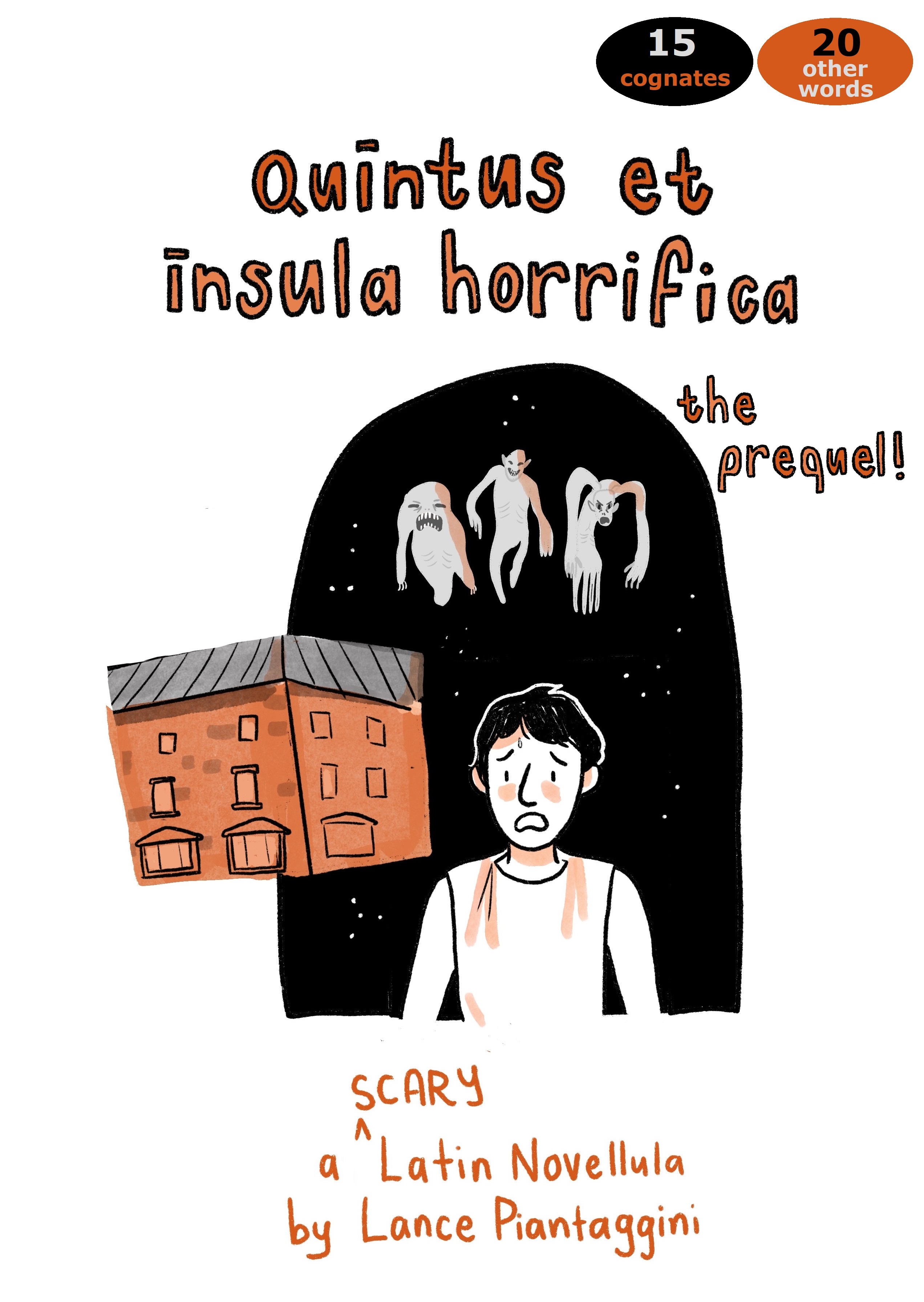
Quīntus et īnsula horrifica (the prequel): Published!

Before Quintus and his parents had money and moved into their house, the family lived in a small Roman apartment. Times were simpler back then, but no less spooky! In this tale, Quintus is 100% scared of the dark, but wants to appear brave in front of his parents. To make things worse, Quintus receives paranormal visitors night after night…or does he?

15 cognates, 20 other words
750 total length

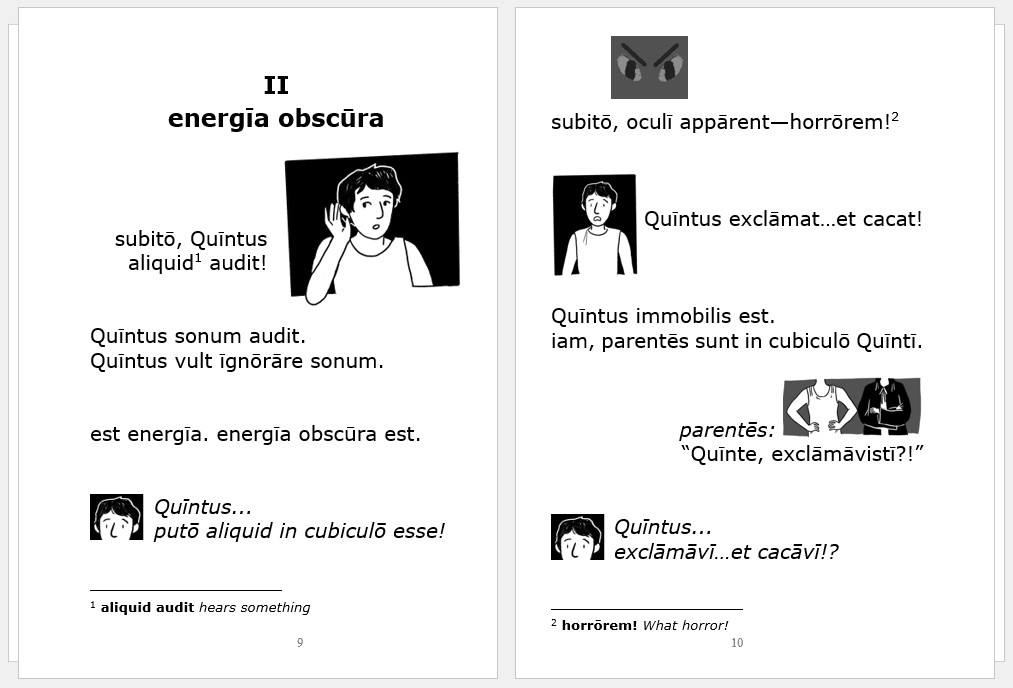
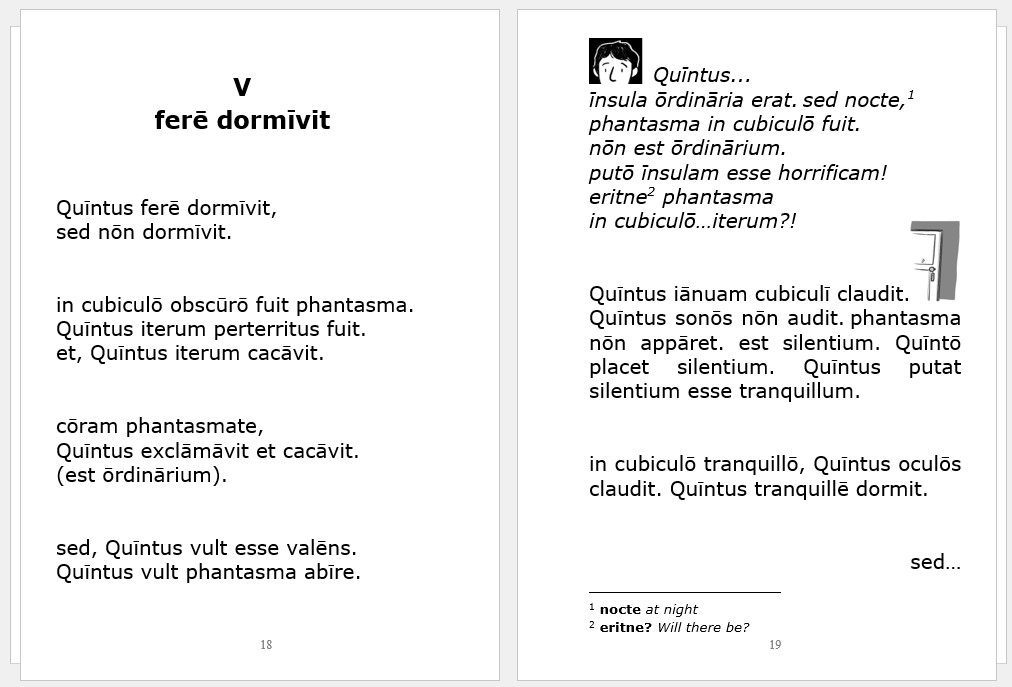
This one’s real short, on purpose. I’ve had the most success in class with the shortest books. Since Latin novellas first started popping up, teachers have noted that the whole-class reading experience can drag on for beginners. Therefore, books around and even under 1,000 total words seem best for a quick read at the start of Latin 1. This book is a prequel to Quīntus et nox horrifica. The new book is similar in reading level and scope to our first books read, Mārcus magulus and Olianna et obiectum magicum. It draws vocab from them, too. īnsula horrifica could also act as a stepping stone to the original for students who want to read what is now “the sequel” on their own once independent reading begins.

Beyond that, the content mirrors what has been our comparison of elite Roman villas and common apartments. This is part of our exploration of Roman topics in Latin 1, and this new book provides a backstory to the social mobility Quintus’ family experiences. Lots to talk about. Or not, and just read for entertainment. Also, there will be an audiobook just like the original tale. We’ve got until October for that, though. Stay tuned. Enjoy!

  1. For Sets, Packs, and eBooks order here
  2. Amazon
  3. eBooks: Storylabs

Flex Time & Google Days

“You teach the kids you have.” I like this nugget of wisdom. It doesn’t matter if previous classes of students did this or that. Everyone must teach the students they have in the room, not anticipated students, or former students. Sometimes what the students in the room don’t know can be surprising, but the only thing that matters is what we do about it. For example, I’ve been perplexed by the lack of digital literacy I’ve been seeing with incoming 9th grade students. Rather than shake my head, pretending that lack of skill isn’t my problem, I’m going to do something about it. I’m going to do something even if it has less to nothing to do with Latin. Why? Because I teach the kids I have, and these kids need to be able to navigate Google Classroom, and I’m tired of pretending it’s fine. The plan? Each week, students will have 20 minutes to organize their learning after another 20 minute independent learning session. The latter part isn’t really new, so let’s start with that:

Flex Time
This independent learning time worked out really well last year. I checked my planning doc and saw that between December and June we had Flex Time a total of eight times. I’ve curated the options, most recently removing Quizlet since I find it less useful when not immediately followed by a whole-class Live session before reading the text. New for this year will be to encourage an ongoing project. Is the goal to read as many novellas as possible? Is the goal to work through an entire textbook? Is the goal to learn about a specific Latin-related topic? Instead of bouncing around the Flex Time options every few weeks or so, students will now choose an ongoing option for this new weekly routine every Wed/Thurs. Yes, they can switch if they really want to, just as long as they reflect why (e.g., “I liked the idea of having textbook structure, but I think Caecilius is boring.”).

Google Days
The second half of Wed/Thurs each week gives students time to check feedback and submit learning evidence (Google Classroom) for Latin class. Once done, or if already caught up, the remaining time is for checking school email (Gmail) and responding to other needs, such as correspondence with teachers, and/or completing other class Google Classroom assignments. No, it does not bother me if a student ends up doing 8 minutes of math at the end of Latin. I’m teaching the students I have, and it’s clear that they need something like this. What I will do is make sure this rolls out smoothly. What I won’t do is hang out at my desk and overestimate my student’s independent learning capability. This kind of work with 9th grade requires heavy monitoring, not unlike the first minutes of independent reading. That is, if I think students are going to magically grab a book and be quiet on their own within 10 seconds, I’m fooling myself. Yet every time I take those first moments to ensure the majority of students—yes, majority, because we can’t have it all, all the time, everywhere, all at once—settle into a task, I’m always rewarded with my own quiet time to read, with the occasional look up, make eye contact, and stare down the kid who’s goofing off until they get back to the book. It works. You just have to commit to both: monitor the room, getting kids on task at the start of an activity, and being unwavering with a teacher look at the ready.

So, the second 20 minutes of Wed/Thurs is also for students to add learning evidence, submitting work from the previous week in addition to what they did during Flex Time. For example, they could attach a notebook pic from Mon/Tues annotation task, as well as a statement about something they learned from their Flex Time findings, how much they read of a book, what they were working on, etc.