When the updated Standards for Classical Languages were shared, one key difference was the near-omission of the word “translating” as an active task, mentioned just once under a description of advanced learners at the postsecondary level (i.e, “Learners conduct research in the target language or assist in the translation of resources for the benefit of others.”), and then appeared in one example learning scenario submitted by a university professor. Granted, these standards have been in draft form—somehow—since 2017, but Latin teachers have been lauding that lack of “translation,” preferring nowadays that students focus more on reading Latin than doing translation exercises. However, it turns out that translating, per se, isn’t the problem…
Continue readingCognates & Latinglish: I’m Not Finished.
Gotta love a trilogy, right? This is my final Winter 2023 post on the whole cognate kerfuffle.
One reason Chinese takes native English speakers a LOT longer to acquire than something like Spanish is because Chinese has approximately zero cognates. Terry Waltz has reported that Spanish has about 3,000 words most English speakers can understand without being taught any of them. Languages with more cognates are acquired faster because cognates play a role in the first developmental stage of second language learning. Check out what ACTFL has to say about the novice language learner and cognates:

Quīntus et īnsula horrifica (the prequel): Published!
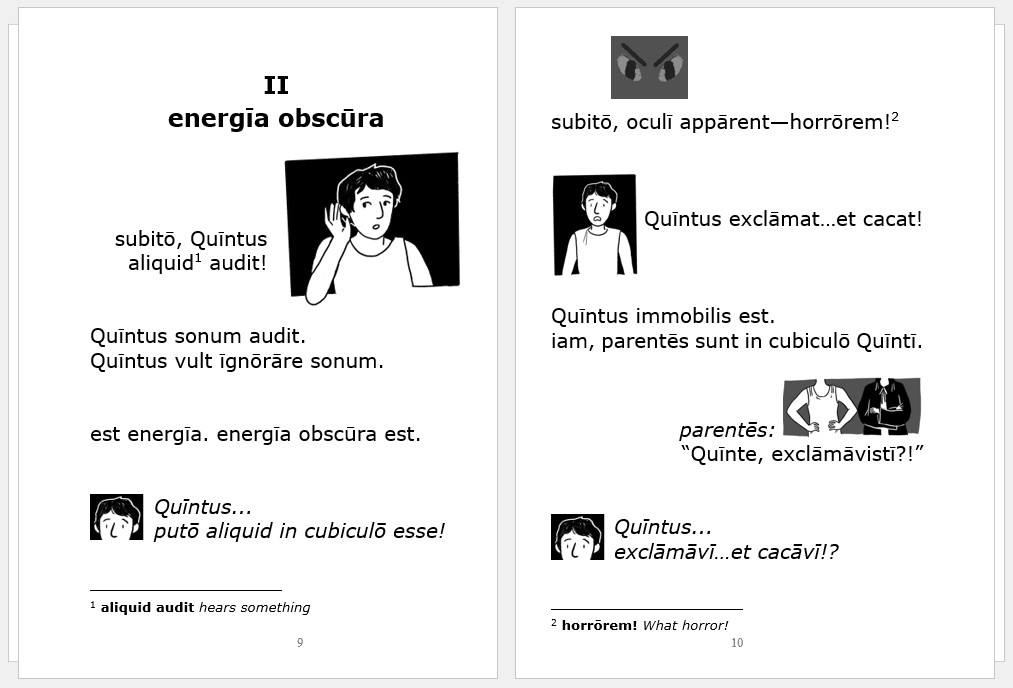
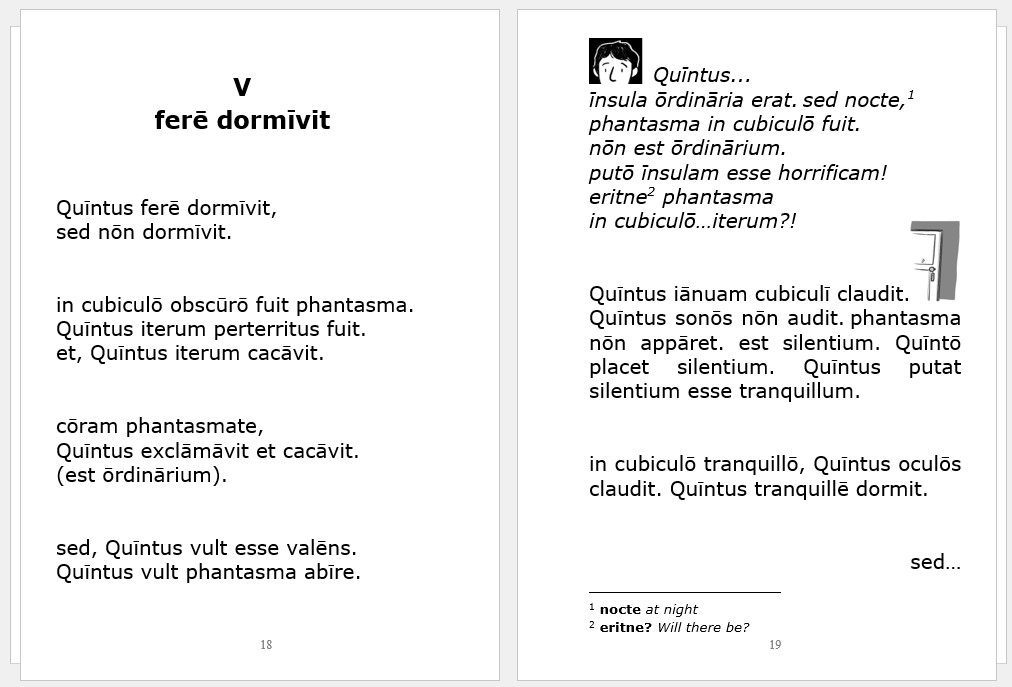
Before Quintus and his parents had money and moved into their house, the family lived in a small Roman apartment. Times were simpler back then, but no less spooky! In this tale, Quintus is 100% scared of the dark, but wants to appear brave in front of his parents. To make things worse, Quintus receives paranormal visitors night after night…or does he?
15 cognates, 20 other words
750 total length
This one’s real short, on purpose. I’ve had the most success in class with the shortest books. Since Latin novellas first started popping up, teachers have noted that the whole-class reading experience can drag on for beginners. Therefore, books around and even under 1,000 total words seem best for a quick read at the start of Latin 1. This book is a prequel to Quīntus et nox horrifica. The new book is similar in reading level and scope to our first books read, Mārcus magulus and Olianna et obiectum magicum. It draws vocab from them, too. īnsula horrifica could also act as a stepping stone to the original for students who want to read what is now “the sequel” on their own once independent reading begins.
Beyond that, the content mirrors what has been our comparison of elite Roman villas and common apartments. This is part of our exploration of Roman topics in Latin 1, and this new book provides a backstory to the social mobility Quintus’ family experiences. Lots to talk about. Or not, and just read for entertainment. Also, there will be an audiobook just like the original tale. We’ve got until October for that, though. Stay tuned. Enjoy!


- For Sets, Packs, and eBooks order here
- Amazon
- eBooks: Storylabs
Flex Time & Google Days
“You teach the kids you have.” I like this nugget of wisdom. It doesn’t matter if previous classes of students did this or that. Everyone must teach the students they have in the room, not anticipated students, or former students. Sometimes what the students in the room don’t know can be surprising, but the only thing that matters is what we do about it. For example, I’ve been perplexed by the lack of digital literacy I’ve been seeing with incoming 9th grade students. Rather than shake my head, pretending that lack of skill isn’t my problem, I’m going to do something about it. I’m going to do something even if it has less to nothing to do with Latin. Why? Because I teach the kids I have, and these kids need to be able to navigate Google Classroom, and I’m tired of pretending it’s fine. The plan? Each week, students will have 20 minutes to organize their learning after another 20 minute independent learning session. The latter part isn’t really new, so let’s start with that:
Flex Time
This independent learning time worked out really well last year. I checked my planning doc and saw that between December and June we had Flex Time a total of eight times. I’ve curated the options, most recently removing Quizlet since I find it less useful when not immediately followed by a whole-class Live session before reading the text. New for this year will be to encourage an ongoing project. Is the goal to read as many novellas as possible? Is the goal to work through an entire textbook? Is the goal to learn about a specific Latin-related topic? Instead of bouncing around the Flex Time options every few weeks or so, students will now choose an ongoing option for this new weekly routine every Wed/Thurs. Yes, they can switch if they really want to, just as long as they reflect why (e.g., “I liked the idea of having textbook structure, but I think Caecilius is boring.”).
Google Days
The second half of Wed/Thurs each week gives students time to check feedback and submit learning evidence (Google Classroom) for Latin class. Once done, or if already caught up, the remaining time is for checking school email (Gmail) and responding to other needs, such as correspondence with teachers, and/or completing other class Google Classroom assignments. No, it does not bother me if a student ends up doing 8 minutes of math at the end of Latin. I’m teaching the students I have, and it’s clear that they need something like this. What I will do is make sure this rolls out smoothly. What I won’t do is hang out at my desk and overestimate my student’s independent learning capability. This kind of work with 9th grade requires heavy monitoring, not unlike the first minutes of independent reading. That is, if I think students are going to magically grab a book and be quiet on their own within 10 seconds, I’m fooling myself. Yet every time I take those first moments to ensure the majority of students—yes, majority, because we can’t have it all, all the time, everywhere, all at once—settle into a task, I’m always rewarded with my own quiet time to read, with the occasional look up, make eye contact, and stare down the kid who’s goofing off until they get back to the book. It works. You just have to commit to both: monitor the room, getting kids on task at the start of an activity, and being unwavering with a teacher look at the ready.
So, the second 20 minutes of Wed/Thurs is also for students to add learning evidence, submitting work from the previous week in addition to what they did during Flex Time. For example, they could attach a notebook pic from Mon/Tues annotation task, as well as a statement about something they learned from their Flex Time findings, how much they read of a book, what they were working on, etc.
Cognates & Unranked Caesar/Virgil
Cognates. Whether you love ’em or hate ’em, how much Latin are we talking about? When they’re used, do cognates end up comprising most of a book’s Latin? Are we talking half? A quarter? Less? And then what does that mean about the rest of a book? How much of a book’s Latin is being dismissed amongst the cognate concerns? One of the concerns is that cognates weren’t used by Classical authors, the claim being that using infrequent words is a problem, and the conclusion being that cognates are unhelpful for today’s Latin learner. I don’t have this concern or have found evidence to support the claim. Nevertheless, I have been wondering just how much—or little—the concerns constitute, percentage-wise, of a book. I also have been wondering if there were many words Classical authors themselves used that other Classical authors didn’t really use. N.B., I don’t mean hapax, just words that were rarely used by others. Thus, if Classical authors preferred to use rare words, too, that would help illustrate how the current cognate fuss is more about preference than anything else. Let’s see…
Continue readingPedagogical Immunity
Certain learners exist who possess what seems like complete immunity to whatever pedagogy they’re subjected to. College students are a good example. Professors rarely have pedagogical training, which is perhaps the most ironic thing about those in charge of training pre-service primary and secondary teachers, but most college students are able to persist through a lack of solid pedagogy. How? Using their interests, some independent learning skills, and a bit of determination. Polyglots are another good example. They’ll learn many languages under all sorts of conditions that don’t transfer to others, claiming they found “the secret,” yet relatively few who adopt their “methods” report success (except for other…polyglots!). Upon thinking this over, many high school students—and not just those studying a second language—are often pedagogically immune, too. These students manage to pass courses even when teachers have wacky pedagogy with unhelpful practices. Consider the teacher using some pre-fab curriculum with loads of busywork. Students will put up with all that busywork. They might not learn much, but they’ll earn credit, then graduate. In that sense, then, these students made it through. They were immune (though not to learning…which we’ll get to). They just made it past the next level. They…”succeeded.”
Continue readingHow To Ungrade Gradelessly In Two Steps
I’ve been told that going gradeless and ungrading are different. While that’s certainly possible, I haven’t seen a clear difference so far. That is, between blogs, Facebook groups, books, and the rare research report under either term (plus more), the similarities stand out way more than any notable differences. There’s quite a bit of consensus among even the most discerning of grading systems related to reducing or eliminating grades. Even a few systems that fall under a generic “standards-based” approach have basically the same features as those that fall under the “gradeless/ungraded.” Whatever you want to call these approaches, this post will show you how to get rid of all the points, scores, and assignment grades while keeping the focus on learning. There are two basic steps:
- Have students put all their classwork, assignments, and assessments into a portfolio.
- Students self-grade, citing evidence from the portfolio.
Documentation Of Participation vs. Evidence Of Learning
I came across a 1993 article on student self-reporting (Darrow, et al.), and spent some time thinking about the idea that became the title of this blog post. As I’ve begun diving deeper into the “ungrading/gradeless” sphere of self-assessment, self-grading, and portfolios, I can say that at first I pretty much was getting the former documentation of participation, not the latter evidence of learning. Earlier this year, my student teacher and I spotted students uploading some questionable “learning evidence” into their portfolio, like notebook pictures with the day’s greeting copied from the board during the first five minutes of class.
This is not evidence of learning.
I’d go as far to say it’s a stretch to even call this something like participating. Copying is the absolute lowest writing skill for first year high school language learners, and this 5-minute routine merely sets up actual participation once class really begins. So, that was obviously documentation of some kind (vs. evidence of learning), and we then steered students towards a more productive direction of getting us evidence of learning. However, not everything students uploaded was as obvious. Take, for example, a Read & Summarize statement. Yes, the student was doing something in class, but was that necessarily doing anything for learning? It’s certainly possible, but just as likely not. The point here is that the difference between documentation of participation and evidence of learning really depends on the quality of what students add to their portfolio. If we just treat it as completion, that’s basically what we’ll continue to get: documentation of participation, which can actually lead to disengagement and lack of participation. As much as school can be school, kids really do find meaningless work worthless, and tend to find meaningful learning valuable. Even the cool kids. It’s important in a portfolio system to provide feedback on what students add so that you ensure meaningful learning occurs.
Easier said than done, but it’s time well spent.
As far as I can tell, there are only two ways to determine if what students add to their portfolio is, indeed, evidence of learning (and not documentation of participation). The first is an objective comparison to previous work, whether that’s on the teacher or the student, and the second is an honest rationale from the student’s end (explaining why what was added shows learning). I find the former tricky in a language class. For example, if you were to use the same text and have students keep submitting assignments based on that throughout the grading term, how sure are you that students are even processing the language anymore (vs. based on memorized English understanding of the text)? One cumbersome way could be to use a core set of vocabulary at the start of the term, and then write different texts with that same core set throughout the grading term that students interact with and complete assignments for. That might do the trick, but even then you’ve got to look at the students who ace the assignments in the beginning. How could they possibly show learning if they’ve already…learned…all that from the start? Also, a picture of a Quick Quiz result or something might just be participation, even if the student is showing you they understood all the Latin. Understanding Latin for 10 minutes during one class isn’t necessarily evidence of learning. Again, you’d need to compare those results over time to make the claim.
So, the comparison to previous work is tricky if not just time-consuming. That’s why I prefer getting students to write some honest rationales explaining why what was added shows learning. It’s all going to be individual anyway. Might as well embrace that.
Track The Characterization Of…
During a meeting with the Director of Curriculum & Instruction, also an ELA teacher, I noticed on the board that students were to read & analyze Book 9 of The Odyssey and track the characterization of either Odysseus or Polyphemus. “Track the characterization of…” got me thinking…
Historically, Latin teachers haven’t really had many texts of substantial length that their students can also read with ease (i.e., in order to then do the heavy lifting of tracking characterization, etc.). This combination hasn’t been possible for centuries, yet novellas have changed that quite a bit. The continuous narrative and character development of even the shortest novellas contain enough information for students to do a “track the characterization of…” task.
So, just before the holiday break, we spent a few classes reading Poenica purpurāria. At the start of the second day, I had this on the board:

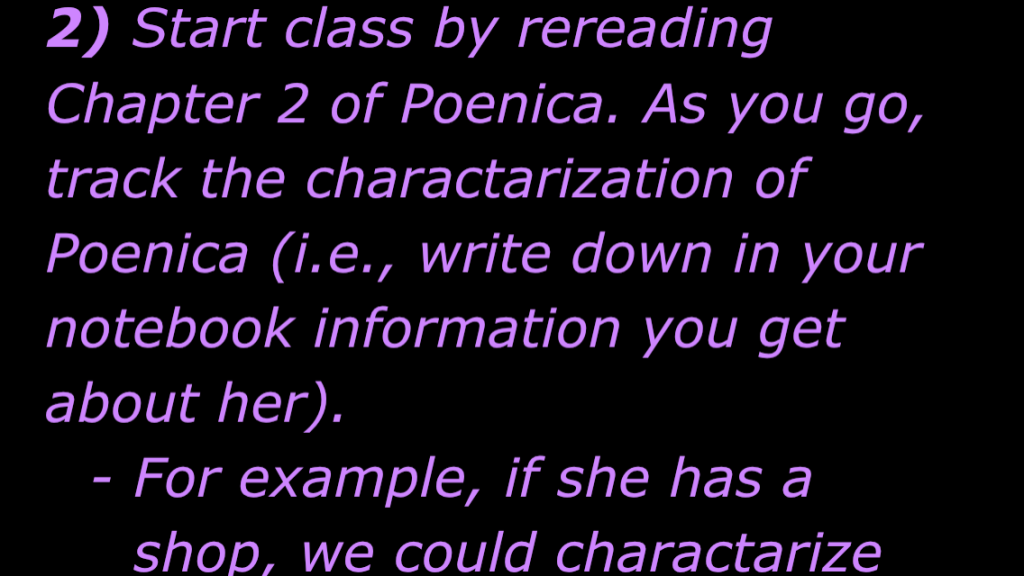

This was not an easy task. Students really had to think beyond the statements. For example, classes thought Poenica must be determined since she immigrated, has her own shop, and already dyed many togas purple. This was a very straightforward task that engaged students in all that higher-order thinking gold.
My thoughts have wondered further. What are some other ELA teacher reading tasks that I could now implement in my own classes when reading novellas (vs. translating passages)?
The Inequity Absurdity
Consider this a double feature hot off yesterday’s Annual Criticism of Latin, or ACL, report. Why another? I was reminded of a toxic idea floating around that the use of cognates is inequitable. This is absurd.
Reality:
- Cognates increase (*increase, not guarantee) the likelihood that students will understand the Latin, especially ones most obvious and familiar in English.
- Students with broader English vocab have a higher likelihood of understanding cognates (*higher, not guaranteed), especially the less familiar ones.
- Students who don’t have as broad English vocab or who don’t recognize the word in the moment will just see one more Latin word.
This is not inequity.
Continue reading Magister P.