Competitive Input Activity: English Quadrant Word Race

You might have caught my variation on Martina Bex’s Word Race. While students certainly were hearing more target language, there were too many that went by too quickly while reading with enough repetition for the novice. Well, here’s an update that reaaaaaally gets students listening to the target language in a more structured, less-harried way:

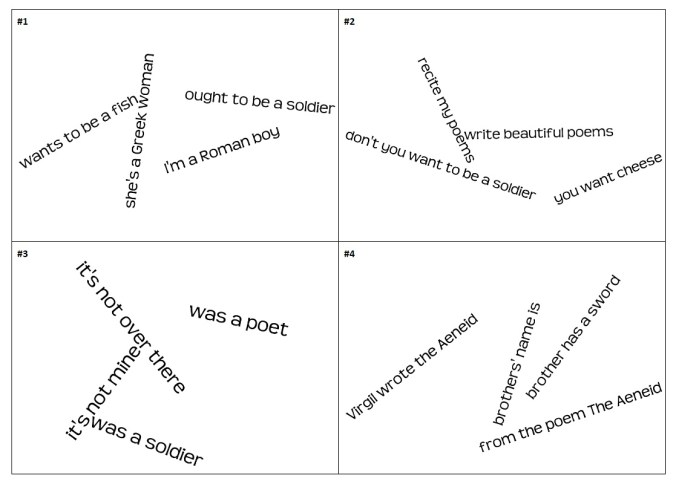
english-quadrant

  • Instead of one large word cloud with many English phrases from the text, create 4 smaller ones that each contain one true phrase from the text, and three other phrases. I’ve been doing 1 funny phrase, 2 possible phrases, and the 1 from the text itself.
  • You still read the text out loud as usual.
  • After the victory dance (i.e. when the faster student is first to circle/highlight the phrase they hear), announce the next quadrant so that students know to listen for the next set of phrases, and begin reading where you left off. This avoids the pacing issue of students listening for many phrases on one large word cloud, and also gives a “reset” moment to the game.

Here’s a link to the a full size template. To use it, Make a Copy to your Drive, create 4 word clouds using Wordle.net (using Mozilla Firefox, NOT Chrome), save the word cloud files, then past them into each quadrant.


“Teaching with CI”

I took a cue from Eric Herman and just updated my blog tagline and email signature. Yes, I dropped “teaching with CI,” not because I’ve done a 180 after ACTFL, but because it doesn’t necessarily distinguish our teaching the way it could. “Teaching with CI” is still a good term that has brought like-minded educators together, but most teachers are confused enough over the role of input in Second Language Acquisition (SLA) such that a different way of expressing what we do might be beneficial for all.

Bob Patrick has been saying for a while that most teachers end up providing at least some comprehensible input (CI) even if they have no clue it’s happening. I agree. As long as students understand what they listen to and/or read, they’re getting CI. So, if a grammar-translation teacher can provide CI, even just sometimes, well then I don’t really want to use a term that aligns myself with that pedagogy.

The big difference between providing CI by chance, and knowingly providing CI is attention to the “C.” It’s usually that “C” (along with the “C” for Compelling) which make the difference between a positive and negative language class experience for our students, and certainly the difference between acquisition, and low vs. high proficiency. Our classrooms are different from most language teachers because we focus on making the target language more comprehensible using various techniques, and strategies. This makes the target language more accessible, which leads to acquisition, and also promotes an inclusive classroom environment. That’s really what teachers seem to mean when using the term “teaching with CI,” so we might as well clearly express what we actually do. We make languages more comprehensible for learners, and not every language teacher can say that.

Teaching for Acquisition
Making Languages More Comprehensible

A Definition of “Output” from BVP

“Output is when students, or language learners actually use language to create a message of their own, from scratch.”

Yep, that would rule-out Sentence Frames (e.g. My favorite food is _____), and any other scaffolding when it comes time to creating a message. The result is “traditional language practice” which has not been shown to lead to acquisition. A single genuine utterance (e.g. “pizza”) as part of a communicative event (e.g. “Charles, what’s your favorite food?”) is more beneficial in the long run.

Continue reading

One Word Image/Picture/Drawing

This is probably the most effective no-prep activity you should become familiar with:

1) Say or ask for one(1) word.
2) Draw it on the board (or have the Class Artist draw it).
3) Ask about it, and add details to the image.

I’m never at a loss for what to add because I rely on my Question Word Posters as reference to drive the image. Looking at the posters around my board, I usually just ask questions in order and get corresponding supporting details without planning a single thing. Here’s an example that began with a single word, fūr (thief)…

Where? = The thief is in Starbucks
From Where? = Lived in Spain
To Where? = Wants to go to Peet’s Coffee in Berkeley, not Cambridge
What? = Has a gladius (Roman sword)
Who? = The thief’s name is Tom
Whose? = The gladius is actually the Starbucks barista’s gladius
When? = It’s night time
Whom? = The thief sees someone with a better, bigger gladius
With Whom? = Donald Trump (obviously!)
To Whom? = The Starbucks barista gives a coffee to Donald Trump
How? = The thief has the gladius because he stole it from the Starbucks barista
How many? = Actually, the Tom the Thief has 7 gladiī—one from each Starbucks in Starbucksville
What sort of? = Tom is actually a bad thief…the Starbucks barista saw him steal the gladius
Why? = Donald Trump is there because he wants to buy all the Starbucks’

Note how some of the details don’t connect (e.g. there is another person with a sword but doesn’t get mentioned again), but realize that they don’t have to. We’re just creating an image, not any kind of plot. Also note, however, how easily this COULD turn into a prompt for a Timed Write, or a Storyasking session, especially given the image we’ve established as a class.

Input & Interaction: Tea with BVP 10.20.16

Listen to highlights from the latest show for more on these Second Language Acquisition (SLA) takeaways.

There are two main camps, and one outlier when it comes to the role of Input and Interaction in SLA. Both assume Input is necessary. However, there are those who believe…

1) Interaction is absolutely necessary in addition to Input.
2) Interaction is beneficial, but not necessary.
3) Interaction isn’t beneficial at all (very few believe this).

A good place to start is defining Interaction, which Bill gave us as “NOT forced speech, but 2+ people demonstrating that they are involved in meaning making (e.g. speaking, facial/eye expression, nodding, other gesturing, etc.)”

A caller brought up the point that Interaction between the teacher and students is under scrutiny by those looking for students to do more of the communicating. After all, it certainly “looks” like lecturing, but Bill’s Principle #2 of a definition for communication (i.e. interpretation, negotiation, and expression of meaning in a given context) supports the process of a teacher expressing ideas to students who interpret those ideas is, most certainly, communication! Bill’s best advice is to “talk with, not talk at” your students. He further warns “if you say 2+ sentences without involving students, you’re doing something wrong.” I see this play out well when teachers circle tactfully. The teachers asks many questions and repeats student answers in order to increase exposure to input, but the students are involved and interacting. I see this play out not-so-well when teachers frequently restart a story from the beginning, or continuously retell the events without new ideas or questions with new information. So, 2+ sentences, then checking in with students is a GOOD strategy.

So, where does Bill stand on the role of Interaction? When learners signal that input is NOT comprehensible, their interaction leads to more comprehensible input, but clarification and negotiation are not needed all the time. Like Stephen Krashen and authors of Angelika’s quote,  Bill agrees that the role of Interaction does not CAUSE acquisition, but it can be beneficial, placing him in camp #2.


High-Frequency: a Concept, not Stats

Recently, John Piazza reminded me of Bill VanPatten’s definition of high-frequency vocabulary as “vocabulary used often in a particular context.”

The classroom context is very important. I can tell you that pater, though the 84th most frequent Latin word (according to Logeion), doesn’t come up much in my classes. You know what does? saccus pyraulocinēticus, meaning “jet pack.” Honestly, I don’t blame kids for finding a reason to sneak that into class, and I don’t mind one bit because a) we can show how Latin works with saccus pyraulocinēticus just as much as we can pater, and b) because it’s pure buy-in that makes Latin class fun.

The high-frequency lists are useful, but don’t forget that those lists are based on literature. Realize, then, that most of your students, if not nearly all, will NEVER read Latin literature. If your class is truly communicative, vocabulary used in your room each day will be relevant to students and their interests. Once you move beyond the Quaint Quīntum, Awesome Octō, Sweet Sēdecim, Top 32, Most Important 52, etc., the “high-frequency list” words you CHOOSE to use in class might be in vain, especially if they aren’t compelling, or worse, somehow causing grief in an effort to “get through” or “cover” words that appear in X, Y, and or Z.

2016-17 DEA

**See this post for all other grading schemes*

In its current form, there are only 3 agreements as part of the Daily Engagement Agreements (DEA), which are to Look, Listen, and Ask. Older versions of DEA had many more, but the 0% Portfolio grading category I now include Powerschool takes care of assignments previously covered under “Be Prepared,” and anything else I need to keep track of.  There’s no need for “No English” because “Listen” covers that. There’s no need for posture agreements because “Look” covers that. Last week a student was lying down between two chairs yet could read the board and was responding with the entire class. This kid understood Latin and was participating…he was just tired. An older system would have made that an issue when there wasn’t an issue. For me, DEA is super streamlined at this point, which means super clear for DAPS (department heads, admin, parents, students).

In terms of weighting, I ended up using last year’s sliding scale idea. Previously, I’ve written how my DEA weight had been anywhere from 0% to 50% of the grade. Colleagues at my new school liked the new sliding scale, but were a little uncomfortable with the 100/0 and 0/100 percentages at the start and end of the year. No problem. After a simple edit, the scale does slide, but at a 90/10, and 10/90 split to include at least a little bit of both DEA and Proficiency. I like this one because DEA now holds most of the weight for half the year, and is equal to Proficiency in 3rd quarter. After all, if students are Looking, Listening, and Asking when they don’t understand, they’ll acquire enough language to “understand most of what they hear and read,” which is honestly the most realistic expectation we could have, and is reflected in that 90% Proficiency weight in June.

N.B. if, somehow, students don’t Look, Listen, or Ask and STILL understand, just don’t take off DEA points!

Quarter 1
DEA = 90%
Proficiency = 10%

Quarter 2
DEA = 75%
Proficiency = 25%

Quarter 3
DEA = 50%
Proficiency = 50%

Quarter 4
DEA = 10%
Proficiency = 90%


Lingua Latīna: LOVE the textbook, but is it right for my students?

No.

Lingua Latīna per sē Illustrāta (LLPSI), the Latin textbook entirely in Latin, has a cult following. I understand the appeal. Personally, I love it, and am currently rereading it for the nth time. Still, I’m wary whenever people suggest LLPSI as the panacea to common pedagogical problems, or assume it’s the most appropriate resource to use when teaching Latin communicatively. Again, I understand, but LLPSI is still a textbook, and comes with every downside of using a textbook to teach communicatively.

Continue reading