The Role of Output: VanPatten

On Episode 8 of Tea with BvP (here, edited down to 13 minutes), Bill made the claim that if Input drives the car of acquisition, Output is in the backseat. He went on to say that you could make Swain happy by saying that Output is riding shotgun, but still not in control.

Bill also said the following:

“One role of Output is to help people get more Input…when you make some kind of Output people can judge…people actually speak to you at the level they perceive you to be at, which gives you better Input for yourself.”

Continue reading

Error Traps: Why students CAN’T make errors in classes with Acquisition as the goal.

In one of Bill VanPatten’s latest Tea with BvP episodes (which I’ve edited down to only his responses, see the CI Materials page for past edited episodes), he talked about how there are no errors when it comes to the expression, interpretation, and negotiation of meaning of our students, at least in terms of language acquisition. What we hear/read from students is a consistent representation of how they’ve construction the second language system in their mind. It is what it is, and there are very few factors besides time and comprehensible input. Thus, there are no errors.

This has HUGE implications for language teaching. Take the following comparison…

Continue reading

Tiny Fluency Writes

Q. What’s worse than thinking you can’t write a lot of Spanish?

A. Feeling bad about it because you’re given a ton of writing space.

Here’s new Fluency Write paper for Timed Writes, Free Writes, Speed Writes, etc., with Novice language learners in mind, particularly those in middle school. There’s still enough space for a fast processor to flip the page and write up to 110 words, but no so much that a slow processor leaves class with a crummy sense of low self-efficacy. Plus, you get 2 Fluency Write papers from every 8.5 x 11 double-sided sheet.

(Front)

fluency 1

(Back)fluency 2

Proficiency Grading FAQs, and New Rubric Option

**Updated Expectations Rubric**

I’ve had many questions when it comes to implementing my complete grading system, or proficiency rubrics independently from DEA. As a result, you’ll find minor adjustments in their appearance, as well as a few changes that highlight the FAQs.

Proficiency Goal Rubrics
Independent Rubrics (when NOT used in complete grading system along with DEA)
Simplified Rubrics (for exploratory, middle school, or less-prescribed high school programs)

Continue reading

Discipulus Illustris: Those Quizzes

**Read about DISCIPVLVS ILLVSTRIS, and Sabrina’s variation for some context**

Should we assess what students remember about their classmates, or should we assess whether students understand Latin?

Although the former has social benefits, let’s face it…we use student details as our understandable messages in Latin. It’s great to know that Johnny’s birthday is in April, but it’s better to be able to read and understand all of the Latin used to express that detail. Inspired by a brilliant new tweak to Ben Slavic’s Quick Quizzes, I’ll be making the following changes:

Continue reading

CI Online: Conclusion

As I reflect a bit, my experience with Teaching CI Online was fine. The obvious physical barrier you would expect to be an issue didn’t actually impede much of anything. CI Online is absolutely possible. One major drawback was lack of reliable internet. On bad days, we just didn’t have class. Occasionally, I had to mute all microphones or disable cameras because of taxed bandwidth at a particular school. That was not cool for checking comprehension, teaching to the eyes, and making connections. If a school was prepared, there were no problems.

Continue reading

Grade [Spin]Doctors: Playing by our School’s Rules

A colleague (let’s just say that there are some who call him……Tim?) asked about using my Grading & Assessment materials and how to make them work for him. I’ve written about a complete overhaul, as well as what to do when you have certain grading categories imposed, but Tim’s situation was different. He was prepared to go full-MagisterP-Grading of only Proficiency and DEA, but had a grading weight scheme imposed upon him of 70/30 (i.e. 70% Summative, and 30% Formative). I won’t discuss how arbitrary these numbers are, or even use the word asinine to criticize such a policy (especially when it comes to language acquisition), but it is what it is for Tim. Let’s look at an option I presented to him…

Continue reading

Curriculum Vocābulōrum: A Contextualized Classroom Game

**Updated English Quadrant Word Race to improve gameplay** 

This is my take on Martina Bex’s Word Race. I consider our activities to be evolved versions of “flyswatter” games that now align more closely to Second Language Acquisition principles. Skip to Martina’s process if you’re unfamiliar with it, then come back to read about my Curriculum Vocābulōrum Variation:

Continue reading

Parallel Characters: Not just in stories

Earlier this week, the following slide during DISCIPVLVS ILLVSTRIS was a huge hit:
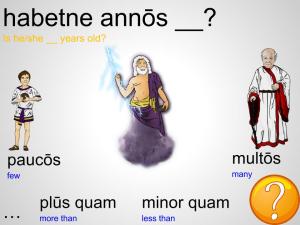
DISCIPVLVS ILLVSTRIS Screenshot

The 3 dots on the lower left link to a slide with a bunch of numbers, but my students already understood the interviewed student’s response of quīndecim as 15, so I began using the images and phrases to ask different questions to verify the detail. I almost got stuck when I asked “is he older than…” while pointing to the senex (old man). Instead, I kept my finger where it was, and asked the class “what is HIS name? What is HE called?” One student quickly said “Frank.” Now I was free to use “is he (our interviewed student) older than Frank?” Then I looked over at the Roman boy on the other side of the slide and asked “what is HIS name? What is HE called?” The class looked at the same student who answered before, who said “Phil,” which was great, so I said “Ohhhhhh, how old is Phil?” The same student thought a minute, and said “8.” So, we continued using the four phrases on the board (all using “habet”) and got quite a bit of mileage out of that one.

Continue reading

Discipulus Illustris: Updated Materials and Variation

**See a  more recent post with some changes to the Quizzes**

Last week at TCI Maine ’15, Sabrina Janczak discussed and demoed Star of the Week, her process for student interviews. Although I first discovered a practical interview process from Bryce Hedstrom’s, word has it that original credit goes to Jody Noble, along with Krashen’s 1983 The Natural Approach as a source for conducting “personal interviews” in the classroom (thanks to Eric Herman and Ben Slavic for those clarifications). Before I discuss Sabrina’s process, let me state that no CI classroom should be without some variation of this year-long activity. We often talk about not being prescriptive, but this is too important to overlook. I’m not suggesting that you do this, and neither is Shia Labeouf. Make time in your schedule, and you will be amazed at the positive change in class culture/environment, and increase in student language production. YES, spontaneous language production by June is not out of the question.

Continue reading