The total running time for this audiobook is about 20 minutes, meaning you could listen to the whole book in one go, then do some follow up activity, such as comparing this prequel to nox horrifica if students have read that one already. We’ll be doing that next week for an off-season thriller filler, perfectly timed for dealing with end-of-year testing madness that makes consistency this time of year quite difficult. In other words, more one-off activities are needed. I’ll add a listening challenge to listen for meaning, then look at the book and check for any pictures, footnotes, and/or clarification as we go. The narration is slower and has enough pauses to do so. The idea is that since my first year Latin students are well-beyond this book’s level, the additional task of purely listening (but having support if needed) should bring the activity up to “their speed.”
So, this audiobook is available on Bandcamp. If you’re not familiar with that site, it’s basically a donation-based way of musicians getting their music to fans. There’s a suggested cost, usually much lower than its value, so fans can choose to throw a few more dollars towards the musicians if they want to support them a bit more. One great feature is that you can stream the tracks a few times before Bandcamp gets sad. That means students can listen to this Latin without any cost to them whatsoever! For use in class, though, you might want to have the audio downloaded so you always have files ready to queue up. Enjoy!
**Update 7.20.23 – This post was SOMEHOW deleted and nowhere in my trash folder?! I’m guessing it occurred when WordPress updated to the JetPack app. I know, you don’t care, but I Just wanted to say that I found the post in its ENTIRETY using the Wayback Machine. Here it is if you wanna see!**
When the draft of the new revised AP Latin course was released, I simultaneously couldn’t care less yet was also amazingly intrigued. So, I did another analysis like the one a few years ago. In short, the good news is that 1) the total amount of Latin has been reduced by about 25%, 2) quite a bit of “OTHER” Latin has been suggested as comprising a third of the overall syllabus alongside Virgil & Pliny, and 3) the revised course has been officially recognized as a second year college equivalent. Now, the bad news…
The Same The revised course is fundamentally the same. While the draft name-drops the trending “language acquisition” phrase, the core texts are still very, very far above the reading level of nearly every student who will take AP Latin. This, in no way, is a tenet of language acquisition, whatsoever. Even methods and theories encouraging a “productive struggle” would draw the line well before anything like Vergil & Pliny after a few years of a new language. Beyond that, most high school students have no business taking a second year college course, anyway. BuT Ap Is AdVaNcEd,RiGhT?! Sure. The problem, though, is all the schools that choose AP as their program capstone without any other option, weeding out kids who “can’t cut it,” and/or backwards designing the whole program down to freshmen year (or lower for “feeder” middle school programs). When AP is used this way—which is very common—most students are denied a senior year language experience, or are unnecessarily forced to struggle through the content.
Core TextVocab The revised Vergil & Pliny selections vocab comes to:
5,500 total words in length
3,500 forms (i.e. aberant + abest = 2)
1,800 meanings/lemmas (i.e. aberant + abest = 1 meaning of “awayness”)*
This particular Vergil & Pliny content not as bad as the current Vergil & Caesar content (i.e., down from 11,700 total words in length, 5,700 forms, and 2,600 total meanings/lemmas). Progress, right? But still nowhere close to what typical students have acquired by senior year. Using the same generous figure of seniors knowing 750 words by the time they begin AP coursework, there’s still more unknown than known vocab. Like, way more (i.e., 1050 unknown words of Vergil & Pliny remain!!). The AP draft also states that “the focus of the course is continued Latin language acquisition with the inclusion of some textual analysis and contextualization skills.” Uh…some…analysis and contextualization skills?! If the focus were actually on acquisition, students would be reading a LOT. To be clear, students still won’t be reading this kind of Latin. To truly “read” these texts, students would need to understand 98% of the Vergil & Pliny selections to have a chance at comprehending what’s going on (see Text Coverage). That ain’t gonna happen. But there’s more, and it might be worse…
The stats so far represent just 65% of the AP syllabus content!
Teacher Choice The AP draft outlines setting aside about 1350 total words of poetry and 1650 total words of prose, all of the teacher’s choosing. This constitutes a third of the revised course content aside from Vergil & Pliny. Now, for this analysis, I got lucky with randomly choosing the recommended Ovid passages from Metamorphoses (i.e., 1450 words), and the Ciceronian letters (i.e., EXACTLY 1650 words). When we add these texts to the core Virgil & Pliny, unfortunately, we get a chart that basically mirrors the current AP one:
While the 2025 AP draft shows the total amount of Latin being reduced by about 25%, it turns out that the vocab difference is only about 4% less (i.e., 2600 total words currently vs. 2300). Progress…right? Here are a few different charts to help visualize all that:
Wildcard Yet I chose Ovid & Cicero. The big wildcard is Teacher’s Choice portion of the AP syllabus. Surely, the impact of choosing text Y or author Z will vary, yet by how much? I was curious about that impact, but I do have a day job, other hobbies, and Ph.D. coursework to do. Rather than look at multiple combinations of poetry and prose, perhaps looking for the most extreme outcomes, I kept Ovid and replaced the Cicero letters with different prose selections amounting to ~1650 words of Latin to see what came up.
Starting with Sallust (Bellum Catilinae,, 5-15), the results were pretty close with just 10 more words added given all the vocab in common with Vergil, Pliny, and Ovid. Next, I pieced together an assortment of Gellius’ Vestal passage in Noctes Atticae (1.12), Eutropius’ founding of Rome in Breviarium Historiae Romanae (1.1-8), and the first five characters of Hyginus’ Fabulae. After all, the stated point of including this “OTHER” Latin is for encouraging teachers “to explore Latin texts from different time periods written by a variety of authors.” The difference between using this assortment of selections instead of Cicero wasn’t staggeringly worse. Then again, it did add about 50 more unique words, increasing those vocab demands, now coming within 200 words of the current AP syllabus!. The point? The Teacher’s Choice portion—a third of the AP syllabus—has the potential to meet (surpass?) the vocab demands of the current AP!
In sum, the revised AP course seems to be an all-too-common case in education: making progress in some areas yet ultimately falling short of addressing a fundamental problem. The 2025 AP is basically the same old thing (i.e., vocab demands are very close to the current AP with just ~4% fewer words) wrapped up in new packaging. I’m sure it will appeal to more teachers, but it doesn’t seem to deliver much else in terms of pedagogical improvements besides reduced workload and a tip of a hat to everyone reading “OTHER” Latin. So, maybe 2035 draft will be promising? I’ll be long gone from the classroom by then. Best of luck to everyone out there!
*Once again, for this analysis mostly done via Voyant Tools & Google Sheets, I rounded to the nearest 100, in the AP’s favor. Errors are unlikely to change things remarkably, and in all likelihood the situation is a little worse than what you see.
Quintus is a gamester who really likes to gamble. The problem? He’s terribly unlucky and never wins! In this tale, Quintus gets himself into a dicey situation, betting all sorts of valuables he can’t afford to lose. Will he come out on top, or lose it all in the end?
16 cognates, 34 other words 840 total length
This is my third novellula written to be short, very much on purpose. Since Latin novellas first started popping up, teachers have noted that the whole-class reading experience can drag on for beginners. I’ve been finding that books under 1,000 total words seem best for a quick read at the start of Latin 1. This new tale is about gaming! I grabbed some dice-cups, dice, and knucklebones online to play as we read the book. Give it a try. Enjoy!
In the original draft of this post, I compared two data sets of students taking the ALIRA. However, I’m not really comfortable publishing that. I really don’t need anyone trying to play the victim when it’s been me going on a decade now defending my teaching practices and the kind of Latin that I read (and write) with students. It’s too bad, too, because the data are quite compelling. Some day, I’ll share the charts. Until then, you’ll have to take my word on it. You probably already know that I don’t fuck around, either, so my word is solid.
In short, the charts will contradict the claim that reading non-Classical Latin leaves students unprepared for reading Classical Latin. They will suggest that reading non-Classical Latin texts, such as those rife with Cognates & Latinglish via class texts and novellas, is of no disadvantage. They will also suggest that reading Classical texts is of no advantage. That’s all I’m prepared to share, for now.
Once a lot more data like these will be presented, though, the jury will start to come in on the matter of what kind of Latin prepares students for any other Latin. From what I’ve seen so far, it looks like A LOT of any Latin can prepare students to read other Latin, and that’s a good thing. These emerging data show that concerns and claims over certain kinds of Latin don’t play out in reality. Still, it’d be good to have more scores, not just the 532 ones currently submitted to that ALIRA form. If this all seems mysterious, it kind of has been. I haven’t shared the spreadsheet yet for viewing. That changes today!
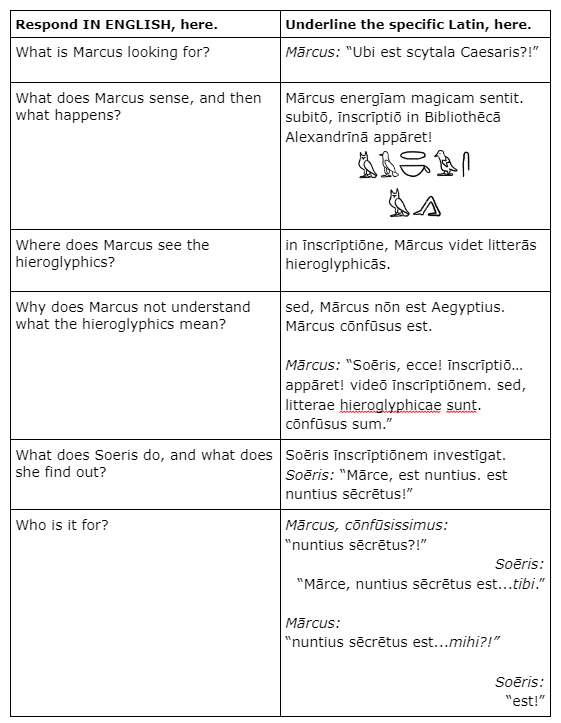
At CANE’s Annual Meeting last week, Bethany Sawyer shared a reading comprehension strategy “in chart form” that I’m calling Table Qs. This EZ format breaks up a text while giving students something specific to do while reading that focuses their attention. I think of this as giving students’ minds a job to do. When I brought this idea to our Director of Curriculum & Instruction, she (also an ELA teacher) found it similar to when they first do annotations. Instead of just “hey, annotate,” there’s always an “annotate for ____” prompt to guide students. It follows, then, that a “hey, read” prompt very well might result in students looking at the text, and maybe registering certain words, but something short of processing the Latin and really comprehending. Table Qs is one support for that. This kind of structure is also a great example of schoolifying CI. In short, students answer a question in the left column, underlining/highlighting its Latin in the right column. All you gotta do is drop text into a Doc, and make some Qs.
The key?
Don’t make obvious questions that allow students to avoid reading altogether! That would defeat the whole purpose. While it took me about 15 minutes to put a front/back Table Q page together, I’d consider it wasted time if all students were to do would be skimming the Latin to answer a question. While making these Qs is certainly a skill, consider rephrasing ones that call for a single word that’s basically already given in the question. Also consider avoiding “who?” Qs when there’s only one proper noun in the selected text. If that’s the case, at least add a follow up (e.g., “who ____ and then what do they do?”).
Check out the fourth Q in the screenshot below. That could’ve been “Marcus is what?” or “Is Marcus confused?” However, the Q allows for a number of responses that all indicate comprehension, such as “he’s not Egyptian” or “he doesn’t know hieroglyphics,” and encourages reading the whole segment (i.e., NOT just picking out only the Latin needed to answer a poorly formed Q). As a confirmation of understanding and to support their answer, students underline (or highlight if a digital Google Doc) the specific Latin. The following screenshot is from the second chapter of Mārcus et scytala Caesaris:
Here are some common numbers floating around the language teaching world, their misinterpretations, and some clarifications to go with each one:
90% This figure comes from an ACTFL position statement on target language use. The biggest misinterpretation I’ve seen is thinking something like students should be speaking the target language 90% of the time. The 90% figure is actually about percentage OF language during class that IS the target language. For example, if you’re reading a 100% Latin text during class and ask SOME questions about it 100% in English, it’s quite possible that target language use is still above 90% (e.g., students read 1,000 total words of Latin and hear 100 words of English questions = 90% target language use). Students need input. This 90% figure is an attempt to prioritize high quantities of language. The alternative to avoid would be something like doing a close reading on a short paragraph of Latin with the discussion entirely in English, perhaps resulting in the opposite 10% target language use, which was quite common in the teaching of languages prior to ACTFL’s statement. Somehow, you’ll still find such low levels of target language use today, despite ACTFL’s efforts back in 2010. N.B. if you do a general search, some ACTFL page might come up that contradicts their original 2010 statement, referring explicitly to class time. It also name-drops Krashen, pointlessly throws in the i+1 concept that itself became misunderstood, cites Vygotsky in some kind of weird sociocultural nod, and ends with an obligatory reference to Long & Swain’s work on output theory. This hodgepodge of ideas is startling, but probably represents how ACTFL tends to remain as NEUTRAL as possible, taking bits and pieces from way too many popular ideas and approaches as if it makes sense to combine them all. Don’t fall into that trap. Follow principles that you know align with each other and don’t conflict!
95% See 98%, below.
96% Perhaps more commonly known as “4%,” the figure of 96% represents the students who typically do NOT continue beyond the second year of language study, here in the US, with the dominant paradigm having been grammar-based teaching. Although programs have been moving to comprehension-based, and/or communicative approaches, it’s still possible that the 4% figure represents some programs today, though the origin dates back to a 1969 speech, detailed in this post. A common misinterpretation has been to claim that individual “4%ers” are the only students capable of learning a language via grammar-translation (GT). This is untrue. The “4%ers” are simply those who tend to stay enrolled. Recently, I’ve argued they represent the pedagogically immune.
98% I’ve seen this (as well as 95%, and even 90% in some cases) shared as “minimum comprehension level” that students should have when reading. This figure actually represents recommended minimum text coverage while reading. It’s from various studies, detailed in this post. In short, a text coverage as high as 98% has been shown to produce comprehension scores as low as 70%. That’s not incredibly good. Also from the studies, a text coverage of 95% produced scores as low as 55%! You don’t want to know what the scores were for 80%!
100% I’ve heard people say that knowing 100% of words means a text will be 100% understandable. That’s not true (see above). In an age of promoting “productive struggle” and “grit,” the accusation is that a 100% understandable text is undesirable because students will somehow not get their +1 level to their i (again, see this post on that whole concept demystified). This is most definitely untrue. Even when comprehension is 100% there are aspects of language (e.g., word order, forms, etc.) that can still be learned. Given what is known about text coverage, there’s very little justification for using target language students don’t know, like above-level texts. Therefore, the 100% figure should be a goal for text coverage or known vocab.
I’ve written about sneaky quizzes in the past. Originally, they were intended to get a grade for the gradebook (I had not discovered ungrading) while being another source of input. I called them “quick quizzes,” rebranded as “comprehension checks,” and then went back. Call them whatever you like. This update is a new way to go about them, scaled to whatever you need, like breaking up a long class with a 5-minute quiz, or adding group collaboration to get a 20-minute activity. In a nutshell:
Collect quiz content from each student.
Use those for the quiz.
Go over the quiz.
About quizzes…I haven’t been putting a single score on anything this whole year, and I’m not going back. If you do, though, have students score their own work. I also haven’t assigned any specific work to turn in this whole year (see portfolios), and I’m not going back. If you do have specific assignments students are expected to turn in, though, report these scores in the gradebook like you would anything else. Here’s more detail…
As part of “schoolifying CI,” here are two more follow-up activities in addition to Read & Summarize and the ole’ standby, Read & Translate:
Read & React(or Listen & React) Students react to narrative events. You could choose a variety of prompts, having students respond to a certain number, etc. based on your class needs. Here’s a selection from Novella Month, which for me is now going to end the school year instead of occupying the February weeks before break. I’ve selected 5-8 of these, and given “respond to 2” etc. instructions depending on scope of text and time:
What could make the story better for you? Is there anything missing?
What other story does this remind you of? How did that connection help you understand the story better?
How are you alike, or different from any of the characters in the story?
How does this story make you feel? When have you felt that way in your life?
What is a message, or lesson in this story? Could it help you, personally, in life?
What can you figure out that isn’t directly in the book? What clues did you use to figure that out?
Why do you think the character(s) acted the way they did?
What do the character'(s)’ choices, or actions tell you about them?
What is the mood, or tone of this story? What makes you say that?
How did the character(s) change during the story?
What traits do the character(s) have? What clues in the story make you believe that?
What questions do you still have? What are you wondering? What would you like to know more about?
What would you like to ask one of the characters?
If you were to reread this, what would you be trying to figure out the second time?
What are the most important parts of the story [so far]?
What do you want to remember after reading this story?
Read & Reflect Unlike responding to prompts about the narrative, this reflection focuses on the reading experience itself:
Describe how easy or hard it felt to read the text. Why do you think it felt that way? What was it about the text or your reading that made it easier or harder for you?
How many times do you think you flipped to the glossary in the back?
Did you look up the same word more than once?
Which kinds of words do you think you looked up the most? Were they names of places? Were they tiny words that can’t really be drawn, like the word “however?” Were they shorter words? Longer? Actions? Descriptions?
What might be a way that today’s reading has made you a better reader? Is your mind making new connections? Did it strengthen ones already formed? Did you notice anything different?
Were there any signs today that your reading has improved? What might they be?
Did you accomplish much during reading today? Why or why not? What might have caused that?
Listen & Reflect For listening, the prompts can be slightly different, recognizing that a lot of the experience is out of the student’s control (vs. reading):
Describe how easy or hard it was to listen and follow along in the text. Why do you think it felt that way? What was it that made it easier or harder for you?
How often did you have to skip reading words/phrases you didn’t understand in order to not get behind with the audio?
Did the same kind of unknown words come up more than once?
What might be a way that today’s listening has made you better at understanding Latin?
Were there any signs today that your understanding has improved? What might they be?
It’s all there. All the evidence that humans baaaaaaasically need to hear/view/read language (i.e., input) that they understand (i.e., comprehensible) is at this point un-questioned. N.B. While the second language acquisition (SLA) field has dropped the word “comprehensible,” now referring to “input” only, teachers are far more likely to identify these researched practices under the broad “CI” term. Bottom line, CI-based practices cannot be dismissed. They can’t really be expected to cause a stir anymore. Instead, it’s discussion involving a mix of opinion and research about “the X amount of Y beyond input” that causes a stir these days. However, let’s recognize the outcome of that discussion is not nearly as important as providing input. It’s not equal. It’s not even 3/4ths. Focusing on input gets us probably 90% there. Add some interaction and purpose for hearing/viewing/reading input, and that’s like 99%.
After a most terrible teaching experience (i.e., remote year 2020-21), I wrote about wanting to double my storytelling efforts for the next year. In 2021-22, it didn’t really happen, with us creating only 10 class stories total, all very short, amounting to something like 700 total words of Latin. Come this year, we made just four (about 300 total words) up until November. This is not much Latin at all, and I’ve come to question its value in my classes.
Besides, I don’t miss it one bit, not really enjoying the storytelling process as of late. Did I ever? Not sure. The learning curve for collaborative storytelling is real steep. It’s hard to tell what might have been productive struggle or just stressful struggle. I certainly loved being a student in storytelling demos—what a friend dubbed “Workshop CI”—but I can’t say for sure that I loved asking stories to a classroom of actual teenage kids who were neutral at best, but who usually couldn’t care less. I know I know, the key is to bank on interests and personalize and make class fun and memorable and make students forget they’re learning a language, blah, blah, blah, but that just doesn’t match my reality. It never has (though it was much closer when teaching middle school). Such a magical storyland context certainly exists for some teachers in some schools teaching some languages to some students. Not mine.
So, I’m getting rid of storytelling.
No worries, though. We have plenty of other activities, and plenty of texts since I began writing these for the absolute beginner. Granted, we still need MORE low level books for independent reading options, yet we’ve reached a point where the number of books exceed what could be read as a whole class for the year (which would be boring, anyway, only reading these books by just one author). In terms of novellas (and now novellulas Pīsō…& Quīntus…), we really do begin reading a book the first week. No need to wait until the spring. So, books are a significant part of class content. They’re anchors we use to explore Roman topics. Aside from those anchor texts, we actually have enough sometimes feels like content overload:
MovieTalk texts (do I even like playing and pausing these anymore instead of just watching then reading the text, either?! Hmm…)
I do, however, want to keep the idea of students-as-content. In my experience, this has helped build a safe learning environment and sense of belongingness right from day one of school. Our class stories were always based on something the student liked. Therefore, this new idea just eliminates the story…


 Magister P.