There’s plenty of talk about forced output (i.e. when students are told to produce language beyond their proficiency level), yet not much has been said regarding forced input. Forced input occurs when students are given a text above their reading level, or told to listen to something beyond their comprehension. Perhaps this is even assigned, and affects the course grade. Forced input also occurs when students are given or assigned anything that lacks a communicative purpose. Forced input is not very meaningful at best, and incomprehensible at worst, which means the target language is less likely to be processed and acquired. Are you forcing input? Let’s see…
Continue readingTeaching with Compelling CI
Doing Something Might Not Be Doing Anything
I’ve been thinking more about the topic of “doing work.” For example, students who don’t “do the work” could face profound consequences if that work accounts for the course grade, which it usually does. But what really *is* the work? Should students even be doing it? These are the kinds of questions seldom asked given daily demands, yet at the same time significantly affect what goes on during the day itself! Let’s investigate…
Continue readingUsing Videos: The Easiest MovieTalk, Clip Chat, wtv.
Don’t even pause the video.
Just use it to set up prior knowledge—what some might consider “pre-teaching”—before reading a text. Afterwards, students will have a bit of context from a 3-5min video clip so you can get to reading the story.
Of course, this changes the experience, but if you’re at all hesitant to provide input during a video, are running out of time, and/or want to focus on providing CI by reading, this is one way to do it.
All you need is a video, and a transcript or story based on it. There’s this database floating around for videos with universal content, but keep an eye out for language-specific videos and animations you could use while exploring the target culture. Some people have already created accompanying texts, but you could always watch, then co-create with students, or spend a planning period writing something on your own. If you find/have something existing, you could always create an additional tier, or embedded reading. N.B. Remember, you only have to create it once! I’ve been writing a new text every year or so to go along with videos collected over time. Here are many texts ready-to-go for Latin.
Discipulī et Magistrī Illustrēs: A Guessing Game
On Facebook, I shared my variation on the student interview program Discipulus Illustris (i.e. Special Person) of getting teacher colleagues to choose and answer questions that I put into Google Slides to play “guess the teacher” with classes. Given the size of our staff, I have every Tuesday covered for the rest of the year. Students have enjoyed the process, but they wanted more. Therefore, instead of conducting the typical student interviews on Thursdays, from this point onward, we’ll play “guess the student.”
Setting it up was easy. Last week, all students chose 5-10 questions to answer (from the list they, themselves, generated earlier in the year), and turned them in. I selected a few at random, and put them into Google Slides. I also assigned point values decreasing with each question, a bit like a Kahoot alternative, as well as 15 seconds between each slide. This game runs itself aside from teams guessing a student on the paper, writing the number (of points) shown on the slide at the time, and dropping it into a hat. This awards teams points that correctly guess the student the fastest, or who take the risk if unsure. I can do three each class, so three rounds of this game will be played each Thursday (until the end of school). Most points out of all three rounds wins.
Not Just A Team Building Game
This isn’t just a game. There’s input. I found it easy to type up student responses in Latin without vocab getting out of bounds. Where it would have, though, I just quoted the student’s response in English. I also removed the English support from the questions that appear on each slide, so students have 15 seconds in their group to process the input. Then, the response appears as they have 15 seconds to confer. In some cases, I took the class through a choral translation of the question, and/ore response. Everything is timed, so there’s a sense of urgency to earn the most points and win the game (i.e. communicative purpose is entertainment).
Adapting Latin: No Excuses & Every-Text Tier Challenge
I’ve been writing my next book on the zodiac signs and their associated myths for months now. Despite being intended for the beginning Latin learner, I thought each myth could use an additional, even simpler, version in the final book. Today, it took me only 7 minutes to adapt one of the myths—that I’ve been writing for months—to about 1/4 the length using fewer words. Every teacher can do this kind of thing. Every.
No excuses.
My Every-Text Tier Challenge goes out to all language teachers. To accept and claim honor after observing greater comprehension from students, just take tomorrow’s text—because there’s no good reason your students aren’t reading every day—and write a simplified version of it…right now. Don’t worry about changing formatting if it’s perfect for printing or something. You can project the simplified version tomorrow and read with students just before they read the original (as part of the simple Talk & Read daily lesson plan format). Oh, and does the text have some twists, or juicy details? Leave them out in the simplified version, and you’re on your way to creating an embedded reading.
Keep doing this for every text until you can adapt Latin (or whatever) so fast you don’t have to think about it. No excuses. “No time” is the usual excuse I hear for not doing this kind of thing, but that tends to come from teachers doing too much planning, quiz creating, and/or too much grading. Just do less of all that, and do more simplifying of texts.
Why Bother?
Bottom line, all students will benefit from reading a simple- to super-simple version of a text. There’s also a very good chance that particular students even need a text at a much lower level to truly receive CI (i.e. input that’s *actually* comprehensible, and not just partly- to incomprehensible input).
Oh, and if it takes you too long to adapt your Latin (or whatever), that’s a really good sign that the original text is too high level for students to read, anyway (i.e. also a sign that you need to be giving more comprehensible texts that provide more comprehensible input). So, I challenge you to the Every-Text Tier Challenge. Of course, there’s no need to share this work, especially with Latin shaming still lingering about, so it’s truly the honor system, here. However, I encourage you to discuss the process of simplifying texts in fōra varia, especially if you’re unsure where to begin, or have questions about this important strategy to make language more comprehensible.
Dante’s Circles Of Latin Shaming Hell
Instances of Latin shaming (i.e. causing one to feel ashamed or inadequate regarding their use of Latin) come up every now and then. I last pondered the issue back in August of 2019 in a draft of this post, first started in 2018 after observing some kind of online scuffle. Like clockwork, there have been public discussions once again regarding Latinity (i.e. quality of Latin), whether spoken in the classroom, or appearing in published works. To be clear, I have no interest in participating in those discussions. None. However, I’d like to share a bit about what’s been going on, and give some examples of Latin shaming…
Continue readingRejoinders: Teacher vs. Students
This year, I’ve begun each quarter by sharing new (or “new”) expectations. These are simple reminders of rules and routines expressed in a slightly different way to keep management tight. For example, Q2 featured “less English, more Latin” to address increased chatter from students becoming more comfortable. This week, I introduced Q3 with “mostly Latin, almost no English.” However, I still don’t require or expect students to speak Latin (i.e. forced output). Here’s how that works…
Continue readingAP Latin: There’s Bad News…And…Worse News
**Related: Revised AP Latin 2025**
I ran texts from the AP Latin syllabus through Voyant Tools:
- 6,300 total words in length
- 2,800 forms (i.e. aberant + abest = 2)
- 1,100 meanings/lemmas (i.e. aberant + abest = 1 meaning of “awayness”)*
Based on the research of Paul Nation (2000), 98% of vocabulary must be known in order to just…read…a text. According to Nation’s research, then, Latin students must know about 6,175 words they encounter in the text in order to read the AP syllabus texts. That’s a text written with 1,100 words. To put that into perspective, it’s been reported that students reasonably acquire ~175 Latin words per year, for a total of something more like 750 by the end of four high school years. Needless to say, there’s a low chance that all 750 would be included the Latin on the AP, and that varies from learner to learner. Even if they were, though, 750 is still only 68% of the vocabulary at best. Although this percentage isn’t the same as text coverage since it doesn’t account for how many of the 1,100 words repeat, it’s safe to say that the number isn’t going to be wildly higher. Even approaching 80% text coverage is not good. We know that reading starts to get very cumbersome below 80%. This is just one reason why no student can actually read AP Latin. Oh wait…
****Those figures are just for Caesar****
Continue readingDemonstrations: Providing Compelling Input
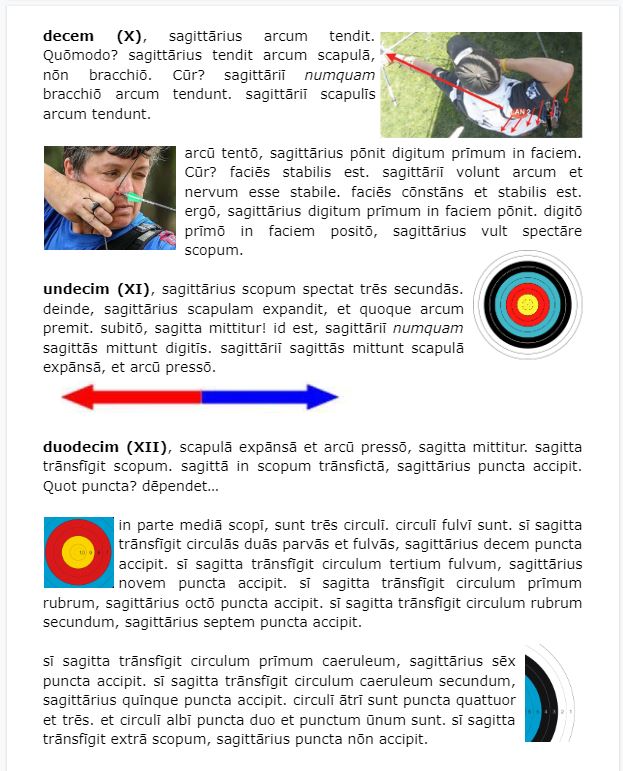

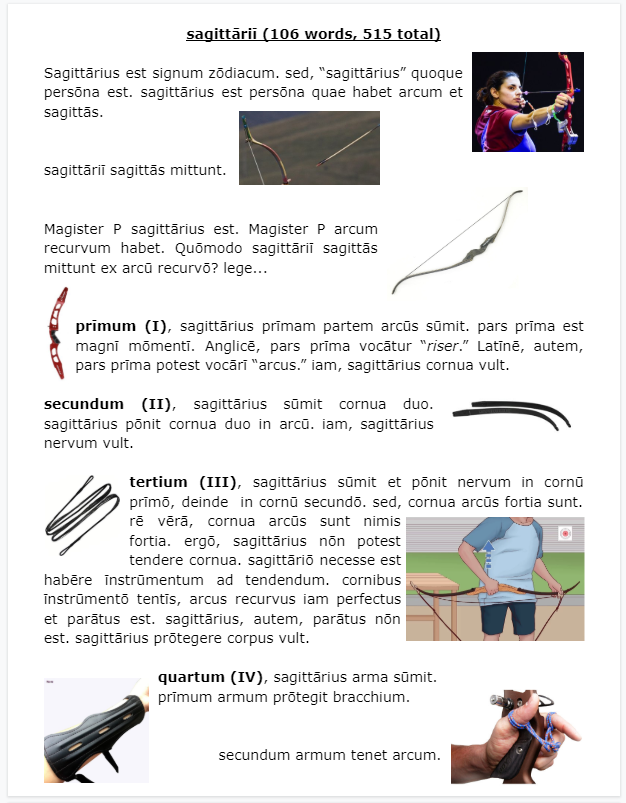
I’ve known that Krashen et al. suggested long ago that using Total Physical Response (TPR) to teach basic dance steps, martial arts, magic tricks, etc. results in compelling input. I’ve seen presenters talk about the idea of doing so, but haven’t really seen it much in classrooms. Now, I’ve performed one of Eric Herman’s magic tricks, but I didn’t really think I knew how to do anything that I could instruct students to do.
However, Tuesday was one of those perfect times to try something new during a weird day because the rest of the week was midterms. Since I got into archery this year, I decided to bring in my bow to demonstrate basic assembly, shot cycle, and target point values. Yes, I cleared this with security as well as admin, and no, I didn’t bring any arrows.
The experience was fantastic.
Students were captivated for a solid 45 minutes, and there’s no surprise why. Humans are naturally curious learners. It’s just that the school system has destroyed the joy of learning. If we can pause that “school feeling” for a moment, we bring back the joy. After my demo using common vocab, I projected a list of archery-specific phrases, and we co-created a quick text on archery. From there, I put together a more comprehensive packet. However, I wasn’t teaching words. I was teaching about archery. That’s the content.
In pedagogical terms, this is content-based instruction (CBI). Students asked a lot of questions about the bow. Why? It’s cool. In comparison, though, they didn’t ask as much about Roman apartment buildings last month. Why? That’s kind of boring, no matter how well we connect the content to their lives. Of course, exploring Roman content works the same way as exploring archery. It’s just that it takes someone with particular interests to get as excited about Romans. However, I’m not convinced that this should be either/or. I’ll both continue to explore Roman content (in Latin), as well as teach about other content (in Latin).
I’m now looking for other things to demo. Drumming might be one. After performing that card trick, I suppose I could teach it. In all of this, I’m reminded of how beneficial it is to include students in the demo process (e.g. distribute toy bows, drum sticks, decks of cards, etc.).
So, What could you teach your students?
The Latin Problem
According to the American Council on the Teaching of Foreign Languages (ACTFL), there’s a scale of five main proficiency levels: Novice, Intermediate, Advanced, Superior, and Distinguished. Most states require Advanced Low speaking proficiency to teach modern languages. However, many teachers attain near-native-like proficiency, anyway. To give you a sense of what that means, beyond Advanced Low, there’s still Advanced Mid, Advanced High, Superior, and then the highest rating on the ACTFL scale, Distinguished, for which the following are features:
“A non-native accent, a lack of a native-like economy of expression,* a limited control of deeply embedded cultural references, and/or an occasional isolated language error may still be present at this level.”
*economy of expression
“The use of the most precise and expressive words and phrases, thus eliminating the need for excess description, wordiness, jargon, or circumlocution.”
Of course, most of these teachers spend time abroad, and/or have found themselves exposed to the target language in some other way. Needless to say, modern language teachers tend to be highly proficient speakers, yet at the same time they’re not necessarily scholars who study the language, earning an M.A. in its literature. Granted, it’s not uncommon for modern language teachers to be that kind of scholar while also studying abroad and/or being exposed to input and interaction elsewhere. However, the former certainly isn’t necessary in order to achieve the latter. Then there’s the Latin problem…
Continue reading Magister P.