Something Strange…

Before I started teaching in 2013, I joined the moreTPRS Yahoo list serve. Then in 2015, I joined Ben Slavic’s PLC. At that time, there were daily—DAILY—conversations about Second Language Acquisition (SLA), with really tough questions being asked, answered, and debated ad nauseam. Then Tea With BVP was launched, with weekly shows until 2018—here are my clips down to the nuts & bolts. N.B. That show was rebooted in a different iteration as TalkinL2 until just about a year ago. Needless to say, I learned a great deal in those five years; far more, in fact, than in my MAT program (no offense, just a result of SLA expert-lacking faculty nationwide).

I cannot overstate this enough when I say that those early years were simply *crucial* in the development of what we all learned about SLA, and teaching languages. Furthermore, what we now know has also been around for like 10, 20, 30, even 40 years beforehand! That is, most scholarship in the last decades haven’t really changed the game of what’s been discussed since the 70s. The problem? This stuff wasn’t (isn’t?) mainstream—at all. That “golden age” of my SLA development involved the constant interaction with perhaps 200, maybe 300 teachers, almost all of whom I can reach out to with a click. I also had direct access to researchers, their ideas, as well as teachers implementing and arguing about what is, essentially, “best practice” for teaching languages in schools. When we didn’t understand, we emailed and got answers. And we were fringe. Having been exposed to the same ideas over and over—not just Krashen & VanPatten—thankfully from a variety of perspectives courtesy of Eric Herman, a solid understanding of universal truths (as much as we can call them that in the field of SLA) was being discussed.

Don’t get me wrong. There was a LOT of disequilibrium that nearly everyone had to face (e.g. “wait, so you’re saying that…”), and it was not without major headaches. After all, teachers’ worlds were literally being turned upside-down (no, I do mean literally like what you thought was the cause was just a result). Even the researchers’ ideas were challenged—by “mere” teachers no less—and fruitful discussion emerged, like when Carol Gaab demanded a concrete response about whether co-creating a story was a communicative act (i.e. had purpose). N.B. Yes, it is; entertainment. There was significant growth at that time, but it wasn’t all roses. We could call a spade a spade, or at least all come to agreement that a heart was definitely not a spade, and then talk about how to make that heart into a spade. Granted, this was within the fringe group of hundreds of teachers who had that shared experience, but there was definitely some kind of “tell me if what I’m talking about is complete nonsense” agreement. Whatever it was, it now feels like he heyday of theory to practice and critical looks at each others’ teaching.

Then…

Continue reading

Latin Students & Scholars

When looking at other not-Latin course curricula in schools, it occurred to me that Latin classes are typically taught as if all students will become Latin scholars. That’s kind of crazy. What’s even crazier? Most teachers don’t have the expectation that all, or even some of their students will become Latin scholars. However, it’s definitely how Latin has been taught, historically (re: goals not aligned with practices). Sure, some schools have the “honors” distinction, making other courses “college prep,” and a common goal of the K-12 system is to prepare students for college. However, does every subject prepare its students to be scholars of that subject before they get to college?

No way.

Let’s look at some examples. I asked my colleagues if a student could a) go on to study their content area’s major in college without taking additional electives beyond basic high school graduation requirements, or b) would they need that kind of boost to get into a program and become a scholar in the field? These were the responses:

Math
“That’s a great question. For the most part, the specialization or focus on math would occur in college. While it would definitely be beneficial for a student to have already taken Calculus or Statistics, AP or otherwise if they’re entering a math field, it’s not necessary. They would still be able to take those courses offered at the college level and pass, assuming they had gained the necessary prerequisite knowledge from their high school courses.”

Science
“In terms of jumping into a science major with little to no background, I think this is the case with the majority of students. They will certainly pick it up in college. YES – high school students could hypothetically have had no science and still become scientists.

ELA
“No typically they would just jump in with 100 level intro courses.”

So, high school courses provide the same level of understanding to both humanities-bound students and STEM-bound students, regardless what students are goin on to study, and it’s only in college that study begins to get specialized. Just as you wouldn’t expect every high school graduate to be a math scholar, every student shouldn’t be expected to be a Latin scholar, right? Yet the literature Latin students are asked to read—typically—is waaaaaaaaay too high. If high school graduates of every subject start their college major at a 100 level course, why are Latin students—in high school—expected to read literature you’d expect in a 200, 300, or even 400 level college course?! There’s just no solid rationale for this scholar-level of study to begin in high school.

To boot, the real story is a bit more grim when you consider how many Latin students bound for Classics programs *do not* continue at that supposed level anyway, instead repeating basic 100 level Latin courses once in college anyway. So, if every high school program prepares students to be independent learners, pursuing whatever major they want in college, why on Earth have Latin teachers been fussing around with texts waaaaaaay beyond the reach of what’s level-appropriate, even to become a scholar in that field?!?!?!

It’s inexplicable.

Student Ownership: Prompts & Novella Month

You’re looking at one of my student’s illustrations. The prompt was to read a description and draw the cover of a new book (coming laaaaaaate spring, btw):

Marcus likes being a young Roman mage, but such a conspicuous combo presents problems in provincial Egypt after he and his parents relocate from Rome. Despite generously offering magical medicine to the locals, this young mage feels like an obvious outsider, sometimes wishing he were invisible. Have you ever felt that way? Marcus searches Egypt for a place to be openly accepted, and even has a run-in with the famously fiendish Sphinx! Can Marcus escape unscathed?

The result in all classes was some pretty amazing buy-in before we even got to the first page! The prompt I chose also generated class content—the source of that class’ Picture Talk—for which students don’t have to be artists like this one; stick figures are great, especially the really silly ones that get everyone laughing…

Continue reading

“Not-Reading” Synonyms

It would take a proficient Latin speaker about 7 hours to read Caesar’s Dē Bellō Gallicō—in its entirety*—at a slow pace (i.e. half the average reading speed).** For comparison, a proficient English speaker reading at the same pace would take over twice as long to get through The Hate U Give (~15 hours). One of these texts is level-appropriate, and now commonly used in 9th grade classes along with 4-5 other full length books and many other short texts throughout the year. The other is nowhere near level-appropriate, yet commonly used in 11th or 12th grade classes as roughly half the year’s focus—certainly not in its entirety—with selections comprising just 13% of the full text. It should be clear which is which, and any K-12 teacher who says their students read Caesar is being as truthful as today’s outgoing president, who has mislead and lied over 29,000 times in office.*** Yet if not an outright lie, the claim of reading Caesar is still highly misleading, and should be addressed ASAP…

Continue reading

“My Time:” A Remote Learning Solution

“Why are students failing?” Or, more specifically, “why are teachers failing students, especially in a pandemic?” A question like that was asked on Twitter sometime last month, and I had a fairly simple take on the matter: teachers didn’t adjust expectations. Sure, kids might not be “doing the work,” but it’s teachers who determine evidence of learning that comprises “the work” in the first place. Our reality is that most evidence of learning we used to get just isn’t possible remotely, or there are significant obstacles in the way. Bottom line, teachers have set expectations that not every student can meet. Even though I anticipated this, my expectations still needed adjusting, too. First, here’s a brief rundown of problems that lead to the “My Time” solution…

Continue reading

The Problem Is Vocab, Not Grammar

This post is not about teaching grammar. This post is about its role in comprehension. Grammar can tell you a word’s function, but what impact does that have if you’re struggling to understand what words mean?! It’s still all about words. In fact, all words contain grammar. If you know what a word means, you’re a little bit closer to acquiring its grammar each time you encounter it. In this post, I use a language I’ve made up for other demonstrations, aptly dubbed Piantagginish, to show how vocab—not grammar—is the real problem regarding comprehension. The pedagogical takeaway is to avoid vocab overload, and shelter vocab whenever possible…

Continue reading

Agrippīna aurīga, Mārcus magulus & mȳthos malus: convīvium Terregis

New year, new books!

My observations after reading novellas *as a whole class* during COVID-19 remote learning has convinced me that audiobooks make for the best experience in that format. Narration has its value, sure, but for whole-class reading, the books with sound effects, character voices, and music, really do up the game. I’ve got three novellas coming up this spring, all with accompanying audiobooks. There will be more details upon publication of each, but here are some brief descriptions…

Continue reading

Collaborative Storytelling: Whole-Class Writing

Back in June, I did this test of what collaborative storytelling could look like for asynchronous learning. However, the process can be used during class for even more interaction, and more story variations. This format also has the benefit of modeling writing, which can become new sources of input with timed writes typed up, edited, and read in class. This is not innovative. I’ve seen teachers do this live in the classroom. However, you might have stepped away from collaborative storytelling for a bit, or just forgotten how easy and enjoyable it can be. I’d recommend getting back into it, keeping it a regular activity throughout the year. Here are my current favorite collaborative storytelling formats for live remote learning:

Whole-Class Writing
Using the super simple story script sequence, write a story by providing either/or details for students to choose, or blank spaces for students to fill-in their own. Share out, step-by-step as teacher restates in target language, and/or submit so teacher can edit, type up, and share back to whole class. You get up to as many new stories as you have students, although I found success projecting just 2 stories; one from the class, and one from another class.

Slide Talk Stories
Screenshare/project the Slides, and scroll through to inspire story detail options. If you want students to compete over details a little more, choose two options from the Slides (e.g. “H.E.R. or Brent Faiyaz?”). Otherwise, choose one detail from the Slides, then whatever other shadow comes to mind. Use the script below for a home-run story.

WOWATS (Whole-class One Word At a Time Stories)
Generate a list of words (e.g. from most recent text, high frequency, all words students know, etc.), randomly choose one, collaborate to use the word in a story, and continue. Consider following Mike Peto’s story structure of limiting each story part to 5 minutes so ideas don’t go off the rails and it takes the whole class.

1) Who? Where? With Whom?
2) Problem
3) Fail to Solve
4) Solution

sīgna zōdiaca Vol. 3: Published!

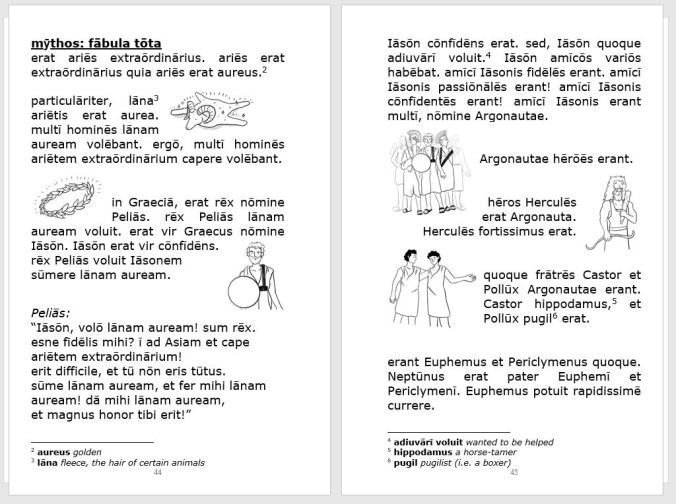
This last of three volumes contains details about Pisces, Aries, Taurus, and Gemini, and features the myths of Typhon, The Golden Fleece, The Minotaur, as well as Castor & Pollux.

Volume III itself contains 62 cognates and 93 other words (excluding names, different forms of words, and meaning established in the text), and is over 3,000 total words in length. The vocabulary across all three volumes comes to 83 cognates and 117 other words. Including all Pisoverse texts, the total number of words written for the beginning Latin student is now just under 65,000 using a vocabulary of just over 800.

Many details in the first four sections of astrologia are repeated from volumes 1 & 2 to provide each reader with a basic understanding of the zodiac signs. sīgna zōdiaca Vol. 3 is available…

  1. For Sets, Packs, eBooks, and Audio—with reduced pricesorder here.
  2. Three-volume-pack special!
  3. Amazon
  4. eBooks: Storylabs & Polyglots
  5. Audio
  6. Free preview (abridged astrologia section, and Piscēs, no illustrations)