AP Latin: There’s Bad News…And…Worse News

**Related: Revised AP Latin 2025**

I ran texts from the AP Latin syllabus through Voyant Tools:

  • 6,300 total words in length
  • 2,800 forms (i.e. aberant + abest = 2)
  • 1,100 meanings/lemmas (i.e. aberant + abest = 1 meaning of “awayness”)*

Based on the research of Paul Nation (2000), 98% of vocabulary must be known in order to just…read…a text. According to Nation’s research, then, Latin students must know about 6,175 words they encounter in the text in order to read the AP syllabus texts. That’s a text written with 1,100 words. To put that into perspective, it’s been reported that students reasonably acquire ~175 Latin words per year, for a total of something more like 750 by the end of four high school years. Needless to say, there’s a low chance that all 750 would be included the Latin on the AP, and that varies from learner to learner. Even if they were, though, 750 is still only 68% of the vocabulary at best. Although this percentage isn’t the same as text coverage since it doesn’t account for how many of the 1,100 words repeat, it’s safe to say that the number isn’t going to be wildly higher. Even approaching 80% text coverage is not good. We know that reading starts to get very cumbersome below 80%. This is just one reason why no student can actually read AP Latin. Oh wait

****Those figures are just for Caesar****

Continue reading
Total Words Read

Last year, I reported total words read up to holiday break, and it’s hard to believe that time of year is upon us again. Since part of my teacher eval goal is to increase input throughout the year, let’s compare numbers. 2018-19 students read over 20,000 total words of Latin by this time. However, this year’s students have read…uh oh…just 11,000?!?!

Hold up.

Something’s going on. I’m positive that students are reading more now, and for longer periods of time. Classes are now structured to be roughly half listening and half reading (i.e. Talk & Read), too. So…why don’t the numbers add up?! Surely there’s a reason. Let’s look into that, starting with this quote from last year’s post:

Over the 55 hours of CI starting in September up to the holiday break, students read on their own for 34 total minutes of Sustained Silent Reading (SSR), and 49 minutes of Free Voluntary Reading (FVR)…

This year’s independent reading time has skyrocketed to 99 and 233. That’s nearly 5x more independent choice reading! Now, last year’s 20,000 figure included an estimated 1,900 from FVR. Therefore, it’s not unreasonable to estimate that this year’s students have read something like 9,500 total words during FVR, which would be like reading a third of this paragraph worth of Latin per minute. If so, the year-to-year comparison would be very close (i.e. 20,000 vs. 20,500). However, I’d expect the numbers to be much higher now with even more of a focus on reading. Seeing as it’s really difficult to nail down a confident number during independent choice reading due to individual differences, then, let’s just subtract all that FVR time from both years, arriving at 18,100 to compare to this year’s 11,000, which is still quite the spread. Let’s do some digging…

Continue reading

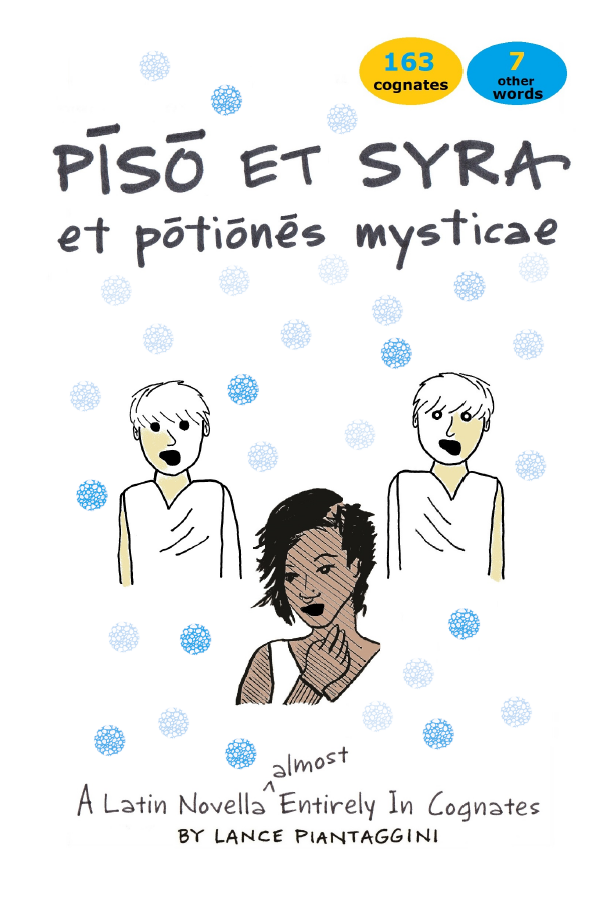
Pīsō et Syra et pōtiōnēs mysticae: The Cognate Book Published!

This novella is written with 163…COGNATES!

That’s right.

There are 163 fairly to super clear Latin to English (and even Spanish) cognates, and then just 7 other necessary Latin words (ad, est, et, in, nōn, quoque, sed) found within this tale of nearly 2500 words in length.

“Piso can’t seem to write any poetry. He’s distracted, and can’t sleep. What’s going on?! Is he sick?! Is it anxiety?! Has he lost his inspiration?! On Syra’s advice, Piso seeks mystical remedies that have very—different—effects. Can he persevere?”

Pīsō et Syra… is the 17th novella in the Pisoverse, the collection of Latin novellas written with sheltered (i.e. limited) vocabulary to provide more understandable reading material for the beginning Latin student. The Pisoverse now provides over 44,000 total words of Latin using a vocabulary of 645 (just about half of which—320—are cognates!).

1) Pīsō et Syra et pōtiōnēs mysticae is now available on Amazon.
2) For Sets, Packs, and Bundle Specials (up to $200 off!), order here.

Free Reading Fridays: We Need More Novellas

Last week, we started Free Voluntary Reading (FVR) in what I’m calling Free Reading Fridays, which is 10 minutes of independent reading at the start of class just before we do some kind of team game. It’s a great way to end the week. I wrote about how first year Latin students have had 143 minutes of FVR so far, but that’s been in segments of 3-5 minutes in the middle of class, with students choosing class texts from their folder. Last Friday was the first day they were able to sit in the back and choose anything from our library…

Continue reading

Q1 Stats: 39% Of Input From Novellas

After sharing the strong start to the year from just the first 12 minutes of day 1, and results of a textbook comparison from the first 4 weeks, I’ve now got some stats from Quarter 1. Having arrived at the first 10 week mark of the year (36 hours), the total words read is now 6,500. But that figure isn’t really what I find most remarkable. How about the fact that 39% of the total input was read in just these last two weeks, from novellas alone…

Continue reading

Input Analysis & Textbook Comparison

One universal thing we can discuss with any language teacher is awareness of how much target language we’re giving students (I, Input), how well they understand (C, Comprehensibility), and the reason for doing an activity (P, Purpose). In fact, this focus is central to our school’s Latin department, and keeping track of input is part of my teacher eval goal.

I covered an ELA teacher’s class last Friday, which means the most productive thing to do was complete some kind of menial task. It just so happened that counting up words is exactly that. So, I compared the input my Albāta class students have received to the Latin found in the first four stages of Cambridge. N.B. I chose the Albāta class section because they’ve read the most total words between all class sections (i.e. 1616 to 1755).

Indeed, Albāta students received about 36% more input than Cambridge (1755 to 1117). Surprisingly, though, the unique word count was also higher by about 24% (221 to 169). I wouldn’t have expected that with such an intent on my part to shelter (i.e. limit) vocabulary unlike what is found in textbooks, so let’s take a look…

Continue reading

Zōdiacī & Weekly Routines

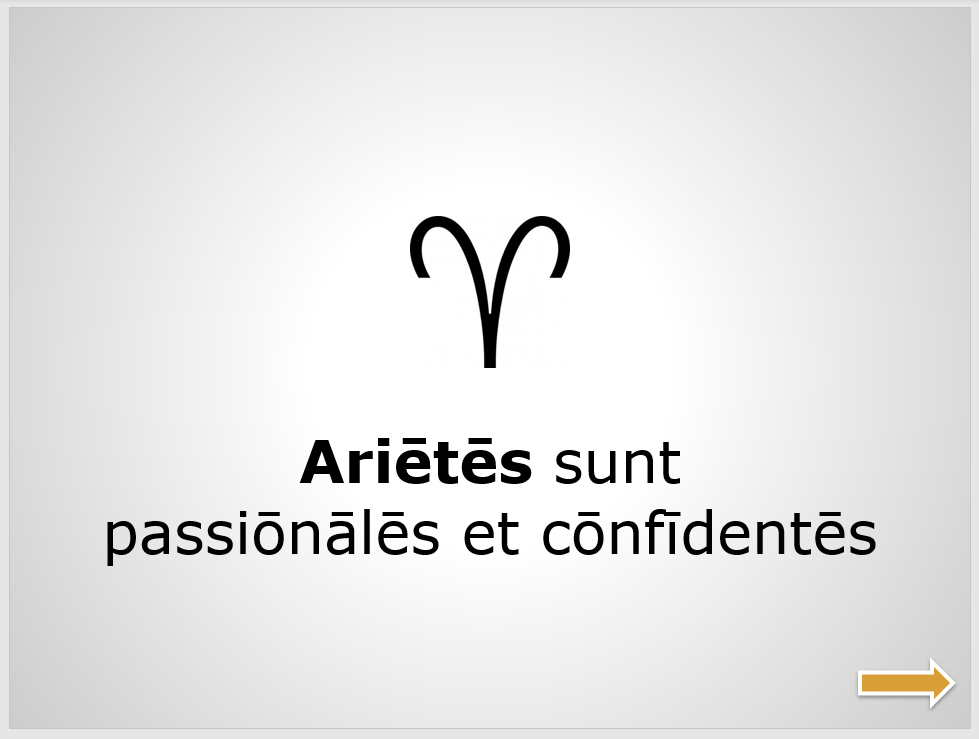
After writing about the first weeks of routines, it’s clear that Total Physical Response (TPR) is now only effective as a brain break. After all, moving about and gesturing isn’t as compelling now that we can hold actual class discussions. When it comes to compelling topics, though, Discipulus Illustris is taking off with zodiac qualities right now in first place in terms of holding interest. As such, I’ve updated the 2019-20 PPT with links to two qualities for each sign:

The follow up question is something like “do you have similar, or different qualities?” This has been awesome. Otherwise, next week introduces MovieTalk, and new Card Talk prompts beyond the four like/like to do drawings we got from the very first class. Talk about a lot of mileage out of that one; it’s been 4 weeks! With these new daily routines comes new planning needs and changes. One change is reading the Tuesday/Thursday Write & Discuss as a whole class (instead of a Do Now). Also, the second half of class on Wednesday/Friday will be devoted to reading; independently, as a whole-class, and then in pairs/groups. Here’s the updated schedule for the next 4-5 weeks, and Do Now/Daily Prep below that:

  • Mondays:
    Do Now – Draw what you did/something you saw over the weekend
    Prep – Determine Tuesday’s Do Now drawing prompt
  • Tuesdays:
    Do Now – [Drawing prompt]
    Prep – 1) Wednesday’s MovieTalk screenshot
    2) Type up text based on Do Now drawings, for Thursday
  • Wednesdays:
    Do Now – See|Think|Wonder (screenshot)
  • Thursdays:
    Do Now – In 1-2 sentences, summarize text (from Tuesday’s drawings)
    Prep – Determine Friday’s Card Talk prompt
  • Fridays:
    Do Now – [Card Talk prompt]
    Prep – Type up & print text based on Card Talk

Do Now & Text-Generating Routines

Classes feel a bit different this year—to say the least—meeting between just 40 and 44 minutes daily. That certainly doesn’t sound like much time for high school, but it’s growing on me. In fact, I’d even say that this is an ideal amount of time to spend in a second language each day, so no complaints, here. Due to the need for super efficient timing, though, my daily structure now looks like this:

  1. Do Now
  2. Activity 1 (or first part of a longer activity)
    -Brain Break-
  3. READ (independently)
  4. Activity 2 (or second part of a longer activity)

To give you a sense of how this looks, on Tuesday we held the first round of student interviews (i.e. Discipulus Illustris/Persona Especial), students read about last Friday’s basketball game, then I asked questions about what we learned from the student in the spotlight, typing into a Google Doc as students copied the Latin into their notebooks (i.e. Write & Discuss). That was it! Thinking of the class day as two parts is really easy to plan for. Also, since classes meet daily, I’ve decided to alternate activities. This makes the week feel like there’s more variety without adding too much. Here are my alternating daily routines for these first weeks of school…

Continue reading

Are My Students Reading Every Day?

No? Why not?

After thinking it over—and I can think things over for a long, long time—I can’t find a compelling reason why students shouldn’t be reading every day, either independently, in pairs/groups/whole class, or both. This year’s students have already read independently for twice as long as last year’s students did…by the end of Quarter 1!!!!

Reading is probably the best source of input, and although I value class time interaction, the reason for all that interaction amounts to being able to read Latin. In fact, I would still place all my eggs in the reading basket when teaching a modern language, too, knowing that interpersonal communication *might* occur outside of the classroom, but that it also might not. However, books can accompany us wherever we go, and literacy is probably the most important skill to promote and build across all content areas, as well as language class.

Bottom line, reading is paramount. Looking back at last year’s plans, there were days when students didn’t read, but I can’t justify that, even for a few minutes at some point between activities. Therefore, I’ve now built reading time into my plans for each day…like…ALL of them…! How?!

Halfway through class, and before ANY reading or any other input-based activity, students read independently for 3 minutes. That’s it!

For example, last week I finished class with TPR (Total Physical Response), but guess what? Students had 3 minutes of independent reading time with their first text. This was after a brain break in the middle of class, and that’s in 40 to 44 minute classes. If I still taught for 1 hour, I’d set a timer for 25, quick break, then read. Every. Day.

Of course, the insistence on this routine means I need a text every day, but that doesn’t mean the text must be long. That also doesn’t mean that a new text is needed every day. While students certainly could be given new text daily, especially with judicious use of copying a text written/typed out during class (i.e. Write & Discuss), a longer text could last a couple days, or even the whole week.

So, if your students aren’t reading every day, what can you do to build in this time?