Inequitable Grading Practices: Vocab Quizzes

Other Posts In This Series:

I followed the same format of polling a large Facebook group of 12,600 language teachers on things-inequitable and grading. Of 144 participants, the overwhelming majority grade some kind of reading comprehension without a focus on individual vocab terms. Quizzing vocab (full-out or vocab section of another assessment) isn’t something I recommend doing, especially not grading it. This holds true across all content areas, not just languages. Why? That kind of focus is on the micro level isn’t necessary, and it might just be measuring a student’s short term memory. We don’t need to document any of that, nor is it particularly helpful to know. In Wormeli’s 2018 update to Fair Isn’t Always Equal, one of his principled responses is “avoid test questions that ask only for basic recall of information” (p.14). That makes sense. We can skip insignificant acts of recall and go straight to whatever the vocab is used for—the greater purpose—presumably to read or interact in the target language. That word knowledge is embedded in the greater, more-purposeful task. Why bother with both?!

Continue reading

Inequitable Grading Practices: Averaging

Other Posts In This Series:

For my third poll in a large Facebook group of 12,600 language teachers in this mini-series on inequity and grading, I asked about averaging. A FRACTION of teachers responded this time, with a total of just 80. Compared to the previous poll participants of 585 for late work penalties, and then 625 for homework, I wonder if this is because averaging is something teachers let the gradebook handle without giving it much thought. Most teachers don’t question homework, but they still play a more active role in creating and assigning it, right? Even setting late policies is something teachers…do. Averaging, though? Looks like we might be in a “set it and forget it” situation. The thing is, the gradebook only does what we tell it to (or its default setting), so if we’re not thinking about that, well…

Poll results had the majority (60) doing some kind of averaging. Let’s unpack all that.

Continue reading

Inequitable Grading Practices: Homework & Zeros

Other Posts In This Series:

Like grades, homework in school is just as expected as yellow buses, questionable cafeteria lunch, rank & file desks, band, and of course, football. Homework is such a part of school culture that it’s hardly given a second thought by the teachers who assign it. I’m sure there’s the following definition somewhere, too:

teacher (n.) = Overqualified and underpaid professional who assigns homework over vacation

Unlike using the lens of standards-based grading (SBG) to illustrate the inequity of late work, the inequity of homework should be self-evident: we cannot monitor student learning, and the home environment—if there is a home—differs from student to student. Some of those environments are conducive to learning, and others not so much. When teachers grade homework, they contribute to keeping those with privilege soaring high while those without get hit with more obstacles. Most teachers not giving homework much thought at least understood how to play the school game (whether or not they did it as students, themselves). Therefore, I’m guessing that the thought of not having a quiet space to do homework, the freedom of not needing to take care of family members, or responsibility of working at the family’s restaurant is questioned by probably just 1% of teachers assigning it. And it’s quite possible that in some communities these situations are completely unheard of. Or, they’re just lurking in the shadows, still there.

For the second week, I polled a Facebook group of 12,600 language teachers, this time on their homework grading policies. After about a week, 625 responded. A little under a quarter (139) grade homework one way or another (e.g., completion, rubric, etc.), with the majority of them (109) dropping a zero in the gradebook if not done.

Continue reading

Inequitable Grading Practices: Late Work Penalties

Other Posts In This Series:

I polled a Facebook group of 12,600 language teachers on their late work grading policies. After about a week, 585 responded. A little under half (255) apply some kind of penalty, whether work is accepted through the entire grading term, within some window or not at all after its due date. If we look at this practice from the perspective of grading standards (vs. completion, or whatever else), it can shed light on how inequitable late work penalties are…

Continue reading

Abbi Holt’s Wisdom On Sustainable & Equitable Teaching

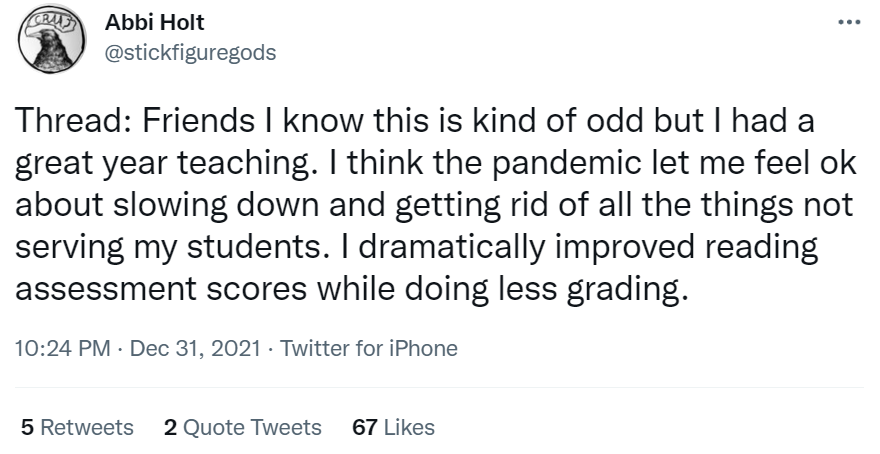
Abbi Holt had a great thread sharing a 6-year progression of practices that have made even teaching through a pandemic tolerable! Here it is with some commentary on why you should look into doing similar things, if not the very same…

Why This Works? #1
Not only is moving slowly and steadily a more responsive approach to teaching learners in the room, but reducing grading is crucial in carving out space for everything that positively impacts teaching and learning.

Continue reading

Redirecting Attention From Phones…Or Not

I asked a giant Facebook group of 12,600 language teachers how they redirect attention away from phones in a way that doesn’t address rule-breaking. Despite that last part, common comments included restating the phone policy, stopping class to talk about phone use (often directed at whole class instead of individuals), confiscating the contraband, or a point system that rewards not breaking the rule. More than one comment involved a direct negative impact to a student’s course grade (maybe check this out?). Some of those practices do redirect a student in the sense of changing the course of their attention, but in a way that directly addresses the rule. I’m more interested in ways to manage behavior during class without much fanfare or acknowledgment…”sneaky”…if you will. I’m interested in masterful redirections so seamless that students don’t know they’re happening. In this post, I list all the comments that were about redirecting student attention. But first…

Why is this an issue?

Continue reading

Check Your Understanding: Return of the Quiz?! Kinda…

It’s been years since I’ve given a quiz. I know that seems crazy coming from a teacher, but there are just so many other ways to get evidence of learning, like The Monitor Assessment, that I haven’t had to bother with quizzes much at all. When I did give them, they were sneaky ways of reading and rereading. In other words, all my quizzes were input-based. This meant that the learning experience (i.e., of receiving input) took place during the assessment. In the literature, this is known as an UNOBTRUSIVE assessment, whereas an obtrusive one would be when there’s an abrupt stop to input and interaction so testing can occur. This is bad. It literally takes away time from learning, an no one wants (or needs) that. A couple examples of obtrusive assessments would be like pulling kids into the hall for some speaking test while who-knows-what is going in the classroom, or holding a “unit test day” that’s really just 20min of testing, then free time or busywork for those who finish. With unobtrusive input-based assessments, however, the learning (i.e., receiving of input) continues, and it’s not a complete waste of time.

I enjoy not wasting time. Don’t you?

Continue reading

Back To Comprehension Basics: Don’t Speak Latin

No, I haven’t reverted back to the grammar-focused pedagogy of the 90s (and no, not the 1890s, either. Grammar teaching is still the dominant one today, which I predict will hold true for another 20 years). Instead, I’m going to challenge us all speaking Latin in the classroom to do so under just one condition:

Students will understand what you’re about to say.

It sounds too basic, I know, but not everyone does this or does this enough. Hence, back to the basics of comprehension-based teaching, right? So my challenge is now out there. If the condition isn’t met, say something in English, or change what we’re about to say to meet the condition. Of course, this challenge wouldn’t exclude the use of new words. No way. How else would students ever expand vocab?! However, this does mean that we must provide CI by using mostly words students already understand, allowing for just a few new ones during class, and then be sure students understand those new words (i.e., at least tell them what the new words mean in English, demonstrate the meaning whenever possible, and use a picture/realia if applicable).

Speech Rate & Text Coverage
The research of Hsueh-Chao & Nation as well as Laufer shows that a text must have 98% coverage of known vocab (tokens) to have a chance of being read with ease (because even 95% text coverage can get woefully low comprehension scores of 55%!). Well, that’s with texts, when the student able to control the pace and even reread! Speech doesn’t work that way. When we say something, the student can’t control our speech rate. They have to signal us. There’s no 15sec replay. They have to signal us. While we’re working towards training students to self-advocate for comprehension, the reality is that listening to Latin is the MUCH harder mode to process. Therefore, it goes without saying that we should be using 98%+ text coverage in speech. Only speaking the target language in class when students will understand will maximize comprehension. Who doesn’t want that?! Practically speaking, then, I challenge us to all give pause the moment we’re about to say something students don’t understand yet, then do the following:

  1. Say it in English and move on.
  2. Restate using other words students already understand.
  3. Use the new word/phrase, immediately establish meaning, then provide micro-exposure.

Micro-exposure
This is my term for giving students a little bit of concentrated exposure to what has the potential to be a one-off and out-of-bounds word/phrase. In practice, when a new word/phrase comes up, expect to sit with it for some statements and questions for a minute or two. Yes, a minute or two. This helps keep vocab limited and comprehension high without vocab overload and noise that students start to get used to (i.e., they begin to tune out the input and be OK with incomprehension because there’s so much of it during class).

Consider the alternative for a minute: a class during which we teachers use new words/phrases as a reaction to what students say. That’s basically a translation class (English –> Latin) without much expectation (and hope) that students will ever be exposed to those words/phrases again.

Think of micro-exposure as circling or something if that helps you, too. However it’s understood and whatever it’s called, we must acknowledge that the absence of micro-exposure entirely can result in a ton of vocab and high levels of incomprehension, or some kind of one-off situational experience like the translation class. Only the kids with the best, most freakish memories will absorb all that input, and there aren’t too many of them in class, if at all.

So, are you ready to not speak Latin unless students will understand what you’re about to say? Why or why not?

Content To Pedagogy: The Natural Progression Of [Latin] Teachers

I’ve observed how teachers first start out all about content. This makes sense. Teachers generally really like, or maybe even love their content area. In the classroom, they’re certainly the experts. That doesn’t mean they rival scholars in terms of knowledge, of course, but most college undergrads possess enough content knowledge to teach what they know. You can even obtain a teaching license in some states having never taken an education course, instead passing tests (e.g., Praxis, MTEL, etc.) almost entirely content-based, with just a fraction of items related to teaching. Quite bluntly, the state of education is such that even with some training, many teachers are missing an overlooked aspect of teaching: solid pedagogy…

Continue reading