Back-to-back posts because I was playing a board game this weekend and forgot to post that night! I have a really hard time being critical of this book, considering in many ways it helped launch my classroom assessment and grading research. Granted, the more I learn, the more asterisks I attach to ideas in Grading for Equity, which is tough for me to admit. I simultaneously recommend that all educators read this to understand basic concepts, like standards, while I also acknowledge that it’s still a grade-focused, and possibly grade-heavy approach. That is, standards-based grading (SBG) is a lot closer to traditional grading than many might think, and has the potential to result in even more grades, just in new packaging (e.g., “Needs Improvement,” and “Proficient”). Therefore, here are my thoughts after my first rereading of this book since really diving deep into classroom assessment and grading literature.
Continue readingAssessment & Grading & MGMT
READ THIS: Blum’s “UNgrading…”
Rereading the preface to this book was a little depressing. The first time I read it over three years ago, I had highlighted “but should we, assuming an end to the lockdown, just go back to business as usual? What if the usual is problematic?” (p. xxii). At the time, I was experiencing “business as usual” despite a glimmer of hope between spring 2020 and 2021 when it looked like grading practices were going to shift in a massive way. They did not.
Continue readingREAD THIS: Dylan Wiliam’s “Embedded Formative Assessment”
I had the opportunity to revisit Wiliams’ 2018 book, Embedded Formative Assessment, while looking for definitions of “formative assessment.” The first two chapters are simply priceless. Beyond those, the other chapters include a general problem to be solved, and then practical techniques on solving them. Here’s an overview of what I consider the best parts…
Continue readingREAD THIS: Mark Barnes’ “Assessment 3.0”
Even though I recommend Mark Barnes’ SE2R feedback model, and have written about that, here, there’s a bit more to his “Assessment 3.0” book than just the model. It warrants further reading…
Continue readingREAD THIS: Sackstein’s “Hacking Assessment” (2nd Ed.)
In getting ready for my 2025 MTA Summer Conference presentation on “Getting More from Your Formative Assessments and Grading,” I found a lot more missing blog posts than just Zerwin’s! For example, I never wrote about Starr Sackstein’s “Hacking Assessment…” years back; there’s good stuff in there, which means I need a record of that stuff here.
Continue readingREAD THIS: Zerwin’s “Point-Less…”
In cobbling together sources for my 2025 MTA Summer Conference presentation on “Getting More from Your Formative Assessments and Grading,” I searched my blog to link posts on books I consider foundational. Somehow, I never published the post I wrote after reading Zerwin’s “Point-less” years back. Her work deserves some attention…
Continue readingAchieving Consensus: A Key To Changing Teacher Practice
If I were ever asked to coordinate a schoolwide grading system change again, I would take a cue from the authors of Data Wise: A Step-by-Step Guide to Using Assessment Results to Improve Teaching and Learning (2013). In Chapter 6, this gem of a statement reads…
Continue reading“It is easy to achieve consensus on solutions that do not require teachers to make changes in their day-to-day practice, even when data show that such practices are consistently ineffective.” (pp. 140-141)
Current Reading: An Awesome Trilogy – Starch & Elliot Studies From 1912-13 Showing The Ridiculous Unreliability of Grading

I love the studies carried out over 110 years ago by Starch & Elliott (1912, 1913a, 1913b). In short, they tested the reliability of English teachers grading papers (1912), and got disastrous results showing an absurd amount of variation in scores across many teachers. Then, they did a second study with geometry teachers (1913), got even greater variation of scores, and finally did a third study with history teachers, essentially replicating the results from the other two.
I often cite these when talking shop, saying something like “we’ve known for 100 years that grading can be incredibly unreliable,” but recently I revisited these foundational studies, and now have an even greater appreciation for their design and findings. In this blog post, I’ll dig into these groundbreaking studies, starting with the 1912 edition…
Continue readingFalse Formatives
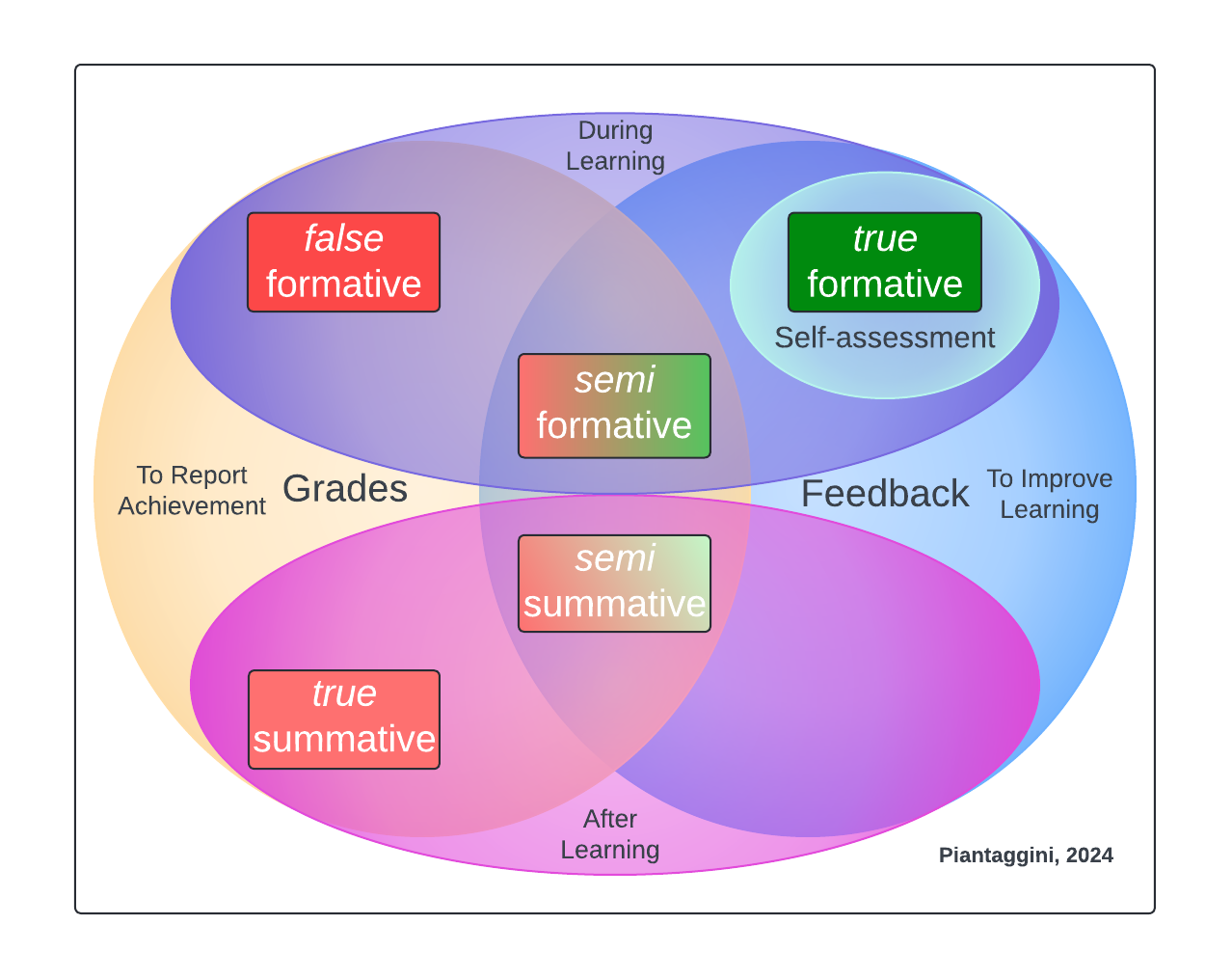
**Click here for the current 2026 TFAM conceptual framework**
I just presented a poster session in Chicago for the NCME Special Conference on Classroom Assessment (Piantaggini, 2024). While I had some rough details for a proposed dissertation study, the focus of discussion with scholars who stopped by was my new assessment model and the theoretical framework that brought me to it. The message I got was “I think you’re onto something,” so I’m sharing my work here to get more eyes on it. Please contact me with any embarrassingly scathing criticism. Otherwise, reply publicly with any other thoughts or questions. After all, this is my blog, not peer review!
So, in this blog post, I’ll describe the model you see above, and how I got there, starting with a major dilemma I identified when reviewing literature on classroom assessment: confusion over grading formative assessments…
Continue readingCurrent Reading: Flexible Deadlines ≠ “No Deadlines” (i.e., Extensions vs. Reassessing)
One concern with flexible deadlines is that in the absence of late work penalties, students will wait until the absolute last, last, last, last, LAST possible moment to turn in their assignments. The fear is that this will create a ton of extra work for the teacher, and that students will not develop time management skills since there are no consequences of a lower grade/reduced points)…because all students in traditional points-based grading systems turn in ALL of their assignments on time, right? And then they graduate and become college students who continue to turn in ALL of their assignments on time, right? And then they graduate and become employees who complete ALL of their tasks on time while being adults who get done ALL of their errands on time, right? All because of low grades and reduced points in school…right? This belief has prevailed despite the lack of empirical evidence to support it. Granted, the fear does seem to play out in some cases when flexible deadlines are misused, or there is some other assessment policy getting in the way. Nonetheless, for any change to take place, this belief must be addressed…
Continue reading
