Cognates. Whether you love ’em or hate ’em, how much Latin are we talking about? When they’re used, do cognates end up comprising most of a book’s Latin? Are we talking half? A quarter? Less? And then what does that mean about the rest of a book? How much of a book’s Latin is being dismissed amongst the cognate concerns? One of the concerns is that cognates weren’t used by Classical authors, the claim being that using infrequent words is a problem, and the conclusion being that cognates are unhelpful for today’s Latin learner. I don’t have this concern or have found evidence to support the claim. Nevertheless, I have been wondering just how much—or little—the concerns constitute, percentage-wise, of a book. I also have been wondering if there were many words Classical authors themselves used that other Classical authors didn’t really use. N.B., I don’t mean hapax, just words that were rarely used by others. Thus, if Classical authors preferred to use rare words, too, that would help illustrate how the current cognate fuss is more about preference than anything else. Let’s see…
Continue readingAuthor: magisterp
Pedagogical Immunity
Certain learners exist who possess what seems like complete immunity to whatever pedagogy they’re subjected to. College students are a good example. Professors rarely have pedagogical training, which is perhaps the most ironic thing about those in charge of training pre-service primary and secondary teachers, but most college students are able to persist through a lack of solid pedagogy. How? Using their interests, some independent learning skills, and a bit of determination. Polyglots are another good example. They’ll learn many languages under all sorts of conditions that don’t transfer to others, claiming they found “the secret,” yet relatively few who adopt their “methods” report success (except for other…polyglots!). Upon thinking this over, many high school students—and not just those studying a second language—are often pedagogically immune, too. These students manage to pass courses even when teachers have wacky pedagogy with unhelpful practices. Consider the teacher using some pre-fab curriculum with loads of busywork. Students will put up with all that busywork. They might not learn much, but they’ll earn credit, then graduate. In that sense, then, these students made it through. They were immune (though not to learning…which we’ll get to). They just made it past the next level. They…”succeeded.”
Continue readingHow To Ungrade Gradelessly In Two Steps
I’ve been told that going gradeless and ungrading are different. While that’s certainly possible, I haven’t seen a clear difference so far. That is, between blogs, Facebook groups, books, and the rare research report under either term (plus more), the similarities stand out way more than any notable differences. There’s quite a bit of consensus among even the most discerning of grading systems related to reducing or eliminating grades. Even a few systems that fall under a generic “standards-based” approach have basically the same features as those that fall under the “gradeless/ungraded.” Whatever you want to call these approaches, this post will show you how to get rid of all the points, scores, and assignment grades while keeping the focus on learning. There are two basic steps:
- Have students put all their classwork, assignments, and assessments into a portfolio.
- Students self-grade, citing evidence from the portfolio.
Documentation Of Participation vs. Evidence Of Learning
I came across a 1993 article on student self-reporting (Darrow, et al.), and spent some time thinking about the idea that became the title of this blog post. As I’ve begun diving deeper into the “ungrading/gradeless” sphere of self-assessment, self-grading, and portfolios, I can say that at first I pretty much was getting the former documentation of participation, not the latter evidence of learning. Earlier this year, my student teacher and I spotted students uploading some questionable “learning evidence” into their portfolio, like notebook pictures with the day’s greeting copied from the board during the first five minutes of class.
This is not evidence of learning.
I’d go as far to say it’s a stretch to even call this something like participating. Copying is the absolute lowest writing skill for first year high school language learners, and this 5-minute routine merely sets up actual participation once class really begins. So, that was obviously documentation of some kind (vs. evidence of learning), and we then steered students towards a more productive direction of getting us evidence of learning. However, not everything students uploaded was as obvious. Take, for example, a Read & Summarize statement. Yes, the student was doing something in class, but was that necessarily doing anything for learning? It’s certainly possible, but just as likely not. The point here is that the difference between documentation of participation and evidence of learning really depends on the quality of what students add to their portfolio. If we just treat it as completion, that’s basically what we’ll continue to get: documentation of participation, which can actually lead to disengagement and lack of participation. As much as school can be school, kids really do find meaningless work worthless, and tend to find meaningful learning valuable. Even the cool kids. It’s important in a portfolio system to provide feedback on what students add so that you ensure meaningful learning occurs.
Easier said than done, but it’s time well spent.
As far as I can tell, there are only two ways to determine if what students add to their portfolio is, indeed, evidence of learning (and not documentation of participation). The first is an objective comparison to previous work, whether that’s on the teacher or the student, and the second is an honest rationale from the student’s end (explaining why what was added shows learning). I find the former tricky in a language class. For example, if you were to use the same text and have students keep submitting assignments based on that throughout the grading term, how sure are you that students are even processing the language anymore (vs. based on memorized English understanding of the text)? One cumbersome way could be to use a core set of vocabulary at the start of the term, and then write different texts with that same core set throughout the grading term that students interact with and complete assignments for. That might do the trick, but even then you’ve got to look at the students who ace the assignments in the beginning. How could they possibly show learning if they’ve already…learned…all that from the start? Also, a picture of a Quick Quiz result or something might just be participation, even if the student is showing you they understood all the Latin. Understanding Latin for 10 minutes during one class isn’t necessarily evidence of learning. Again, you’d need to compare those results over time to make the claim.
So, the comparison to previous work is tricky if not just time-consuming. That’s why I prefer getting students to write some honest rationales explaining why what was added shows learning. It’s all going to be individual anyway. Might as well embrace that.
Track The Characterization Of…
During a meeting with the Director of Curriculum & Instruction, also an ELA teacher, I noticed on the board that students were to read & analyze Book 9 of The Odyssey and track the characterization of either Odysseus or Polyphemus. “Track the characterization of…” got me thinking…
Historically, Latin teachers haven’t really had many texts of substantial length that their students can also read with ease (i.e., in order to then do the heavy lifting of tracking characterization, etc.). This combination hasn’t been possible for centuries, yet novellas have changed that quite a bit. The continuous narrative and character development of even the shortest novellas contain enough information for students to do a “track the characterization of…” task.
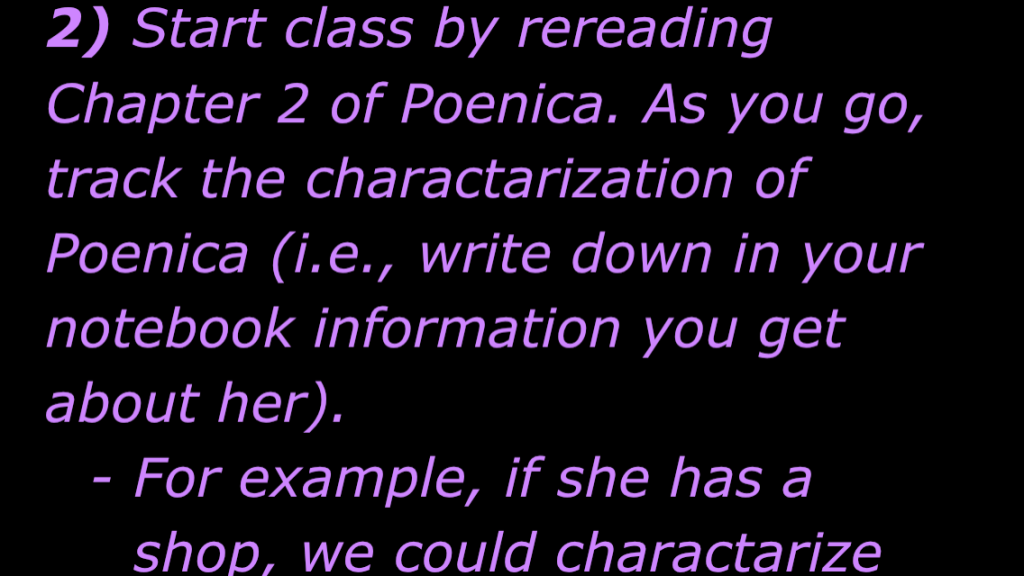
So, just before the holiday break, we spent a few classes reading Poenica purpurāria. At the start of the second day, I had this on the board:


This was not an easy task. Students really had to think beyond the statements. For example, classes thought Poenica must be determined since she immigrated, has her own shop, and already dyed many togas purple. This was a very straightforward task that engaged students in all that higher-order thinking gold.
My thoughts have wondered further. What are some other ELA teacher reading tasks that I could now implement in my own classes when reading novellas (vs. translating passages)?
The Inequity Absurdity
Consider this a double feature hot off yesterday’s Annual Criticism of Latin, or ACL, report. Why another? I was reminded of a toxic idea floating around that the use of cognates is inequitable. This is absurd.
Reality:
- Cognates increase (*increase, not guarantee) the likelihood that students will understand the Latin, especially ones most obvious and familiar in English.
- Students with broader English vocab have a higher likelihood of understanding cognates (*higher, not guaranteed), especially the less familiar ones.
- Students who don’t have as broad English vocab or who don’t recognize the word in the moment will just see one more Latin word.
This is not inequity.
Continue readingCognate Concerns? It Must Be January…
This year’s Annual Criticism of Latin, or ACL for short, is about a month early. It’s been the same old gripes with the same old assumptions going back to 2018 or so. Almost every concern rests on the assumptions that a student will continue Latin in college and will be negatively impacted somehow by the decisions modern Latin authors have made. That’s two biggies: continue Latin, and be negatively impacted.
Continue readingQuizzing For Learning vs. Quizzing To Get A Grade
I was talking to a colleague about an assessment idea I had. The scenario began “if I were a math teacher…,” but really, this idea applies to anyone who gives quizzes. Many teachers I observe who assess like this usually hang out at their desk while students take the quiz. Sometimes it’s timed. Sometimes there are “after the quiz…” instructions on the board. In the literature, this is called an obtrusive assessment, with class on pause, sometimes the entire time.
So, if I were to ever assess like that, instead of hanging out at my desk, I’d start circulating the room, stopping at each student to point out a quiz item they should review (e.g., “Ja’den, spend more time on #3”). And I’d do this the entire time, just walking around, essentially doing all the correcting I would’ve done during my planning period, and even providing some feedback. It’s kind of like a more involved individualized Monitor Assessment. My colleague was wondering how this “real-time rolling assessment” would really show what students know and can do. We talked a bit. Questions were asked like “with so much scaffolding, how do we know the student can do anything on their own?” The truth is, they might not, but how is that any different? In fact, during that whole discussion I forgot to consider what the “real-time rolling assessment” was being compared to. That is, how is a give quiz/collect/correct/hand back procedure any different, really, for finding out what a student knows or can do?
It comes down to process.
Continue readingIndependent Reading Lessons
When it comes to the fairly recent phenomenon of independent choice reading for Latin, how do students choose what to read, and what do they do when flipping through the book? These simple lessons get students thinking about why we want them reading level-appropriate books and to understand how important it is to choose ones that feel easy, as well as what we mean by actual reading (vs. some other close reading, skimming, etc.). Most importantly, perhaps, we want to show students the difference between what a translating experience and a reading one is. These two lessons are scalable, but I recommend taking at least 15 minutes.
A) How To Choose A Book (requires novellas with full glossaries)
- Students choose 3 random books from the library.
- Read/”read” that book, using the glossary for unknown words (~3 minutes).
- Count up total words read/”read.”
- Repeat with other two books.
- Share & Discuss.
Students should have a range of words read (e.g., 20 to 200). Mention that some might have been unlucky enough to have chosen the three highest level books. Obviously, they’re not gonna get as much out of a higher level book. The main thing to point out is that the book each student read the most of should be the kind of one they choose during independent reading. Strategies like “if you have to keep flipping,” or “if it feels too much like work” should send the message to get a book that’s at- or below-level, resulting in optimized input. N.B. get this poster from Eric Herman if you don’t already have it. I constantly point to it during class to show priorities (i.e., 1 = lots of Latin, 2 = must be comprehensible…). Once they get the idea of which kind of reading level will be most helpful, because you still get a lot out of books that are easily read and below-level (see Bill’s tweet below), do another mini lesson on how to read.
B) How To Read (or, Reading vs. Translating)
- Read book as fast as possible, skimming and getting the gist of what’s going on (~1 minute).
- Count up total words read.
- Go back and read for understanding, as if they had to tell someone who didn’t know Latin a) what the story is about, and b) what’s happening right now in the chapter (~1 minute).
- Go back and read as if to memorize and describe everything with incredible detail! (~1 minute).
- Share & Discuss.
The main point to make is that #1 is waaaay too fast. All that input doesn’t matter if students can’t recall what happened, or have no idea what’s going on. #3 is waaaaay too slow. They’ll never get enough input reading with that much attention to detail while trying to memorize. #2 is what we’re going for: reading with enough comprehension to retell the story to someone else.
Punished By Rewards & Advantages To The Single-Point Rubric
As if researching how to eliminate grading and reduce assessment couldn’t get much better, I’ve now got something else. Alfie Kohn’s 1993 masterpiece really ought to be required reading for every educator. Coming up on its 30 year anniversary, the author at the time reviewed studies dating just as far back to the 1960s. This post is gonna focus on self-assessments. When it comes to students self-assessing, evidence suggests that the more students think about HOW WELL they’re doing (vs. WHAT they’re doing), they do it poorly.
That’s crazy-unintuitive, right?!
Continue reading