In getting ready for my 2025 MTA Summer Conference presentation on “Getting More from Your Formative Assessments and Grading,” I found a lot more missing blog posts than just Zerwin’s! For example, I never wrote about Starr Sackstein’s “Hacking Assessment…” years back; there’s good stuff in there, which means I need a record of that stuff here.
Continue readingAuthor: magisterp
READ THIS: Zerwin’s “Point-Less…”
In cobbling together sources for my 2025 MTA Summer Conference presentation on “Getting More from Your Formative Assessments and Grading,” I searched my blog to link posts on books I consider foundational. Somehow, I never published the post I wrote after reading Zerwin’s “Point-less” years back. Her work deserves some attention…
Continue readingAmazon Novella Cost Increase :(
To clarify, Amazon isn’t increasing their cost to print books. They’re just decreasing royalties paid to authors (for books listed under $9.99), which means that unless many authors agree to earning quite a bit less per book (in my case it’s over 30%), there will be an increase to your cost of purchasing novellas. The good news? It’s only through Amazon purchases…
That is, I encourage teachers to buy directly from authors and novella distributors whenever possible (e.g., my square site, or Storybase Books) since printing costs are remaining the same; whatever deals authors and distributors have struck up aren’t affected by Amazon’s royalty decrease, so you can enjoy lower-cost novellas through them. See this tab on the crowd-sourced novella document on places to get books other than Amazon.
Is there a catch? Not really. Direct purchases tend to have lower list prices than Amazon, though shipping costs added to the order might come as a surprise since they’re hidden by Prime free shipping. For example, most of my books are increasing to $10 on Amazon, but my set of 12 favorite books is $70 plus shipping ($9), not the Amazon list of $120.
On a side note, I’m also taking this opportunity to switch my covers to the glossy format since I’ve heard that the matte versions can get a little grimy over the years, making that really nice original texture end up kind of gross (eww!). Sorry it’s taken so long, JP!
Achieving Consensus: A Key To Changing Teacher Practice
If I were ever asked to coordinate a schoolwide grading system change again, I would take a cue from the authors of Data Wise: A Step-by-Step Guide to Using Assessment Results to Improve Teaching and Learning (2013). In Chapter 6, this gem of a statement reads…
Continue reading“It is easy to achieve consensus on solutions that do not require teachers to make changes in their day-to-day practice, even when data show that such practices are consistently ineffective.” (pp. 140-141)
A Language-Teaching Post
I’m returning to my stomping grounds in what feels like a guest post on my own site! That is, every now and then I think “if I were to teach high school (or middle school) Latin again, I’d try this.” Well, it does nobody any good to keep those ideas in my head, so here’s what’s been on my mind…
Continue reading0 To 170: Nine Years Of Latin Novellas
In August of 2020, I wrote 0 To 70: Five Years Of Latin Novellas. Two years later, the number of Latin novellas nearly doubled. Well, another two years have gone by and we’ve seen 40 more, which is an increase of 31%! Above all, there are now 38 authors out there writing different kinds of Latin. In this post, I want to celebrate that different kind of Latin while revisiting some findings…
Continue readingCurrent Reading: An Awesome Trilogy – Starch & Elliot Studies From 1912-13 Showing The Ridiculous Unreliability of Grading

I love the studies carried out over 110 years ago by Starch & Elliott (1912, 1913a, 1913b). In short, they tested the reliability of English teachers grading papers (1912), and got disastrous results showing an absurd amount of variation in scores across many teachers. Then, they did a second study with geometry teachers (1913), got even greater variation of scores, and finally did a third study with history teachers, essentially replicating the results from the other two.
I often cite these when talking shop, saying something like “we’ve known for 100 years that grading can be incredibly unreliable,” but recently I revisited these foundational studies, and now have an even greater appreciation for their design and findings. In this blog post, I’ll dig into these groundbreaking studies, starting with the 1912 edition…
Continue readingFalse Formatives
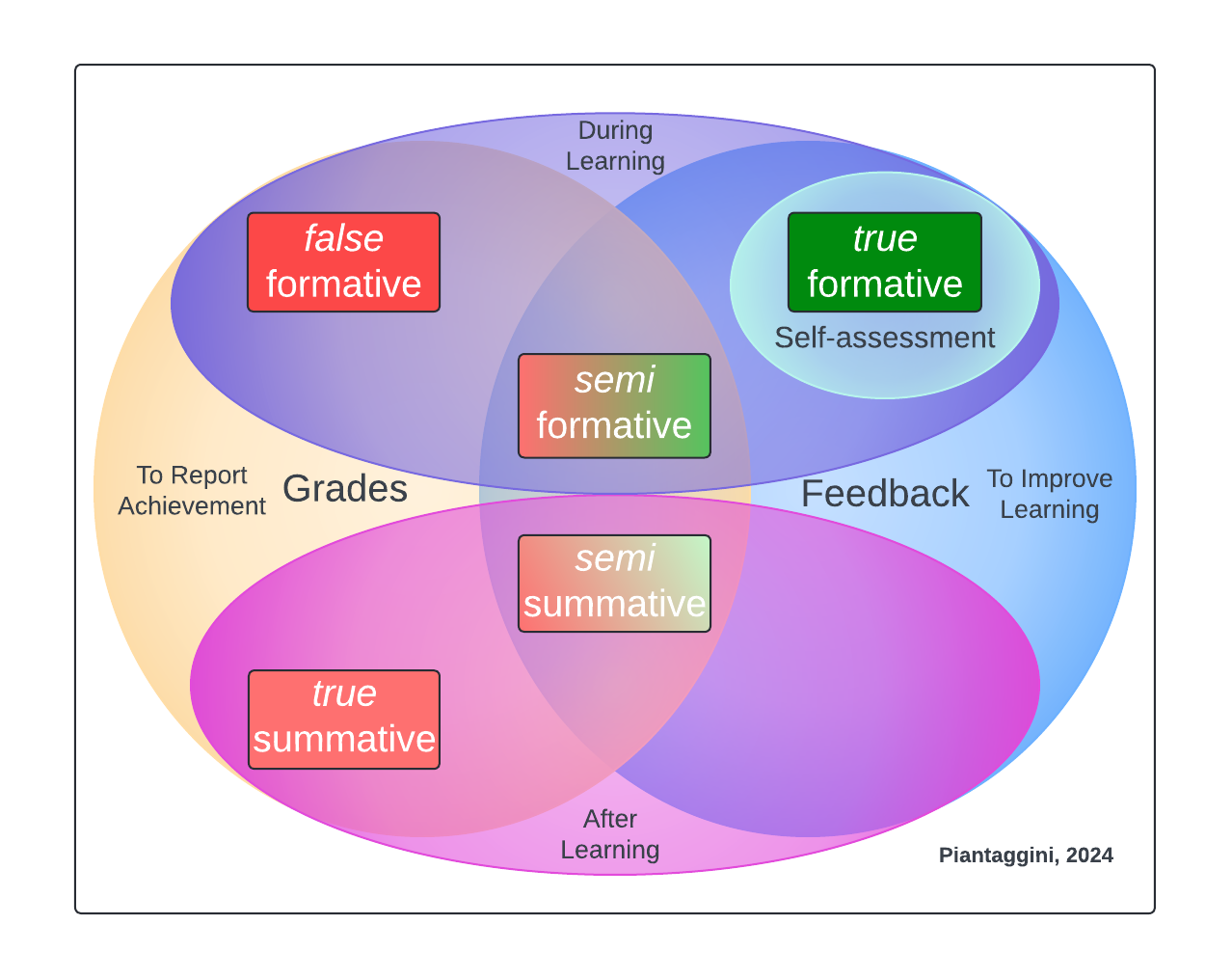
Click here for the updated model and latest research.
I just presented a poster session in Chicago for the NCME Special Conference on Classroom Assessment (Piantaggini, 2024). While I had some rough details for a proposed dissertation study, the focus of discussion with scholars who stopped by was my new assessment model and the theoretical framework that brought me to it. The message I got was “I think you’re onto something,” so I’m sharing my work here to get more eyes on it. Please contact me with any embarrassingly scathing criticism. Otherwise, reply publicly with any other thoughts or questions. After all, this is my blog, not peer review!
So, in this blog post, I’ll describe the model you see above, and how I got there, starting with a major dilemma I identified when reviewing literature on classroom assessment: confusion over grading formative assessments…
Continue readingCurrent Reading: Flexible Deadlines ≠ “No Deadlines” (i.e., Extensions vs. Reassessing)
One concern with flexible deadlines is that in the absence of late work penalties, students will wait until the absolute last, last, last, last, LAST possible moment to turn in their assignments. The fear is that this will create a ton of extra work for the teacher, and that students will not develop time management skills since there are no consequences of a lower grade/reduced points)…because all students in traditional points-based grading systems turn in ALL of their assignments on time, right? And then they graduate and become college students who continue to turn in ALL of their assignments on time, right? And then they graduate and become employees who complete ALL of their tasks on time while being adults who get done ALL of their errands on time, right? All because of low grades and reduced points in school…right? This belief has prevailed despite the lack of empirical evidence to support it. Granted, the fear does seem to play out in some cases when flexible deadlines are misused, or there is some other assessment policy getting in the way. Nonetheless, for any change to take place, this belief must be addressed…
Continue readingCurrent Reading: Assessing Students Not Standards (Jung, 2024)
Given over 20 years of schools attempting to implement standards-based grading (SBG), Lee Ann Jung’s 2024 release, Assessing Students Not Standards, offers a refreshing alternative. Is it part of a post-SBG era? Maybe. There are a lot of SBG concepts that are universally good, and the message is clear from researchers and teachers: let’s keep those. But there’s more. We can rebuild SBG. We have the experience. We can make SBG better than it was. Better, stronger, faster.
Another message is getting clearer, too, and seems right at home with the ungrading movement. Jung states “we need to grade better, but we also need to grade less. A lot less” (p. 20). This is aligned with my own research on exploring 1) ways to reduce summative grading, and 2) find formative grading alternatives (i.e., so they remain formative). So, let’s get into some stuff in the book…
Continue reading Magister P.