Agrippīna aurīga, Mārcus magulus & mȳthos malus: convīvium Terregis

New year, new books!

My observations after reading novellas *as a whole class* during COVID-19 remote learning has convinced me that audiobooks make for the best experience in that format. Narration has its value, sure, but for whole-class reading, the books with sound effects, character voices, and music, really do up the game. I’ve got three novellas coming up this spring, all with accompanying audiobooks. There will be more details upon publication of each, but here are some brief descriptions…

Continue reading

Collaborative Storytelling: Whole-Class Writing

Back in June, I did this test of what collaborative storytelling could look like for asynchronous learning. However, the process can be used during class for even more interaction, and more story variations. This format also has the benefit of modeling writing, which can become new sources of input with timed writes typed up, edited, and read in class. This is not innovative. I’ve seen teachers do this live in the classroom. However, you might have stepped away from collaborative storytelling for a bit, or just forgotten how easy and enjoyable it can be. I’d recommend getting back into it, keeping it a regular activity throughout the year. Here are my current favorite collaborative storytelling formats for live remote learning:

Whole-Class Writing
Using the super simple story script sequence, write a story by providing either/or details for students to choose, or blank spaces for students to fill-in their own. Share out, step-by-step as teacher restates in target language, and/or submit so teacher can edit, type up, and share back to whole class. You get up to as many new stories as you have students, although I found success projecting just 2 stories; one from the class, and one from another class.

Slide Talk Stories
Screenshare/project the Slides, and scroll through to inspire story detail options. If you want students to compete over details a little more, choose two options from the Slides (e.g. “H.E.R. or Brent Faiyaz?”). Otherwise, choose one detail from the Slides, then whatever other shadow comes to mind. Use the script below for a home-run story.

WOWATS (Whole-class One Word At a Time Stories)
Generate a list of words (e.g. from most recent text, high frequency, all words students know, etc.), randomly choose one, collaborate to use the word in a story, and continue. Consider following Mike Peto’s story structure of limiting each story part to 5 minutes so ideas don’t go off the rails and it takes the whole class.

1) Who? Where? With Whom?
2) Problem
3) Fail to Solve
4) Solution

sīgna zōdiaca Vol. 3: Published!

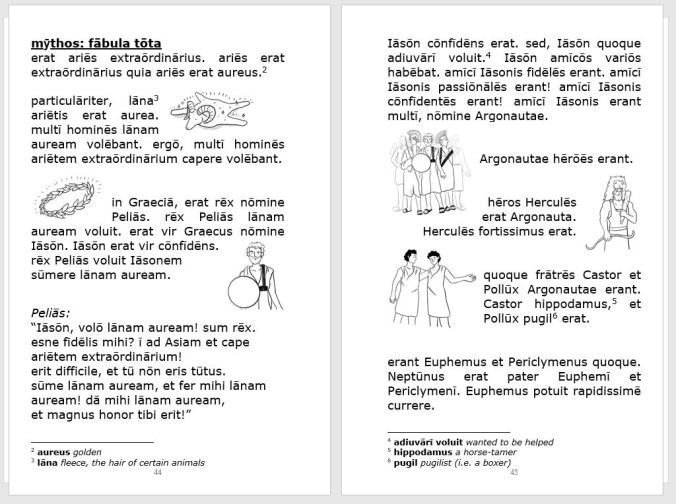
This last of three volumes contains details about Pisces, Aries, Taurus, and Gemini, and features the myths of Typhon, The Golden Fleece, The Minotaur, as well as Castor & Pollux.

Volume III itself contains 62 cognates and 93 other words (excluding names, different forms of words, and meaning established in the text), and is over 3,000 total words in length. The vocabulary across all three volumes comes to 83 cognates and 117 other words. Including all Pisoverse texts, the total number of words written for the beginning Latin student is now just under 65,000 using a vocabulary of just over 800.

Many details in the first four sections of astrologia are repeated from volumes 1 & 2 to provide each reader with a basic understanding of the zodiac signs. sīgna zōdiaca Vol. 3 is available…

  1. For Sets, Packs, eBooks, and Audio—with reduced pricesorder here.
  2. Three-volume-pack special!
  3. Amazon
  4. eBooks: Storylabs & Polyglots
  5. Audio
  6. Free preview (abridged astrologia section, and Piscēs, no illustrations)

Flashcard Blitz

As a comprehension-based and communicative language teacher, I’ve largely dismissed promoting any use of flashcards due to their connection with memorization. Beyond disappointing research about this kind of explicit learning, my classroom experience has confirmed that the more students are aware of language, the less fluent they seem to become. For example, the frequent note-taking academic students are typically those who can’t respond without second-guessing themselves and checking said notes, overly concerned with accuracy, etc., which slows them down quite a bit. Above all else, teaching practices requiring memorization lead to inequity since individual differences can’t be accommodated. Then, Eric Herman lobbed some mind grenades in Acquisition Classroom Memo #39. He can be trusted to do that, and we’re all better teachers for it…

Continue reading

Slide Talk Stories & Super Simple Story Script Sequence

After looking at all the collaborative storytelling options for our first class story, we decided Mike Peto’s simple structure of a 20min story—tops—was exactly what we were looking for. In preparation, I suggested that we script out some basic either/or detail options, one of which being a “shadow” (i.e. non-option), and the other what we think they’d likely choose. Student teacher Magister K suggested that we look to each class’ Slide Talk slides to find something they already liked…

Continue reading

sitne amor? Published!

“Piso and Syra are friends, but is it more than that? Sextus and his non-binary friend, Valens, help Piso understand his new feelings, how to
express them, and how NOT to express them! This is a story of desire,
and discovery. Could it be love?”

I hate what I’ve been seeing and hearing in the world, but Yoda warned us of the dark side path—fear to anger to hate to suffering—and no one needs any of that. Lets face it, the only real way to get out of this mess is to strike down hate with love…and humor. My contribution to all that is a love story that takes more of a lighthearted, comical turn. Piso crashes and burns, falling flat on his face, and deals with all the feels of a young adult. I’ll neither confirm nor deny that any of this draws from personal experience.

In sitne amor?, the Pisoverse characters are getting older in their world. This novella picks up on perhaps one of the most mysterious and powerful emotions—love. Ancient Romans and other Latin writers have been obsessed with the topic for centuries. Love is complicated, relatable…timeless. Perhaps that’s why my students requested a love story among their top choices for a next novella. Therefore, it seemed appropriate to write a tale that includes all the blunders of someone trying to figure it all out for the first time, perhaps not unlike many Latin students!

One major reason for writing sitne amor? is an increasing need for students in more diverse Latin classrooms to refer to themselves. Traditional Latin dictionary entries are organized by masculine forms, yet there are plenty of girls, women, and non-binary students looking to express their identity in the target language. Bob Patrick has written that neutrum means “neither,” as in neither masculine nor feminine, therefore its use for non-binary descriptions in Latin is perfect. I’d like to thank my wife Christa Whitney and other members of the LGBTQ community—especially librarian Katharine Janeczek, MLS, whose career focus includes LGBTQ literature—for all their help with this novella. sitne amor? is available…

  1. For Sets, Packs, eBooks, Audio, and Bundle Specials, order here.
  2. Amazon
  3. eBook on Storylabs and Polyglots
  4. Audio
  5. Free preview (Chapters 1-6, no illustrations)

Running A Tight nāvis

Here are more organizational tips and tricks to stay sane.

Notifications
In general, it’s not a bad idea to turn off all notifications, all the time, for everything. Then, turn on only what you need, like Calendar event reminders, etc. One helpful notification is “late” work. I don’t take off any points for late work because #1…pandemic…and #2 that’s stupid anyway, but I definitely don’t need to be checking responses every hour, either. If a student gets around to something, I want to be notified, not go tracking them down…

Continue reading