Teaching Latin poems without giving much thought to their metrical structure is a bit like teaching Haikus in paragraph form. Haikus are short and simple, though. If you’re only interested in a Haiku’s content, topic, or message, you could skip the 3 by 5-7-5 structure and students would read a few lines just fine. It’s still a bit silly, but there’s not much getting in the way. Then there’s Latin. If you’re only interested in a Latin poem’s content, topic, or message, its form is unnecessarily obtuse for the reader if you have no intention of really looking at the meter.
Timothy Moore’s article, “Don’t Skip the Meter! Introducing Students to the Music of Roman Comedy” (Classical Journal, 2013), has a clear message, right from the title. For years, I’ve felt the same way. It’s not breaking news that I began writing novellas in 2016 under a similar premise. Considering most Latin students drop after the second year, very few of them ever experience poetry typically read in years three or four. Therefore, my first book shared a glimpse into what Latin poetry has to offer beginning students. I didn’t fully realize that personal poetic pursuit until last year when I unabashedly unleashed 270 lines of poetry straight—no chaser—in ecce, poēmata discipulīs! With facing English, poetry is now available to all Latin students…
I took this idea from Kelly Gallagher, the History teacher who wrote the “readicide” book. At some point, he started having kids read current news “articles of the week (AOW)” in groups and told them to work together and “highlight their confusion.” I honestly haven’t though about this in a decade, then it just popped into my head the other day. I realized this could be another “skip the quiz” assessment that gives us just as good data, if not better. The task was simple:
In groups of 3-4, read the text (i.e., this week the full Pisces myth from signa zodiaca: vol. III).
Highlight your confusion.
I handed out one text and one highlighter per group. To complete the simple task, students read and interacted, helping each other understand the story. I collected them for use the next class. What I got was a list of words and phrases nearly all groups didn’t know, and a few here and there that each group blanked on. That’s all I needed to make the language more comprehensible, discussing the text the next day and having a short list of words/phrases to park on. Here, “park” refers to a strategy of asking questions and restating answers while focusing on a part of the text that wasn’t as comprehensible (i.e., unknown words). This provides micro-exposure to the words in question, making subsequent reading go more smoothly.
Key Observations & Pedagogical Implications
This was a major confidence boost for students who might have doubted their ability to read a text of about 400 words long. Even the most-highlighted packet turned in had no more than 10 unknown words. These were level-appropriate texts. If, however, the packets I got back were marked up beyond belief, that’d tell me the full version couldn’t be read with any ease—the majority of class time and effort unnecessarily spent arriving at comprehension, not starting with comprehension and doing something more with it, prompting a new text or new level of the text. This is more valuable data than any quiz.
Students read the story together, receiving input once. Then, we read the story together as a class, students stopping me when we got to a place they highlighted. We discussed the story’s meaning, as well as any etymological connections to the unknown words, and whenever possible, additional input was provided through Q&A. Therefore between a) the first run through in groups withtheir discussion & rereading while negotiating meaning (because I monitored student interaction), b) the rereading the next day, and c) hearing the Q&A, I wouldn’t be surprised if this 400-word story ended up providing over 1,000 words of input over just two classes. I’ve never heard of any quiz with that much input.
I usually just read new novellas with students, cold-open. That is, besides reading the back cover description and having a quick discussion to situate the topic, there’s no prep, no fanfare. On occasion, I’ve had students do a little frontloading of some vocab on a Quizlet (and before that on Desmos during our remote year) to make the reading go more smoothly. I’ve also done that for certain chapters once we’ve already started reading, but again, there hasn’t been anything very structured ahead of time. It’s been mostly “just read,” all together, from the start.
Earlier this week, though, I stumbled upon a new way of starting a book together as a class. We began The Star Diaries, and to build on the intrigue and mystique of this book, I played into the mysterious details contained in the description. Here it is:
Not much was known about The Architects—guardians of the stars—until their diaries were found in dark caves sometime during the Tenth Age. Explore their mysterious observations from the Seventh Age (after the Necessary Conflict)—a time just before all evidence of their existence vanished for millennia! What happened to The Architects? Can you reconstruct the events that led to the disappearance of this ancient culture?
As you can see, we’ve got some knowns and unknowns right away. The Architects—are they even people?! They had diaries. There’s something called ages, and there were 10 of them. There was a Necessary Conflict. Was that a big war? The Architects vanished. How long was between Ages Seven and Ten?! How many 1,000s of years are we talking about?! They were an ancient culture. When is now?!
A simple nōta/īgnōta anchor chart really helped sort things out and set up the discovery later on. Students spent a couple minutes writing their own charts of what’s known and unknown right in their notebooks. When it came time to share, I wrote details in Latin on the board, using this time to establish meaning of 10 or so words we were about to read in the book.
I wanted to write a short text using the most frequent words students have read so far this whole year. Although I might have been able to predict what most of those words were, the data was insightful. To be clear, this is a *minimum* amount students have read. I copied text from seven novellas we read as a whole class, as well as any class texts in the digital library, then ran it through Voyant Tools. What does NOT appear in the data is the day’s opening greeting I have on a Google Doc that has the date and some statements, as well as any short Type & Talk that didn’t make its way into an edited text for the digital library. The data also does NOT account for what’s heard in class, which is a considerable amount of the input students have received, especially at the beginning of the year. I can’t say including all that would double the stats for every word you see, but it might for some, and certainly would for the ones at the top of this list. Let’s start with the top words appearing at least 100 times:
These are two variations on Bob Patrick’s One Word At a Time Stories (OWATS). OWATS has been around for years, before the first novellas, in fact. I can’t say that I’ve done OWATS with much frequency, but it’s becoming more and more appealing when I scroll through various activities used to get texts.
COWATS I liked the research Miriam Patrick shared on code-switched (CS) readings, so I wanted to give a scaled-back version a try. In addition to creating CS class texts earlier in the year alongside facing English and full glossary versions, I thought the format might work well with OWATS. It did. The format was to write a story—in English—incorporating one Latin word at a time. Observations:
I saw more cohesive stories.
Groups wrote more Latin than I expected (i.e., beyond just the one word).
The stories were easy to type up in the code-switch format.
I would choose one or two stories to type up entirely in Latin and share with the class.
VOWATS This variation uses VERBA cards as the words given to students to create stories. It eliminates the prep of writing out words on paper, or creating a list, and also generates more variety (since students won’t be getting the same base of words). This could result in less repetition than COWATS or OWATS. For a tighter cluster of vocab, though, select a group of VERBA cards, keeping them in order as students come to you to get their next word. Have them write it down before heading back to their group, and then you’ll be handing out the same words to each group. Plus, zero prep besides choosing some words.
I polled the large Facebook group of 12,600 language teachers once again, this time on retakes. Retakesaren’t always necessary. However, when we tell a student they can’t redo or retake something, especially if they request it, the message is that it’s OK to not learn the content, or that learning isn’t really a process that matters, or that we get more than one shot at. Students have one chance, on the one day we’ve decided, following the timeline we determined, to show what they know and can do. That’s almost narcissistic, no? How sure are we that we’ve cracked the code of learning and set the perfect date for an assessment? Right…
I’ve sometimes seen retakes referred to as “free passes,” yet the easiest thing we can do is slap a zero on something, tell a student they have to deal with the score they got, maybe followed by “better luck next time,” or shake our head at any redo/retake requests. This actually absolves students from the responsibility of doing anything further, from the actual learning. In such cases, it becomes inequitable NOT to offer redos/retakes. Granted, they still might not be necessary, though, especially if you have a grading system that accounts for continuous learning, etc., but suffice to say that retakes are a good practice, and at times necessary for equity. Retakes are a good idea for anyone averaging all assignments in a category. Those kind of retakes can…”correct”…for the problems associated with lumping every grade together (as seen in this post). But even then, not all retakes are the same.
This was the first large poll that had an overwhelming majority of participants reporting the use of an inequitable practice: optional retakes. That might come as news to some, but this one’s counter-intuitive, so no worries. The next highest number of responses was setting a cut-off for the optional retake, and having no retakes at all. The smallest number of responses went to mandatory retakes—the actual recommended equitable practice—and those who don’t do retakes for various reasons not tied directly to a student’s grade. Let’s unpack all that. But first…
I’m gonna ask readers to pause here and reflect.
I really don’t need to hear right now from anyone getting upset as I share all these best practices that have shown to advance teaching and learning. Don’t take things personally. They’re not. This is a profession, so let’s be professional. This sharing of ideas is done mostly a grassroots thing because teacher education is inadequate and we’ve got some catching up to do, not unlike second language teachers learning well after the fact that input is like 100x more important than any output. Let’s not forget there are tens of thousands of language teachers who were never trained that way, and who still aren’t there yet, either. It follows, then, that we wouldn’t want to be equivalent teachers in the dark about grading, assessing, inequity, and equity. So, if you don’t need to hear about possible inequitable practices you might be using right now—because it’s just too much—that’s fine. Put this on the back-burner and get to it later. Otherwise, let’s look at what makes optional retakes inequitable…
I followed the same format of polling a large Facebook group of 12,600 language teachers on things-inequitable and grading. Of 144 participants, the overwhelming majority grade some kind of reading comprehension without a focus on individual vocab terms. Quizzing vocab (full-out or vocab section of another assessment) isn’t something I recommend doing, especially not grading it. This holds true across all content areas, not just languages. Why? That kind of focus is on the micro level isn’t necessary, and it might just be measuring a student’s short term memory. We don’t need to document any of that, nor is it particularly helpful to know. In Wormeli’s 2018 update to Fair Isn’t Always Equal, one of his principled responses is “avoid test questions that ask only for basic recall of information” (p.14). That makes sense. We can skip insignificant acts of recall and go straight to whatever the vocab is used for—the greater purpose—presumably to read or interact in the target language. That word knowledge is embedded in the greater, more-purposeful task. Why bother with both?!
Two years ago, almost to the day, I wrote about Latin shaming in what’s turning out to be a quasi-annual public discussion on Latinity (i.e., quality of Latin). In 2020, the discussions concerned Latin spoken in the classroom as well as published works. This year, I’m told the focus is on novellas, which might have something to do with their proliferation. After all, in February of 2020 there were 52 books. Having doubled that number to 113 as of last week, and going from 18 author voices to 26, there’s a lot more different Latin being written now. Different Latin must lead to more opinions about that Latin. Granted, I haven’t been a part of these public discussions myself, but word gets around. Perhaps the 2023 panel on what it means to teach students to actually read Latin has spurred the latest round of things-Latīnitās. I have no idea for sure. Suffice to say that Latin shaming still plagues the profession. Instead of full-out shaming, though, this post sticks to general criticism. In my experience, there are two broad categories of criticism: that which matters, and that which doesn’t…
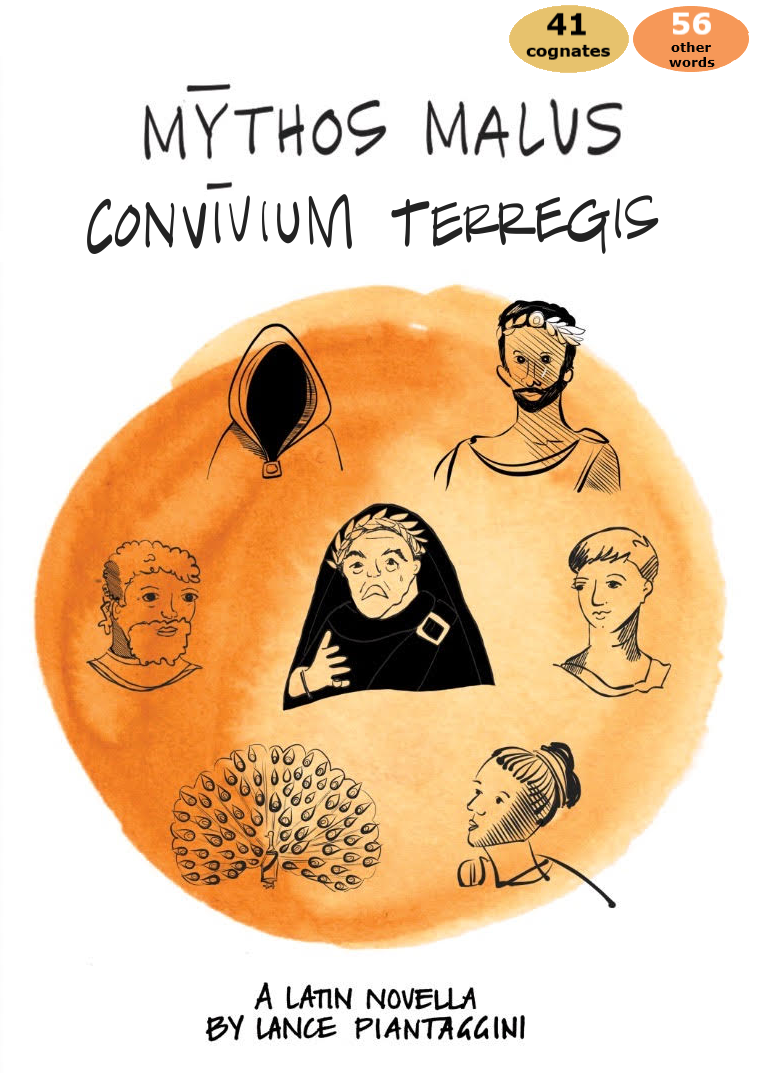
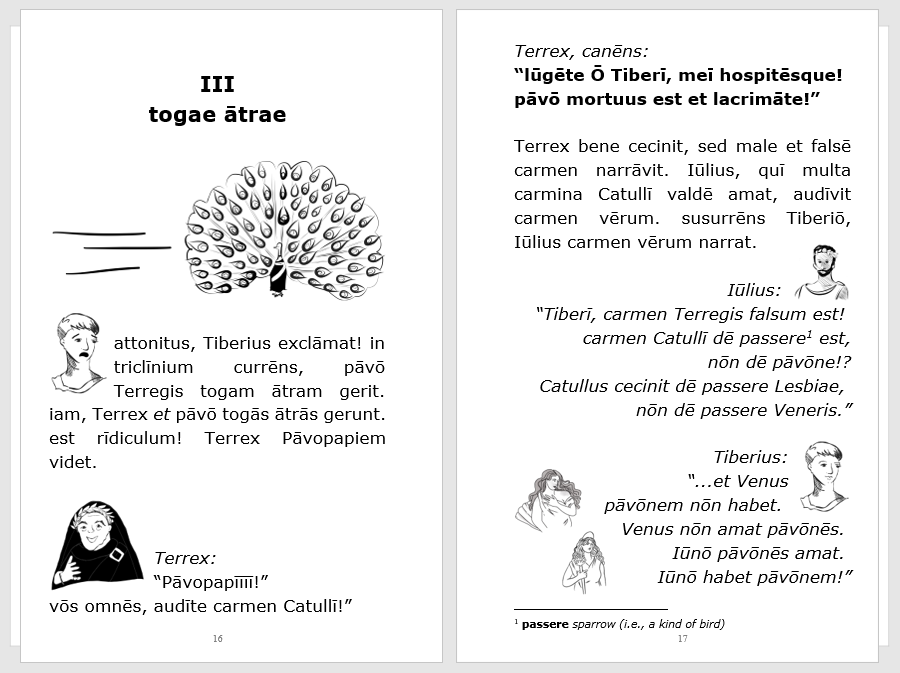
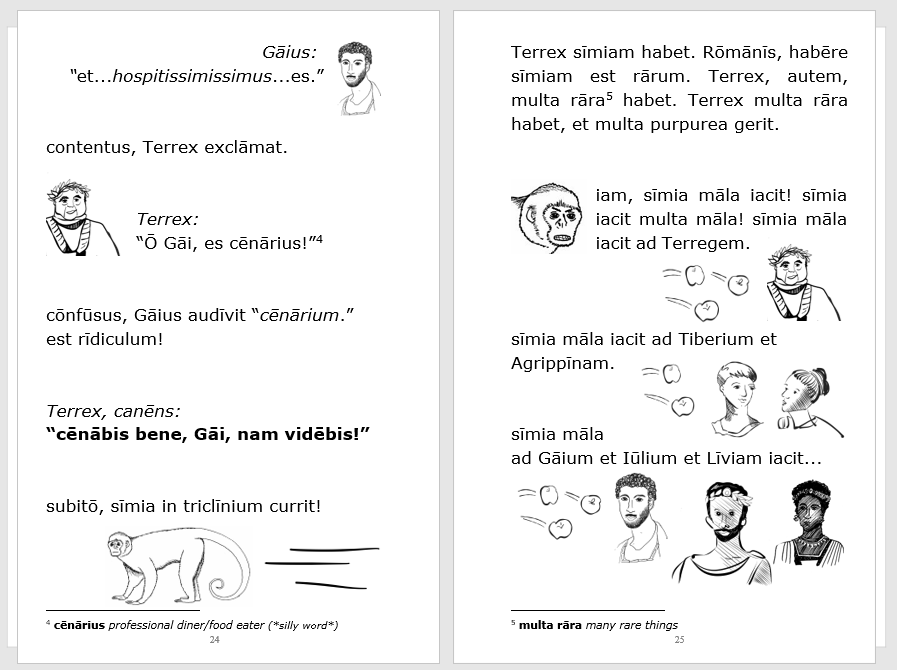
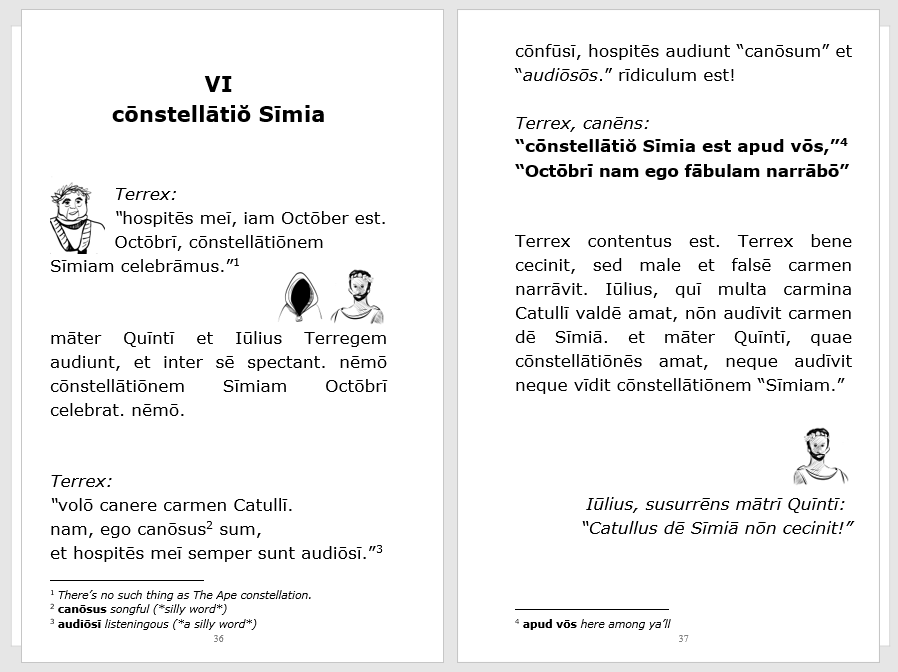
An obvious nod to Petronius’ Cena Trimalchionis, yes, but this is not an adaptation, by any means. In this tale, Terrex can’t get anything right during his latest dinner party. He’s confused about Catullus’ carmina, and says silly things left and right as his guests do all they can to be polite, though patience is running low. With guests fact-checking amongst themselves, can Terrex say something remotely close to being true? Will the guests mind their manners and escape without offending their host?
41 cognates, 56 other words 2600 total length
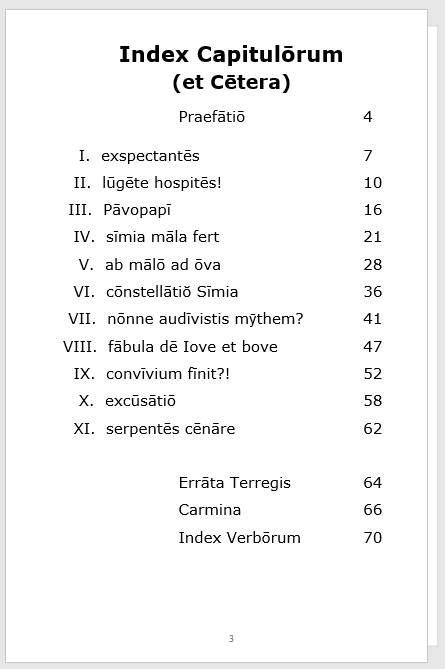
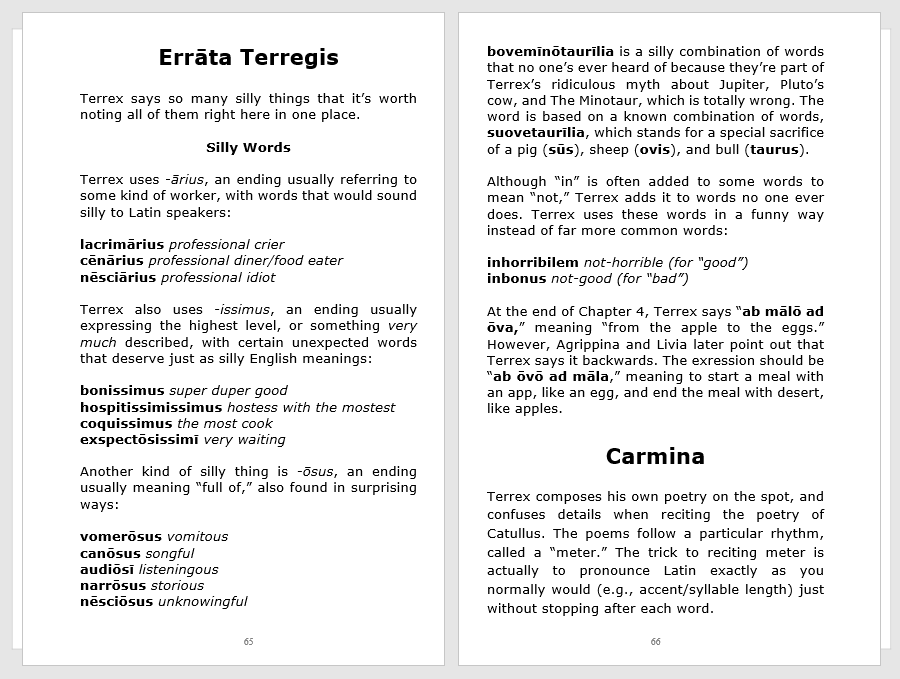
I cannot say this is my last book for good, but it’s the final Pisoverse novella I have planned. It’s probably my most comical book, too, which feels like a nice way to wrap up the series. The novella also fills a gap between the highest word counts of my Beginner level and the few narratives at Low Intermediate. Wordplay is certainly a highlight as Terrex makes up words, though still within conventions of Latin word-formations (see Errāta Terregis screenshot in the slideshow). Anyone with some familiarity with Catullus should get a kick out of Terrex’s blunders, too. In sum, this book is entertaining, for sure.
For Sets, Packs, and eBooks order here (especially featured in Top Picks pack)
For my third poll in a large Facebook group of 12,600 language teachers in this mini-series on inequity and grading, I asked about averaging. A FRACTION of teachers responded this time, with a total of just 80. Compared to the previous poll participants of 585 for late work penalties, and then 625 for homework, I wonder if this is because averaging is something teachers let the gradebook handle without giving it much thought. Most teachers don’t question homework, but they still play a more active role in creating and assigning it, right? Even setting late policies is something teachers…do. Averaging, though? Looks like we might be in a “set it and forget it” situation. The thing is, the gradebook only does what we tell it to (or its default setting), so if we’re not thinking about that, well…
Poll results had the majority (60) doing some kind of averaging. Let’s unpack all that.



 Magister P.