
A frequent complaint of comprehension-based Latin teaching is that students aren’t challenged enough. Critics point to Bloom’s “understanding” level, assuming that everything stops there, imagining students hanging out in the lower-order thinking levels. Given that assumption, the critic’s takeaway is that “CI Latin” is unchallenging, and lacks higher-order thinking.
Untrue.
What is true is that comprehension-based Latin teaching prioritizes understanding as step zero. Under such an approach, nothing is done without first understanding the Latin in front of all students. One immediate implication is that Latin texts must be level-appropriate for beginners in the first years of a new language. And that level is quite low. Therefore, it is true that these texts are at a much, much, much lower level than the kinds of texts traditionally used in Latin classrooms, but that’s just text level. This says nothing about thinking level. Do these truths mean that students do NOT engage in higher-order thinking with these lower level texts? Are students NOT challenged when reading and discussing in class?
Sustained Focus & Discussion
Since students can truly understand the Latin that’s given to them under a comprehension-based Latin approach, challenging coursework comes in the form of a) sustaining focus of reading (and also listening to) copious amounts of Latin, and b) discussing those texts. A traditional Latin approach uses shorter texts of a very, very, very high level, and all discussions are held in English. In other words, there are low amounts of input. One result of this approach is that students don’t get as much exposure to the language in context compared to a comprehension-based approach that prioritizes input. Also, the cognitive demand placed on students when even a small amount of spoken Latin instructions or questioning takes place in class is already higher than the traditional class that’s almost entirely in English. Where’s the challenge? It’s in the sheer increased volume of Latin read (and to varying degrees that which is heard). N.B. This suggests that “CI Latin” is MORE challenging than traditional.
When discussing texts students already understand, it’s the questioning that presents opportunities for higher-order thinking. Students are asked open-ended, and “why?” questions about the content. They’re asked to consider different perspectives, and what they’d do as one of the narrative’s characters. They’re asked how they would end novellas that leave us all wanting more. Sometimes students even do this IN LATIN! Granted, this can be the case under a traditional Latin approach, too. Yet, the difference is there’s no parsing, or translating done beforehand. Under a comprehension-based approach, students can engage immediately in higher-order thinking. Under a traditional approach, however, Latin texts are far too high for that, and require far more steps before engaging with the content in that way. N.B. This shows that “CI Latin” and traditional Latin are AT LEAST equal in terms of higher-order thinking, with the immediacy of “CI Latin” suggesting that it’s MORE challenging than traditional, once again. Regarding those high level Latin texts, they’ve been considered the source of “challenging” work under a traditional approach, though students mainly parse, and translate them in order to understand, which is anything but immediate. If, however, students can simply…read…Latin, then all that “challenging” work becomes unnecessary. Since all that “challenging” work is gone, critics claim that students are unchallenged. Yet how challenging is parsing and translating according to Bloom’s?
Recall
We can easily poke holes in how the basis of a grammar-based approach is recall, which is mostly determined by individual students’ memory, not any pedagogical practice. Let’s pause to recognize how this is Bloom’s lowest level, in fact below the “understanding” level that critics claim is a fault of “CI Latin!” Critics have long considered a grammar-based approach to be “challenging” work, though under scrutiny perhaps it’s more accurate to call it “cumbersome” work. Roughly millions of people would agree. At best, the translating done in a traditional approach falls under “application.” Then again, comprehension-based Latin teachers have students translate, too, only what is already understood and not in order to understand. Once again, these approaches are at least par, though that’s the most amount of hedging we can give. Nonetheless, most of the actual higher-order thinking in traditional Latin classrooms is done in English once that translation has been established. That’s fine, but the more of that going on in a class, the more it should fall under an ELA course, not a World Language one!
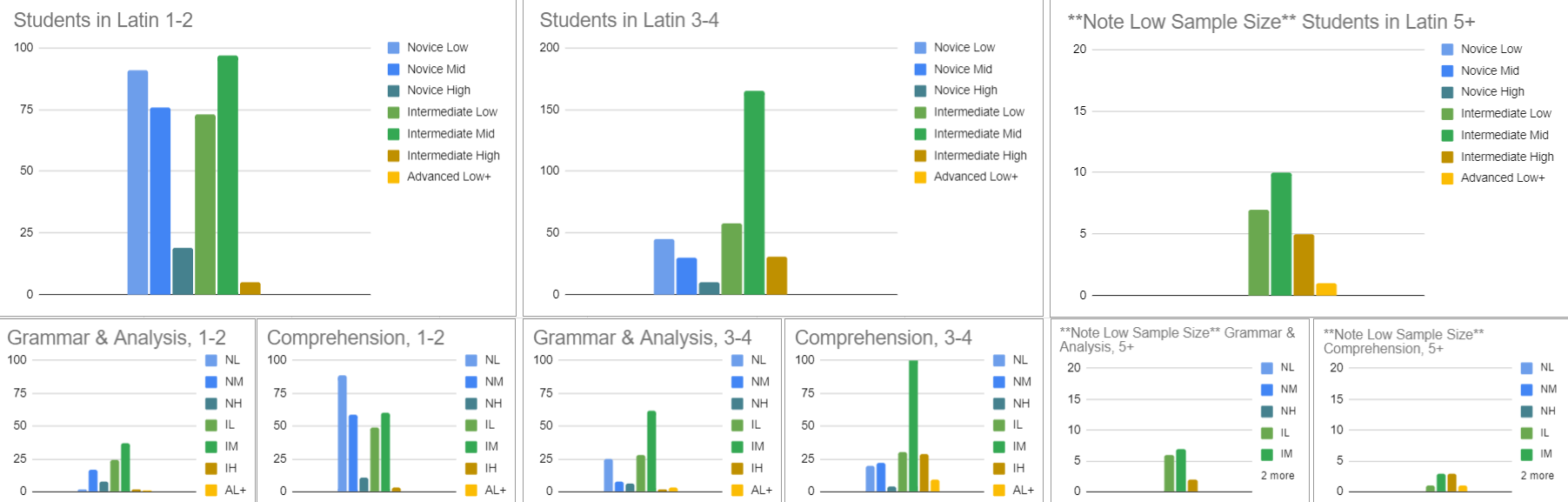
In sum, critics should think twice before claiming “CI Latin” isn’t challenging and that learners hang out in in lower-order thinking levels. Common definitions of what is meant by “challenging” and what falls under “higher-order thinking” are in no way superior to a comprehension-based approach. Furthermore, when direct comparisons are made, a traditional approach might even be less effective, demonstrably. Such is the case with reading proficiency. A comprehension-based approach is at least as effective, and in all likelihood more so. For example, the graphs from this screenshot of the current live data from crowdsourced ALIRA scores would look very different if favoring a traditional program. Interested in more comparisons? Consider helping out by providing your scores! It should take minutes.
 Magister P.