Amazon Novella Cost Increase :(

To clarify, Amazon isn’t increasing their cost to print books. They’re just decreasing royalties paid to authors (for books listed under $9.99), which means that unless many authors agree to earning quite a bit less per book (in my case it’s over 30%), there will be an increase to your cost of purchasing novellas. The good news? It’s only through Amazon purchases…

That is, I encourage teachers to buy directly from authors and novella distributors whenever possible (e.g., my square site, or Storybase Books) since printing costs are remaining the same; whatever deals authors and distributors have struck up aren’t affected by Amazon’s royalty decrease, so you can enjoy lower-cost novellas through them. See this tab on the crowd-sourced novella document on places to get books other than Amazon.

Is there a catch? Not really. Direct purchases tend to have lower list prices than Amazon, though shipping costs added to the order might come as a surprise since they’re hidden by Prime free shipping. For example, most of my books are increasing to $10 on Amazon, but my set of 12 favorite books is $70 plus shipping ($9), not the Amazon list of $120.

On a side note, I’m also taking this opportunity to switch my covers to the glossy format since I’ve heard that the matte versions can get a little grimy over the years, making that really nice original texture end up kind of gross (eww!). Sorry it’s taken so long, JP!

Basics: Summary of Recurring Ideas & Posts

After 10 years of teaching, I left the classroom in 2023. I’ve earned an Ed.S. and passed comprehensive exams in the fall of 2025, making me a Candidate for a Ph.D. in Teacher Education. I research grading and classroom assessment, and work with pre-service educators. Here are my most up-to-date practices—frozen in time like Pompeii or Herculaneum right up to my last day in the classroom—that were fundamental to my teaching, making all the daily activities possible…

Continue reading

KDP Cost Increase, Square Site Still $5/Book

KDP announced higher printing costs. As a result, my novellas on Amazon are increasing to $8. However, I’ve kept the deals on my Square site to about $5 per book to continue supporting teachers getting multiple copies for the classroom. Yes, there is a shipping cost. For everyone used to Prime free shipping, that cost might seem alarming. Yet it’s a reality I’m very familiar with having experience working at a UPS Store. Still comes out cheaper than Amazon, though.

Also, I’ll be updating my novella list over the next month to check prices. That’s about 150 books, though, so if you find a discrepancy, just contact me with the update. Thanks!

Novella Spotlight: diāria sīderum (The Star Diaries)

diāria sīderum is a personal favorite. I think this one is my best, honestly, though it appears to be an unlikely choice for the Classicist Latin teacher. Then again, they’re not the ones reading the book. Students are! The sci-fi/fantasy narrative has a bit of a “who dunnit?” feel to it, with students seeking to figure out what made the book’s ancient culture disappear. It’s in three parts using half cognates. The first part has 30 cognates and 30 other words (i.e., 60 total), and the other two parts add 20 and 20 words to that, respectively (i.e., 100 total). It was written so that my Latin 1 class could read a 1000-word long intro to “The Architects” in Part 1 to get a sense of what was going on just before their disappearance. Then, during independent reading, anyone interested could finish Parts 2 and 3 that provide more clues as to what happened.

And that might not be everyone…

Continue reading

Quīntus et āleae īnfortūnātae: Published!

Quintus is a gamester who really likes to gamble. The problem? He’s terribly unlucky and never wins! In this tale, Quintus gets himself into a dicey situation, betting all sorts of valuables he can’t afford to lose. Will he come out on top, or lose it all in the end?

16 cognates, 34 other words
840 total length

This is my third novellula written to be short, very much on purpose. Since Latin novellas first started popping up, teachers have noted that the whole-class reading experience can drag on for beginners. I’ve been finding that books under 1,000 total words seem best for a quick read at the start of Latin 1. This new tale is about gaming! I grabbed some dice-cups, dice, and knucklebones online to play as we read the book. Give it a try. Enjoy!

  1. For Sets, Packs, and eBooks order here
  2. Amazon
  3. eBooks: Storylabs

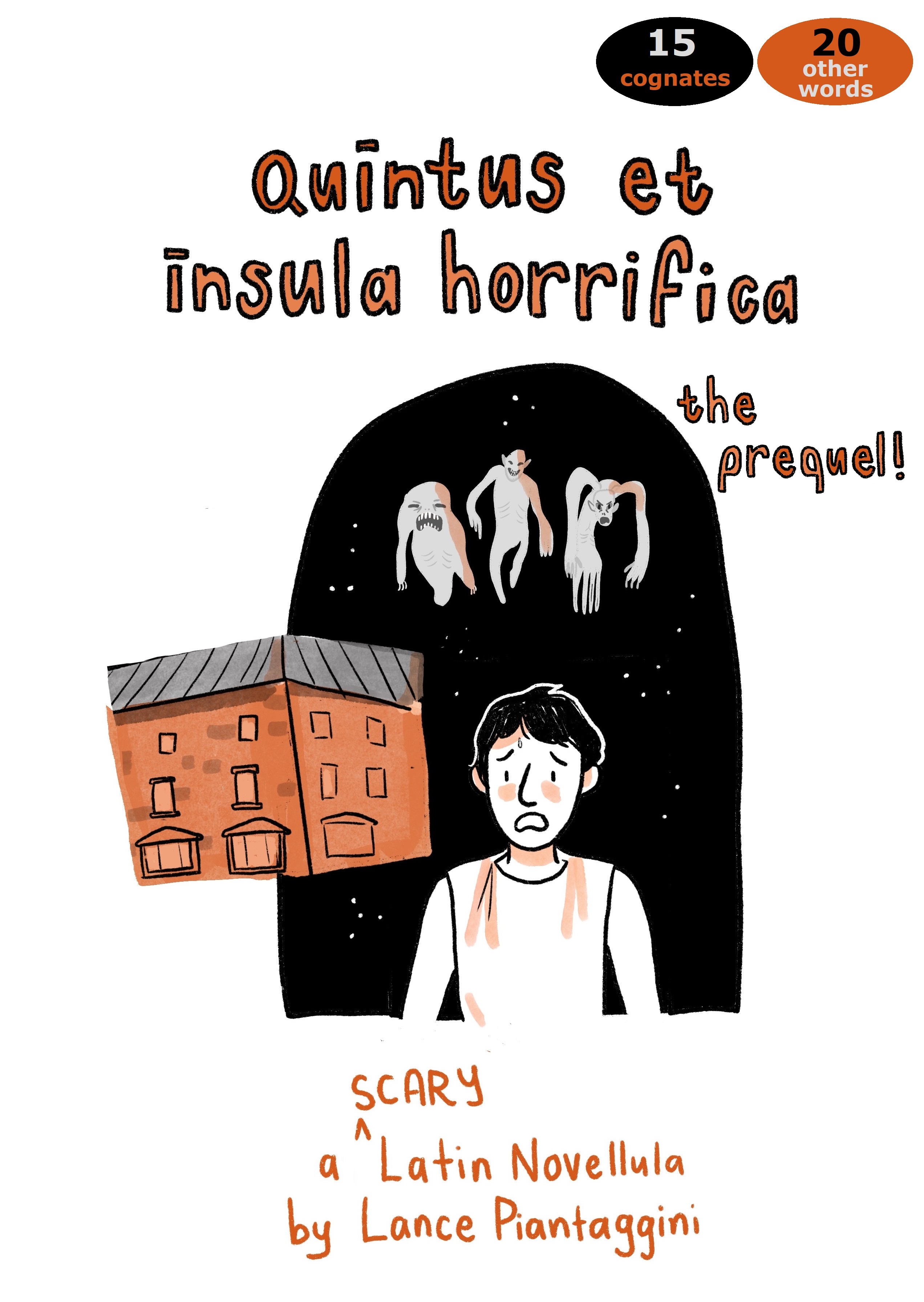
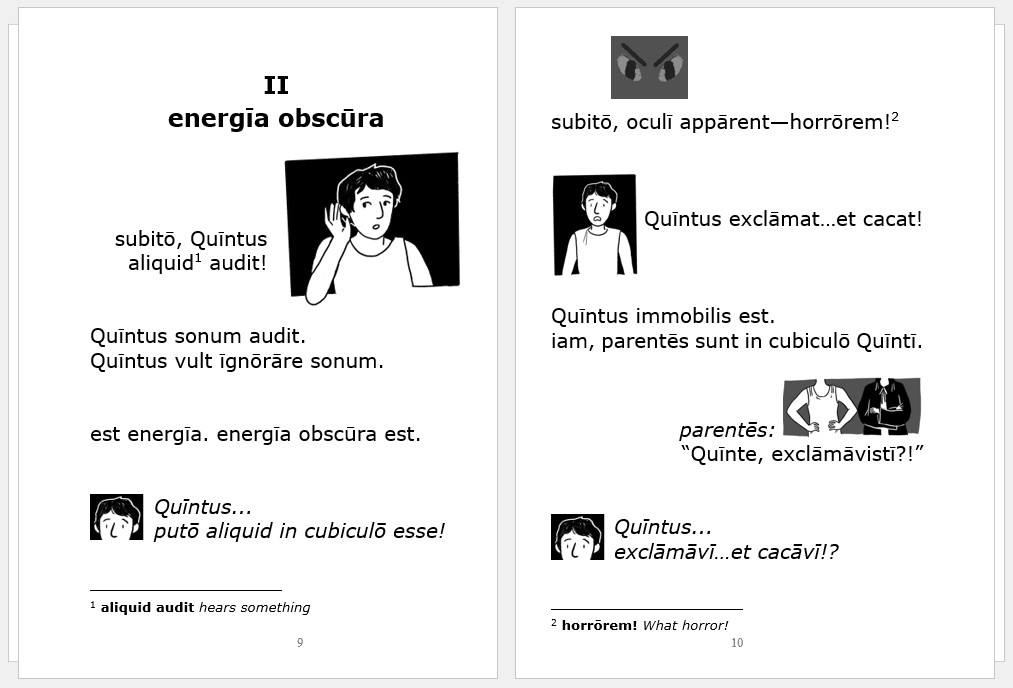
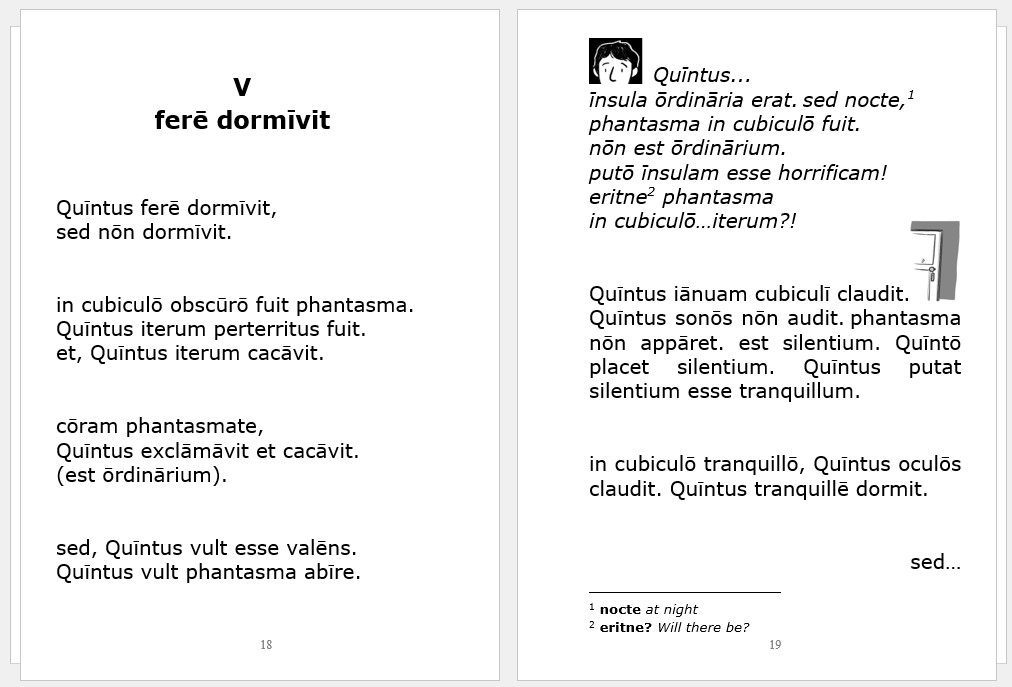
Quīntus et īnsula horrifica (the prequel): Published!

Before Quintus and his parents had money and moved into their house, the family lived in a small Roman apartment. Times were simpler back then, but no less spooky! In this tale, Quintus is 100% scared of the dark, but wants to appear brave in front of his parents. To make things worse, Quintus receives paranormal visitors night after night…or does he?

15 cognates, 20 other words
750 total length

This one’s real short, on purpose. I’ve had the most success in class with the shortest books. Since Latin novellas first started popping up, teachers have noted that the whole-class reading experience can drag on for beginners. Therefore, books around and even under 1,000 total words seem best for a quick read at the start of Latin 1. This book is a prequel to Quīntus et nox horrifica. The new book is similar in reading level and scope to our first books read, Mārcus magulus and Olianna et obiectum magicum. It draws vocab from them, too. īnsula horrifica could also act as a stepping stone to the original for students who want to read what is now “the sequel” on their own once independent reading begins.

Beyond that, the content mirrors what has been our comparison of elite Roman villas and common apartments. This is part of our exploration of Roman topics in Latin 1, and this new book provides a backstory to the social mobility Quintus’ family experiences. Lots to talk about. Or not, and just read for entertainment. Also, there will be an audiobook just like the original tale. We’ve got until October for that, though. Stay tuned. Enjoy!

  1. For Sets, Packs, and eBooks order here
  2. Amazon
  3. eBooks: Storylabs

Pīsō senex et sempermūtābilisyllabī: Published!

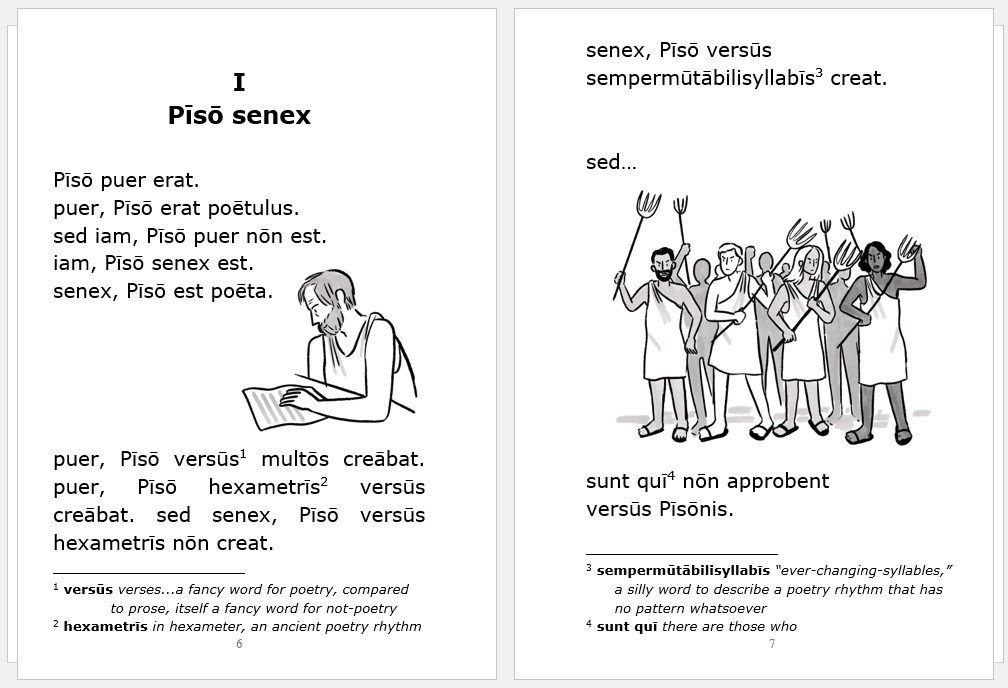
Piso has grown old. For years, people have been telling Piso how to write his own poetry. They’ve wanted it to sound like the legendary poet, Vergilimartivenallus, widely considered the GOAT, but Piso doesn’t take suggestions from those who don’t write any poetry of their own. Besides, that would change Piso’s verses into something they aren’t—someone else’s. He’s got plenty of advocates, anyway. But the mob persists, and keeps trying to get Piso to change how he writes. Mysteriously, the more Piso tries to write in his own voice, the more things start to get a bit…Strange.

18 cognates, 26 other words
800 total length

Who wants satire? I do, I do! You should know that no hexameter was harmed in the writing of this novellula (<– that word is even in the subtitle). In fact, we skipped the meter [almost] entirely. That’s basically it. Oh, and if you’re familiar with Pīsō et Syra et pōtiōnēs mysticae, and/or a personal favorite, diāria sīderum, there’s some stuff in here for ya. So, let’s welcome another <50-word tiny little book to the collection.

  1. For Sets, Packs, and eBooks order here
  2. Amazon
  3. eBooks: Storylabs

“What Novellas Do You Buy, Magister P?”

All of them.

When someone shares the latest novella to the Latin Best Practices Facebook group, I add it to my list, then drop the link into my budget/item request form at school so I can get a copy. I order one, read it, then order more if it’s gonna work well for first year Latin students. I’ll order a lot more if it’s a hit, or maybe 1-2 if it seems good but a little above reading level. Once I notice students always going for a particular title during independent reading time, I might even order enough so we can read some of the book as a whole class. N.B. no, I don’t always finish books as a whole class, especially if it’s been more than 3 weeks of reading.

Continue reading

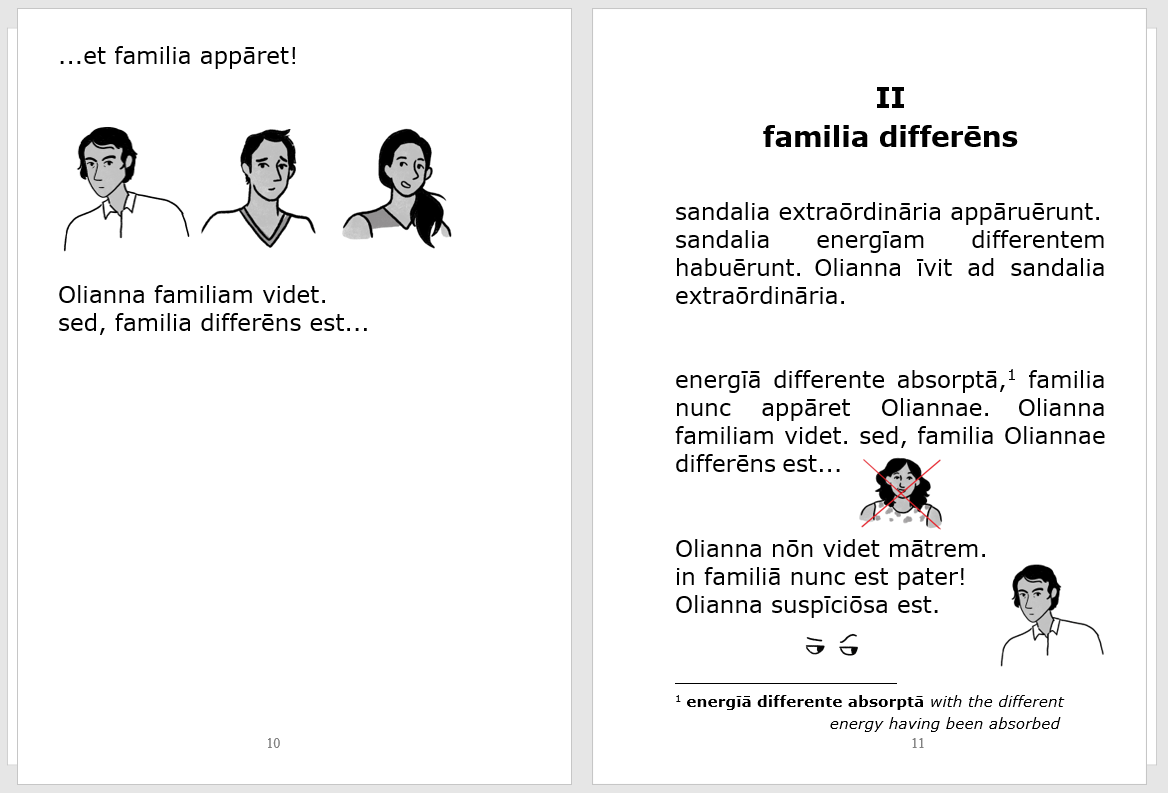
Olianna et sandalia extraōrdināria: Published!

Olianna learns more about herself and her family in this psychological thriller continuation of “Olianna et obiectum magicum.” We begin at a critical moment in the original, yet in this new tale, not only does the magical object appear to Olianna, but so do a pair of extraordinary sandals! Olianna has some choices to make. How will her decisions affect the timeline? Will things ever get back to normal? If so, is that for the better, or worse?


20 cognates, 20 other words
1500 total length

While many Pisoverse novellas contain references to each other, none of them are what I would consider a sequel. This new book is different, though, picking up immediately in mediās rēs of an event towards the end of Olianna et obiectum magicum. As a true sequel, then, Olianna et sandalia extraōrdināria was deliberately written to include almost all the vocab from the original. The result is a book with 40 words, but just half are new. This reduces the vocab burden for any reader already familiar with the first book.

  1. For Sets, Packs, and eBooks order here
  2. Amazon
  3. eBooks: Storylabs

Latin Criticism: Two Broad Categories

Two years ago, almost to the day, I wrote about Latin shaming in what’s turning out to be a quasi-annual public discussion on Latinity (i.e., quality of Latin). In 2020, the discussions concerned Latin spoken in the classroom as well as published works. This year, I’m told the focus is on novellas, which might have something to do with their proliferation. After all, in February of 2020 there were 52 books. Having doubled that number to 113 as of last week, and going from 18 author voices to 26, there’s a lot more different Latin being written now. Different Latin must lead to more opinions about that Latin. Granted, I haven’t been a part of these public discussions myself, but word gets around. Perhaps the 2023 panel on what it means to teach students to actually read Latin has spurred the latest round of things-Latīnitās. I have no idea for sure. Suffice to say that Latin shaming still plagues the profession. Instead of full-out shaming, though, this post sticks to general criticism. In my experience, there are two broad categories of criticism: that which matters, and that which doesn’t…

Continue reading