Revised AP Latin 2025: Good News…Still Bad News…And Maybe Even Worse News

**Update 7.20.23 – This post was SOMEHOW deleted and nowhere in my trash folder?! I’m guessing it occurred when WordPress updated to the JetPack app. I know, you don’t care, but I Just wanted to say that I found the post in its ENTIRETY using the Wayback Machine. Here it is if you wanna see!**

When the draft of the new revised AP Latin course was released, I simultaneously couldn’t care less yet was also amazingly intrigued. So, I did another analysis like the one a few years ago. In short, the good news is that 1) the total amount of Latin has been reduced by about 25%, 2) quite a bit of “OTHER” Latin has been suggested as comprising a third of the overall syllabus alongside Virgil & Pliny, and 3) the revised course has been officially recognized as a second year college equivalent. Now, the bad news…

The Same
The revised course is fundamentally the same. While the draft name-drops the trending “language acquisition” phrase, the core texts are still very, very far above the reading level of nearly every student who will take AP Latin. This, in no way, is a tenet of language acquisition, whatsoever. Even methods and theories encouraging a “productive struggle” would draw the line well before anything like Vergil & Pliny after a few years of a new language. Beyond that, most high school students have no business taking a second year college course, anyway. BuT Ap Is AdVaNcEd, RiGhT?! Sure. The problem, though, is all the schools that choose AP as their program capstone without any other option, weeding out kids who “can’t cut it,” and/or backwards designing the whole program down to freshmen year (or lower for “feeder” middle school programs). When AP is used this way—which is very common—most students are denied a senior year language experience, or are unnecessarily forced to struggle through the content.

Core Text Vocab
The revised Vergil & Pliny selections vocab comes to:

  • 5,500 total words in length
  • 3,500 forms (i.e. aberant + abest = 2)
  • 1,800 meanings/lemmas (i.e. aberant + abest = 1 meaning of “awayness”)*

This particular Vergil & Pliny content not as bad as the current Vergil & Caesar content (i.e., down from 11,700 total words in length, 5,700 forms, and 2,600 total meanings/lemmas). Progress, right? But still nowhere close to what typical students have acquired by senior year. Using the same generous figure of seniors knowing 750 words by the time they begin AP coursework, there’s still more unknown than known vocab. Like, way more (i.e., 1050 unknown words of Vergil & Pliny remain!!). The AP draft also states that “the focus of the course is continued Latin language acquisition with the inclusion of some textual analysis and contextualization skills.” Uh…some…analysis and contextualization skills?! If the focus were actually on acquisition, students would be reading a LOT. To be clear, students still won’t be reading this kind of Latin. To truly “read” these texts, students would need to understand 98% of the Vergil & Pliny selections to have a chance at comprehending what’s going on (see Text Coverage). That ain’t gonna happen. But there’s more, and it might be worse…

The stats so far represent just 65% of the AP syllabus content!

Teacher Choice
The AP draft outlines setting aside about 1350 total words of poetry and 1650 total words of prose, all of the teacher’s choosing. This constitutes a third of the revised course content aside from Vergil & Pliny. Now, for this analysis, I got lucky with randomly choosing the recommended Ovid passages from Metamorphoses (i.e., 1450 words), and the Ciceronian letters (i.e., EXACTLY 1650 words). When we add these texts to the core Virgil & Pliny, unfortunately, we get a chart that basically mirrors the current AP one:

While the 2025 AP draft shows the total amount of Latin being reduced by about 25%, it turns out that the vocab difference is only about 4% less (i.e., 2600 total words currently vs. 2300). Progress…right? Here are a few different charts to help visualize all that:

Wildcard
Yet I chose Ovid & Cicero. The big wildcard is Teacher’s Choice portion of the AP syllabus. Surely, the impact of choosing text Y or author Z will vary, yet by how much? I was curious about that impact, but I do have a day job, other hobbies, and Ph.D. coursework to do. Rather than look at multiple combinations of poetry and prose, perhaps looking for the most extreme outcomes, I kept Ovid and replaced the Cicero letters with different prose selections amounting to ~1650 words of Latin to see what came up.

Starting with Sallust (Bellum Catilinae,, 5-15), the results were pretty close with just 10 more words added given all the vocab in common with Vergil, Pliny, and Ovid. Next, I pieced together an assortment of Gellius’ Vestal passage in Noctes Atticae (1.12), Eutropius’ founding of Rome in Breviarium Historiae Romanae (1.1-8), and the first five characters of Hyginus’ Fabulae. After all, the stated point of including this “OTHER” Latin is for encouraging teachers “to explore Latin texts from different time periods written by a variety of authors.” The difference between using this assortment of selections instead of Cicero wasn’t staggeringly worse. Then again, it did add about 50 more unique words, increasing those vocab demands, now coming within 200 words of the current AP syllabus!. The point? The Teacher’s Choice portion—a third of the AP syllabus—has the potential to meet (surpass?) the vocab demands of the current AP!

In sum, the revised AP course seems to be an all-too-common case in education: making progress in some areas yet ultimately falling short of addressing a fundamental problem. The 2025 AP is basically the same old thing (i.e., vocab demands are very close to the current AP with just ~4% fewer words) wrapped up in new packaging. I’m sure it will appeal to more teachers, but it doesn’t seem to deliver much else in terms of pedagogical improvements besides reduced workload and a tip of a hat to everyone reading “OTHER” Latin. So, maybe 2035 draft will be promising? I’ll be long gone from the classroom by then. Best of luck to everyone out there!

*Once again, for this analysis mostly done via Voyant Tools & Google Sheets, I rounded to the nearest 100, in the AP’s favorErrors are unlikely to change things remarkablyand in all likelihood the situation is a little worse than what you see.

Pedagogical Immunity

Certain learners exist who possess what seems like complete immunity to whatever pedagogy they’re subjected to. College students are a good example. Professors rarely have pedagogical training, which is perhaps the most ironic thing about those in charge of training pre-service primary and secondary teachers, but most college students are able to persist through a lack of solid pedagogy. How? Using their interests, some independent learning skills, and a bit of determination. Polyglots are another good example. They’ll learn many languages under all sorts of conditions that don’t transfer to others, claiming they found “the secret,” yet relatively few who adopt their “methods” report success (except for other…polyglots!). Upon thinking this over, many high school students—and not just those studying a second language—are often pedagogically immune, too. These students manage to pass courses even when teachers have wacky pedagogy with unhelpful practices. Consider the teacher using some pre-fab curriculum with loads of busywork. Students will put up with all that busywork. They might not learn much, but they’ll earn credit, then graduate. In that sense, then, these students made it through. They were immune (though not to learning…which we’ll get to). They just made it past the next level. They…”succeeded.”

Continue reading

“Lowered Expectations”

There appears somewhere, in some publication, the following quote:

“…though he does not lower his expectations and students really do still have to memorize things.”

The source isn’t important. The “he” doesn’t matter (it’s not me, btw). It’s the rest of this statement that deserves a duly critique, not an ad hominem. Shall we?

Assumptions
In my research, I’ve been learning about “positionality,” which is making one’s interests, motivations, and assumptions known. I’ve also heard these referred to as “priors.” A researcher’s assumptions might be found in their theoretic framework section, which allows readers to understand the perspective, and situate the entire study. For example, the same study could be conducted by two teachers: one whose theoretical framework supports comprehension-based language teaching, and another who rejects that. Everything, from the epistemological view to the research question(s), data collection, interview protocol, analysis and interpretation—all of it—rests upon one’s assumptions. Well, in unpacking the quote above, we can identify three assumptions:

Continue reading

Text Coverage & DCC’s Top 1000

**Updated 2.25.21 with details from this post**

The DCC frequency list is often consulted for choosing which words to use when writing Latin for students. It certainly makes sense to use ones they might encounter over and over again vs. those they might not, but *how* frequent are these frequent words? In particular, I was curious what a student could probably read having acquired the Top 1000 words on DCC’s list. Here’s some quick background…

Continue reading

Latin Students & Scholars

When looking at other not-Latin course curricula in schools, it occurred to me that Latin classes are typically taught as if all students will become Latin scholars. That’s kind of crazy. What’s even crazier? Most teachers don’t have the expectation that all, or even some of their students will become Latin scholars. However, it’s definitely how Latin has been taught, historically (re: goals not aligned with practices). Sure, some schools have the “honors” distinction, making other courses “college prep,” and a common goal of the K-12 system is to prepare students for college. However, does every subject prepare its students to be scholars of that subject before they get to college?

No way.

Let’s look at some examples. I asked my colleagues if a student could a) go on to study their content area’s major in college without taking additional electives beyond basic high school graduation requirements, or b) would they need that kind of boost to get into a program and become a scholar in the field? These were the responses:

Math
“That’s a great question. For the most part, the specialization or focus on math would occur in college. While it would definitely be beneficial for a student to have already taken Calculus or Statistics, AP or otherwise if they’re entering a math field, it’s not necessary. They would still be able to take those courses offered at the college level and pass, assuming they had gained the necessary prerequisite knowledge from their high school courses.”

Science
“In terms of jumping into a science major with little to no background, I think this is the case with the majority of students. They will certainly pick it up in college. YES – high school students could hypothetically have had no science and still become scientists.

ELA
“No typically they would just jump in with 100 level intro courses.”

So, high school courses provide the same level of understanding to both humanities-bound students and STEM-bound students, regardless what students are goin on to study, and it’s only in college that study begins to get specialized. Just as you wouldn’t expect every high school graduate to be a math scholar, every student shouldn’t be expected to be a Latin scholar, right? Yet the literature Latin students are asked to read—typically—is waaaaaaaaay too high. If high school graduates of every subject start their college major at a 100 level course, why are Latin students—in high school—expected to read literature you’d expect in a 200, 300, or even 400 level college course?! There’s just no solid rationale for this scholar-level of study to begin in high school.

To boot, the real story is a bit more grim when you consider how many Latin students bound for Classics programs *do not* continue at that supposed level anyway, instead repeating basic 100 level Latin courses once in college anyway. So, if every high school program prepares students to be independent learners, pursuing whatever major they want in college, why on Earth have Latin teachers been fussing around with texts waaaaaaay beyond the reach of what’s level-appropriate, even to become a scholar in that field?!?!?!

It’s inexplicable.

“Not-Reading” Synonyms

It would take a proficient Latin speaker about 7 hours to read Caesar’s Dē Bellō Gallicō—in its entirety*—at a slow pace (i.e. half the average reading speed).** For comparison, a proficient English speaker reading at the same pace would take over twice as long to get through The Hate U Give (~15 hours). One of these texts is level-appropriate, and now commonly used in 9th grade classes along with 4-5 other full length books and many other short texts throughout the year. The other is nowhere near level-appropriate, yet commonly used in 11th or 12th grade classes as roughly half the year’s focus—certainly not in its entirety—with selections comprising just 13% of the full text. It should be clear which is which, and any K-12 teacher who says their students read Caesar is being as truthful as today’s outgoing president, who has mislead and lied over 29,000 times in office.*** Yet if not an outright lie, the claim of reading Caesar is still highly misleading, and should be addressed ASAP…

Continue reading

1969: 50 Years of “4%ers”

Just a few months after the moon landing, Superintendent John Lawson (Shaker Heights, OH) gave a speech at the Symposium on Foreign Language Teaching at Indiana University. Its age certainly shows. Then again, were it not for the typeface, you’d think some of these statements appeared yesterday in a blog! I find it striking that such “progressive” and “controversial” ideas have been discussed for 50 years, pretty much coinciding with the civil rights movement, yet without much fundamental change to either. There’s no excuse for the latter. As for second language teaching, that’s slightly more understandable considering the field of Second Language Acquisition (SLA) was hardly established by the late 60s.

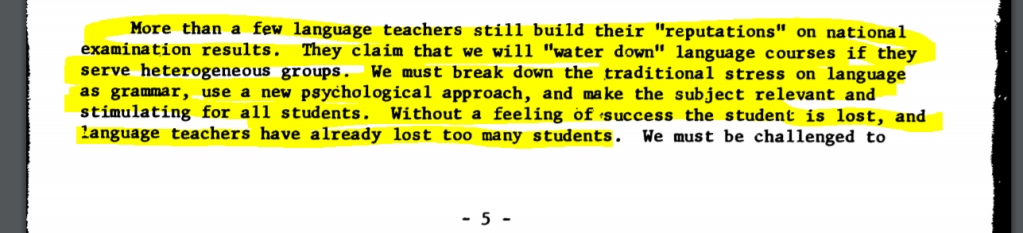
To give you a sense of how relevant Lawson’s ideas are today, look at this statement addressing the importance of compelling topics, and what now has become criticism against using unadapted texts driving the AP Latin problem:

There’s also a section, while brief, managing to address topics like teaching to the test, teacher perception of status in their field, elitism, exclusivity, ineffective pedagogy, compellingness, connectedness, comprehensibility, and confidence. All that back in 1969. Holy moly, right?!

That speech also happens to be the source of the “4%er” term that Keith Toda just shared in his latest (and last-for-a-while) blog post. Now, Keith is somewhat of a self-proclaimed man of the shadows not really active on social media, so my first thought was that he didn’t know the “4%er” term doesn’t really come up these days. In fact, I had to go back to a 2015 moreTPRS list email to search for the references contained in here! But maybe that term is exactly what teachers need to be reminded of right now. Let’s start with its history:

Continue reading

The Cost Of Education: Value Analysis & Equity

Right now, I’m filling out our department wishlist request form for next school year. There are 81 novellas, and 10 textbooks for AP (five Caesar, five Virgil). The total cost of novellas is $691.91, and the total cost for the textbooks is $710. The $710 would cover five students enrolled in AP. The $691.91 will fill my FVR (Free Voluntary Reading) library to include everything currently published, as well as build two additional libraries in other teachers’ classrooms, covering all Latin students at our school.

This all got me thinking of some big questions.

  • When funds are tight, who do they tend to go to?
  • How many Latin programs would choose to fund the five AP students over the rest?
  • What does the decision to offer AP really cost a school beyond the $93 exam fee (i.e. teacher training, materials, etc.)?
  • Given what we know about AP Latin, how much time, effort, and money should be allocated?
  • How do we place value (beyond $) on different classroom materials?
  • Which materials provide the most purposeful CI?
  • What’s essential? What’s extra?

Forced Input

There’s plenty of talk about forced output (i.e. when students are told to produce language beyond their proficiency level), yet not much has been said regarding forced input. Forced input occurs when students are given a text above their reading level, or told to listen to something beyond their comprehension. Perhaps this is even assigned, and affects the course grade. Forced input also occurs when students are given or assigned anything that lacks a communicative purpose. Forced input is not very meaningful at best, and incomprehensible at worst, which means the target language is less likely to be processed and acquired. Are you forcing input? Let’s see…

Continue reading