Something Strange…

Before I started teaching in 2013, I joined the moreTPRS Yahoo list serve. Then in 2015, I joined Ben Slavic’s PLC. At that time, there were daily—DAILY—conversations about Second Language Acquisition (SLA), with really tough questions being asked, answered, and debated ad nauseam. Then Tea With BVP was launched, with weekly shows until 2018—here are my clips down to the nuts & bolts. N.B. That show was rebooted in a different iteration as TalkinL2 until just about a year ago. Needless to say, I learned a great deal in those five years; far more, in fact, than in my MAT program (no offense, just a result of SLA expert-lacking faculty nationwide).

I cannot overstate this enough when I say that those early years were simply *crucial* in the development of what we all learned about SLA, and teaching languages. Furthermore, what we now know has also been around for like 10, 20, 30, even 40 years beforehand! That is, most scholarship in the last decades haven’t really changed the game of what’s been discussed since the 70s. The problem? This stuff wasn’t (isn’t?) mainstream—at all. That “golden age” of my SLA development involved the constant interaction with perhaps 200, maybe 300 teachers, almost all of whom I can reach out to with a click. I also had direct access to researchers, their ideas, as well as teachers implementing and arguing about what is, essentially, “best practice” for teaching languages in schools. When we didn’t understand, we emailed and got answers. And we were fringe. Having been exposed to the same ideas over and over—not just Krashen & VanPatten—thankfully from a variety of perspectives courtesy of Eric Herman, a solid understanding of universal truths (as much as we can call them that in the field of SLA) was being discussed.

Don’t get me wrong. There was a LOT of disequilibrium that nearly everyone had to face (e.g. “wait, so you’re saying that…”), and it was not without major headaches. After all, teachers’ worlds were literally being turned upside-down (no, I do mean literally like what you thought was the cause was just a result). Even the researchers’ ideas were challenged—by “mere” teachers no less—and fruitful discussion emerged, like when Carol Gaab demanded a concrete response about whether co-creating a story was a communicative act (i.e. had purpose). N.B. Yes, it is; entertainment. There was significant growth at that time, but it wasn’t all roses. We could call a spade a spade, or at least all come to agreement that a heart was definitely not a spade, and then talk about how to make that heart into a spade. Granted, this was within the fringe group of hundreds of teachers who had that shared experience, but there was definitely some kind of “tell me if what I’m talking about is complete nonsense” agreement. Whatever it was, it now feels like he heyday of theory to practice and critical looks at each others’ teaching.

Then…

Continue reading
“Not-Reading” Synonyms

It would take a proficient Latin speaker about 7 hours to read Caesar’s Dē Bellō Gallicō—in its entirety*—at a slow pace (i.e. half the average reading speed).** For comparison, a proficient English speaker reading at the same pace would take over twice as long to get through The Hate U Give (~15 hours). One of these texts is level-appropriate, and now commonly used in 9th grade classes along with 4-5 other full length books and many other short texts throughout the year. The other is nowhere near level-appropriate, yet commonly used in 11th or 12th grade classes as roughly half the year’s focus—certainly not in its entirety—with selections comprising just 13% of the full text. It should be clear which is which, and any K-12 teacher who says their students read Caesar is being as truthful as today’s outgoing president, who has mislead and lied over 29,000 times in office.*** Yet if not an outright lie, the claim of reading Caesar is still highly misleading, and should be addressed ASAP…

Continue reading

The Problem Is Vocab, Not Grammar

This post is not about teaching grammar. This post is about its role in comprehension. Grammar can tell you a word’s function, but what impact does that have if you’re struggling to understand what words mean?! It’s still all about words. In fact, all words contain grammar. If you know what a word means, you’re a little bit closer to acquiring its grammar each time you encounter it. In this post, I use a language I’ve made up for other demonstrations, aptly dubbed Piantagginish, to show how vocab—not grammar—is the real problem regarding comprehension. The pedagogical takeaway is to avoid vocab overload, and shelter vocab whenever possible…

Continue reading

CI, Equity, User-Error & Inequitable Practices

I don’t agree that the statement “CI is equitable” is harmful. Yet, I also don’t think the message behind “CI isn’t inherently equitable” is wrong, either. John Bracey said one can still “do racist stuff” while teaching with CI principles. Of course, we both know that’s an issue with content, not CI. Still, I get the idea behind that word “inherent.” In case you missed the Twitter hub bub, let me fill you in: People disagree with a claim that CI is “inherently equitable,” worried that such a message would lead teachers to say “well, I’m providing CI, so I guess I’m done.” I don’t think anyone’s actually saying that, but still, I understand that position to take.

Specifically, the word “inherent” seems to be the main issue. I can see how that could be seen as taking responsibility away from the teacher who should be actively balancing inequity and dismantling systemic racism. However, teachers haven’t been as disengaged from that equity work as the worry suggests. I’ve been hearing “CI levels the playing field” many times over the years from teachers reporting positive changes to their program’s demographics. What else could that mean if not equity? But OK, I get it. If “inherent” is the issue, maybe “CI is more-equitable” will do. If so, though, at what point does a teacher go from having a “more-equitable” classroom to an “equitable” one? And is there ever a “fully-equitable” classroom? I’m thinking no. So, if CI is central to equity—because you cannot do the work of bringing equity into the classroom if students aren’t understanding (i.e. step zero), and nothing has shown to be more equitable than CI, well then…

For fun, though, I’ll throw in a third perspective. Whereas you have “CI is equitable” and “nothing makes CI equitable per se,” how about “CI is the only equitable factor?” I’m sure that sounds nuts, but here it goes: Since CI is independent from all the content, methods, strategies, etc. that teachers choose, as a necessary ingredient for language acquisition, CI might be the only non-biased factor in the classroom. Trippy.

I don’t think that third perspective is really worth pursuing, though, so let’s get back to the main points. Again, I understand the message behind “CI isn’t inherently equitable” as a response to “CI is equitable.” However, I suspect the latter is said by a lot of people who aren’t actually referring to CI. Don’t get me wrong; some get it, and are definitely referring to how CI principles reshaped their language program to mirror demographics of the school. However, others are merely referring to practices they think is “CI teaching.” This will be addressed later with the Dunning-Kruger Effect. Otherwise, let’s talk equity…

Continue reading

1969: 50 Years of “4%ers”

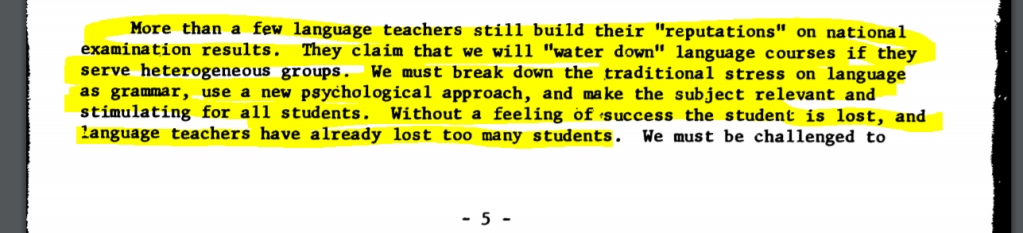
Just a few months after the moon landing, Superintendent John Lawson (Shaker Heights, OH) gave a speech at the Symposium on Foreign Language Teaching at Indiana University. Its age certainly shows. Then again, were it not for the typeface, you’d think some of these statements appeared yesterday in a blog! I find it striking that such “progressive” and “controversial” ideas have been discussed for 50 years, pretty much coinciding with the civil rights movement, yet without much fundamental change to either. There’s no excuse for the latter. As for second language teaching, that’s slightly more understandable considering the field of Second Language Acquisition (SLA) was hardly established by the late 60s.

To give you a sense of how relevant Lawson’s ideas are today, look at this statement addressing the importance of compelling topics, and what now has become criticism against using unadapted texts driving the AP Latin problem:

There’s also a section, while brief, managing to address topics like teaching to the test, teacher perception of status in their field, elitism, exclusivity, ineffective pedagogy, compellingness, connectedness, comprehensibility, and confidence. All that back in 1969. Holy moly, right?!

That speech also happens to be the source of the “4%er” term that Keith Toda just shared in his latest (and last-for-a-while) blog post. Now, Keith is somewhat of a self-proclaimed man of the shadows not really active on social media, so my first thought was that he didn’t know the “4%er” term doesn’t really come up these days. In fact, I had to go back to a 2015 moreTPRS list email to search for the references contained in here! But maybe that term is exactly what teachers need to be reminded of right now. Let’s start with its history:

Continue reading

Weekend-Working Teachers: Just Wait

When I present at conferences and give in-school PD on the topics of grading, assessment, and/or planning, I like to share this slide that includes all the jobs I’ve held prior to (and during!) teaching:

One use of this slide is to show how I approach teaching as a job just like any typical worker would do. That is, when the work day is over, the work day is over. I effectively “punch out” of teaching at the end of the school day, and return to work on the next “shift,” no questions asked. I share this because most teachers are anything but your typical worker, which has significant implications. A lot of them go from one classroom as students themselves straight to another classroom as teachers with little to no experience in any other profession, perhaps besides college work study or a part time job in high school. Some are so fortunate that they never had to work before they began teaching. That means teaching the only example of work to many (most?). There’s a big problem with that…

Continue reading

What CI Isn’t (reboot)

**Updated 5.1.2020 with CI is not immersion.**

Nearly three years ago, I wrote about misunderstandings I kept observing with the term “CI.” Since then, CI has not changed at all, of course, but my own use of it has. I now tend to avoid the term because it’s been misrepresented at best, and corrupted at worst. Whenever I can, I refer simply to “input” because in a comprehension-based and communicative language teaching (CCLT) approach, comprehension (C) is not only implied, but step zero. However, I think there’s a need once again for a reminder of what CI is not, as I’ve found non-examples to be just as helpful when it comes to explaining pedagogy.

Continue reading

COVID-19 Contingency & CANE Flash Sales

Without sensationalizing the global matter, let’s recognize that employers are considering contingency plans for unexpected, or impending work closures. What would employees need at home in order to continue working for a week, or two, or three? This extends to educators and school closures. In fact, our admin have already been asked to prepare. At the very least, having a plan is a good thing for everyone, regardless of risk. However, I’ve already observed unreasonable burdens placed on teachers to invent new expectations, routines, policies, assignments, quizzes, tests, etc. Sure, the situation is extraordinary, but what I’ve seen is missing a few key factors…

Continue reading

Dante’s Circles Of Latin Shaming Hell

Instances of Latin shaming (i.e. causing one to feel ashamed or inadequate regarding their use of Latin) come up every now and then. I last pondered the issue back in August of 2019 in a draft of this post, first started in 2018 after observing some kind of online scuffle. Like clockwork, there have been public discussions once again regarding Latinity (i.e. quality of Latin), whether spoken in the classroom, or appearing in published works. To be clear, I have no interest in participating in those discussions. None. However, I’d like to share a bit about what’s been going on, and give some examples of Latin shaming…

Continue reading

AP Latin: There’s Bad News…And…Worse News

**Related: Revised AP Latin 2025**

I ran texts from the AP Latin syllabus through Voyant Tools:

  • 6,300 total words in length
  • 2,800 forms (i.e. aberant + abest = 2)
  • 1,100 meanings/lemmas (i.e. aberant + abest = 1 meaning of “awayness”)*

Based on the research of Paul Nation (2000), 98% of vocabulary must be known in order to just…read…a text. According to Nation’s research, then, Latin students must know about 6,175 words they encounter in the text in order to read the AP syllabus texts. That’s a text written with 1,100 words. To put that into perspective, it’s been reported that students reasonably acquire ~175 Latin words per year, for a total of something more like 750 by the end of four high school years. Needless to say, there’s a low chance that all 750 would be included the Latin on the AP, and that varies from learner to learner. Even if they were, though, 750 is still only 68% of the vocabulary at best. Although this percentage isn’t the same as text coverage since it doesn’t account for how many of the 1,100 words repeat, it’s safe to say that the number isn’t going to be wildly higher. Even approaching 80% text coverage is not good. We know that reading starts to get very cumbersome below 80%. This is just one reason why no student can actually read AP Latin. Oh wait

****Those figures are just for Caesar****

Continue reading