Abbi Holt’s Wisdom On Sustainable & Equitable Teaching

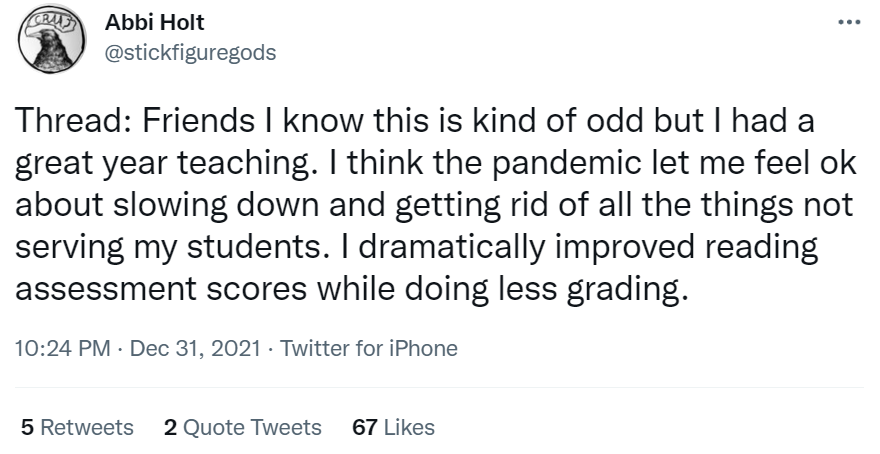
Abbi Holt had a great thread sharing a 6-year progression of practices that have made even teaching through a pandemic tolerable! Here it is with some commentary on why you should look into doing similar things, if not the very same…

Why This Works? #1
Not only is moving slowly and steadily a more responsive approach to teaching learners in the room, but reducing grading is crucial in carving out space for everything that positively impacts teaching and learning.

Continue reading

Mārcus et scytala Caesaris: Published!

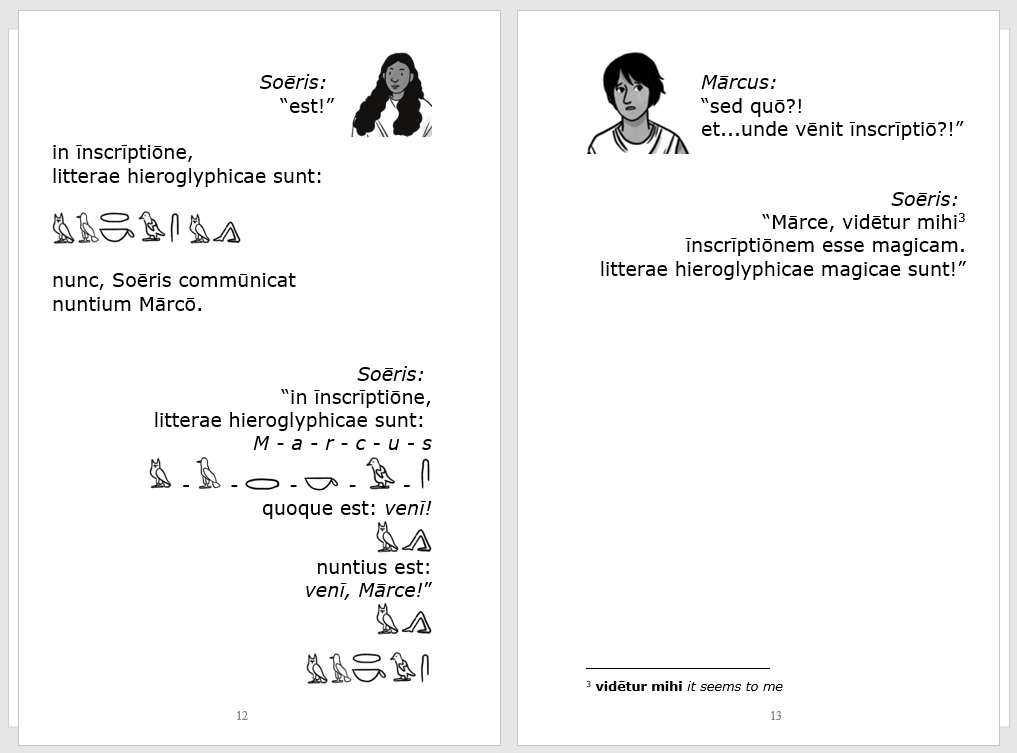
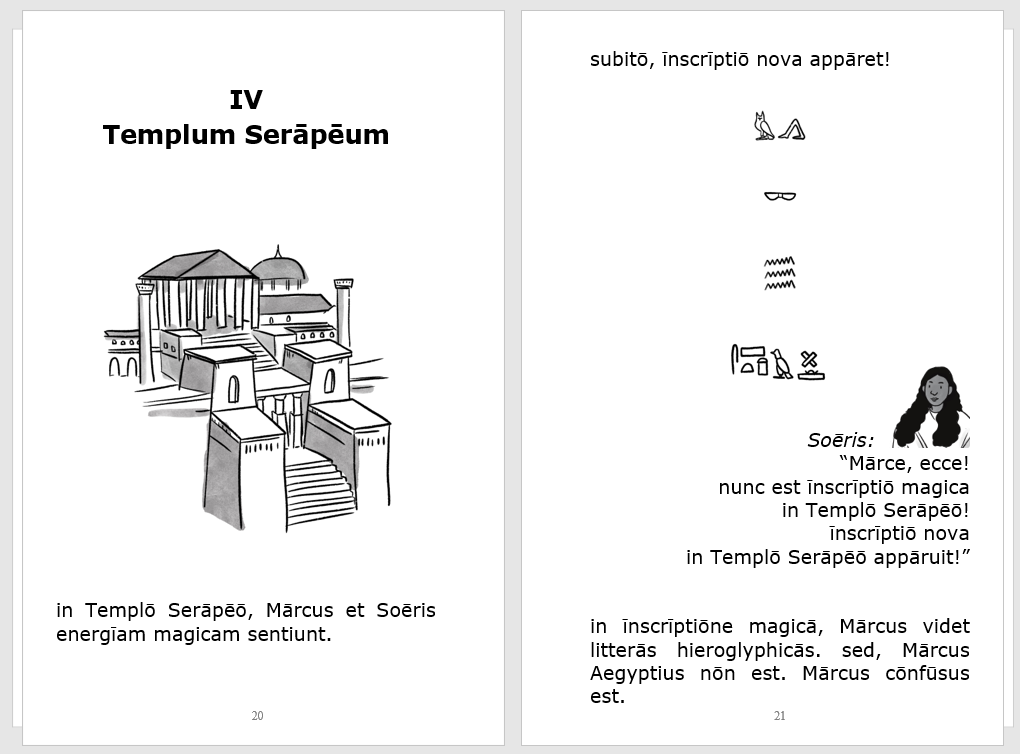
Marcus has lost something valuable containing a secret message that once belonged to Julius Caesar. Even worse, it was passed down to Marcus’ father for safekeeping, and he doesn’t know it’s missing! As Marcus and his friend, Soeris, search Alexandria for clues of its whereabouts, hieroglyphs keep appearing magically. Yet, are they to help, or to hinder? Can Marcus decipher the hieroglyphs with Soeris’ help, and find Caesar’s secret message?


20 cognates, 30 other words
1400 total length

After last month’s Star Diaries right on the heels of Poetry Practice and Olianna published just before the school year, Mārcus et scytala Caesaris is now available, leaving just one more book left in the latest production schedule.

Of all the novellas we’ve read this year in Latin 1, Marcus has been the most enjoyed character and story overall. When I showed students the proof copy of Marcus’ new saga, one class even applauded. That’s the kind of program buy-in we’re building with consistent independent reading (below- or at-level), and that’s why I continue writing these kinds of books. The new Mārcus doesn’t disappoint. As stated in the preface…

“the purpose of including hieroglyphs throughout this book is not to teach the ancient Egyptian language. Instead, the purpose is to introduce students to the alphabet so they can begin to recognize them, not unlike exploring ancient Greek for short unit, as is common in many Latin courses. More broadly, the idea behind learning these alphabets is to introduce students to the ancient world beyond Rome, which tends to get all the attention when it comes to antiquity. So, I hope you enjoy this introduction to ancient Egyptian hieroglyphs via Latin!”

  1. For Sets, Packs, and eBooks order here
  2. Amazon
  3. eBooks: Storylabs

Quick Competition: Most Points Wins!

Here’s a competitive reading activity I came up with on the fly the other day. You could consider it one of those “sneaky” re-reading strategies, almost like an annotation task, but more fun. It’s no frills, has an element of chance (like Lucky Reading Game), and adds a novel twist to reading any text. Here are the instructions I project:

  1. In your notebook, write down as many X as you can, in English.
  2. When the time is up, we’ll review, and you get a point for each detail the teacher calls out.
  3. Most points wins!

What’s “X?”
Anything you want. We just read about Sagittarius from sīgna zōdiaca Vol. II, so X was “facts about Sagittarius.” Students feverishly read through pages to scoop up details.

What Details Get Points?
Anything you want. In the zodiac example, I set a timer for 5 minutes, then started reading back from the beginning, making up points as I went (e.g., “If you wrote down something about Sagittarius being the 9th sign, give yourself a point). Just like The Monitor Assessment, I also gave points for details as a way to check comprehension.

What Do Students Win?
My go-to reward is “glory and honor,” which honestly is enough for students. Besides, they get a laugh out of the fanfare knowing I won’t try to bribe them into playing games with anything other than winning as the purpose.

Redirecting Attention From Phones…Or Not

I asked a giant Facebook group of 12,600 language teachers how they redirect attention away from phones in a way that doesn’t address rule-breaking. Despite that last part, common comments included restating the phone policy, stopping class to talk about phone use (often directed at whole class instead of individuals), confiscating the contraband, or a point system that rewards not breaking the rule. More than one comment involved a direct negative impact to a student’s course grade (maybe check this out?). Some of those practices do redirect a student in the sense of changing the course of their attention, but in a way that directly addresses the rule. I’m more interested in ways to manage behavior during class without much fanfare or acknowledgment…”sneaky”…if you will. I’m interested in masterful redirections so seamless that students don’t know they’re happening. In this post, I list all the comments that were about redirecting student attention. But first…

Why is this an issue?

Continue reading

The Star Diaries (diāria sīderum): Published!

Not much was known about The Architects—guardians of the stars—until their diaries were found in dark caves sometime during the Tenth Age. Explore their mysterious observations from the Seventh Age (after the Necessary Conflict)—a time just before all evidence of their existence vanished for millennia! What happened to The Architects? Can you reconstruct the events that led to the disappearance of this ancient culture?


60-100 words, half cognates (i.e., 30-50)!
1000-3200 total length

Of all my books, I’m most excited for this one. Why? It’s my first completely new work of speculative fiction. What’s speculative fiction? It’s got elements from various genres, no-doubt SCI-FI, but without certain connotations one might expect, like being a nerdy genre. I like its characterization as “modern mythmaking,” and this book does just that. In diāria sīderum, I’ve created a new culture not connected to ours or the Romans, yet still plausibly within our universe somewhere along some an ancient timeline in the future. In fact, I approached the details of The Architects with intercultural competence in mind. What might their products and practices tell us? How are known cultures similar? How are they different?

I’m not gonna say anything else. Just know that there’s a LOT of details lurking about in this book that a beginner Latin reader could pick up on, especially if they spend some FVR time (Free Voluntary Reading) after you start the first section as a whole class. Besides, it’s a “who-dun-it?” of sorts, with a clear trail waiting to be discovered. Don’t skip the audio on this one, either. Enjoy!

Intro excerpt
Narrātor I excerpt
Narrātor SP-VI excerpt
Narrātor SP-X excerpt

  1. For Sets, Packs, and eBooks order here
  2. Amazon
  3. eBooks: Storylabs
  4. Audiobook

Check Your Understanding: Return of the Quiz?! Kinda…

It’s been years since I’ve given a quiz. I know that seems crazy coming from a teacher, but there are just so many other ways to get evidence of learning, like The Monitor Assessment, that I haven’t had to bother with quizzes much at all. When I did give them, they were sneaky ways of reading and rereading. In other words, all my quizzes were input-based. This meant that the learning experience (i.e., of receiving input) took place during the assessment. In the literature, this is known as an UNOBTRUSIVE assessment, whereas an obtrusive one would be when there’s an abrupt stop to input and interaction so testing can occur. This is bad. It literally takes away time from learning, an no one wants (or needs) that. A couple examples of obtrusive assessments would be like pulling kids into the hall for some speaking test while who-knows-what is going in the classroom, or holding a “unit test day” that’s really just 20min of testing, then free time or busywork for those who finish. With unobtrusive input-based assessments, however, the learning (i.e., receiving of input) continues, and it’s not a complete waste of time.

I enjoy not wasting time. Don’t you?

Continue reading

DEBATE: Support The Statement (Sneaky Novella ReReading)

I’ve done “support the statement” activities in the past, but none quite like this debate version that student teacher Caroline Spurr suggested. I highly recommend giving this a try. No, there are no points awarded. Just one side reads their quote (& page #), other side gets rebuttal, then repeat.

How do you find the argūmentum?!

Good Q! I’ll be on the lookout for specific debate topics from now on when we read every novella, but here are some general tips:

  • Come up with a question (e.g., Do the Romans and Egyptians value Marcus?), then one team rereads to find statements supporting a “yes” response, and the other “no.”
  • Go with something from the book students are already talking about (e.g., you hear “ugh, I hate Terrex. He’s the worst!” so you set up something like “Terrex is terrible vs. Terrex is not terrible”).
  • Turn qualities into a comparison (e.g., Who’s stronger?).
  • Compare two characters (e.g., Who’s more responsible, Piso’s mother or father?).
  • Choose a statement that falls under a theme found in the book, then one team rereads to find statements supporting it, and the other its negative.

Critical Thinking
Almost every student thinks that Olianna‘s family is cruel, with good reason since the book states that explicitly in several places! However, this novella debate builds evidence-seeking skills. We just told one half of the room to put aside their own thoughts and instead scour the pages for anything used to support the position that the family is not cruel. Although the unpopular opinion, every class was able to find at least some evidence, and they spent time rereading. This goes back to communicative purpose. Why did students reread? To prepare for a debate they found compelling to participate in. This was pure entertainment.

That particular debate topic of Olianna’s family being cruel was certainly stacked in one direction. However, the book ends with several prediction questions about the future, which is a common way I end my novellas to promote discussion. For the second debate, we had students vote on one of the questions. Half the class looked for quotes to support “yes” and the other half “no.”

The format is basically think | pair | share, with students a) spending time on their own rereading (sneaky, right?) and writing a quote and its page # in notebooks (FYI, notebook pics are great evidence of learning for gradebooks), b) pairing with group to discuss what they found, and then c) the debate.

Back To Comprehension Basics: Don’t Speak Latin

No, I haven’t reverted back to the grammar-focused pedagogy of the 90s (and no, not the 1890s, either. Grammar teaching is still the dominant one today, which I predict will hold true for another 20 years). Instead, I’m going to challenge us all speaking Latin in the classroom to do so under just one condition:

Students will understand what you’re about to say.

It sounds too basic, I know, but not everyone does this or does this enough. Hence, back to the basics of comprehension-based teaching, right? So my challenge is now out there. If the condition isn’t met, say something in English, or change what we’re about to say to meet the condition. Of course, this challenge wouldn’t exclude the use of new words. No way. How else would students ever expand vocab?! However, this does mean that we must provide CI by using mostly words students already understand, allowing for just a few new ones during class, and then be sure students understand those new words (i.e., at least tell them what the new words mean in English, demonstrate the meaning whenever possible, and use a picture/realia if applicable).

Speech Rate & Text Coverage
The research of Hsueh-Chao & Nation as well as Laufer shows that a text must have 98% coverage of known vocab (tokens) to have a chance of being read with ease (because even 95% text coverage can get woefully low comprehension scores of 55%!). Well, that’s with texts, when the student able to control the pace and even reread! Speech doesn’t work that way. When we say something, the student can’t control our speech rate. They have to signal us. There’s no 15sec replay. They have to signal us. While we’re working towards training students to self-advocate for comprehension, the reality is that listening to Latin is the MUCH harder mode to process. Therefore, it goes without saying that we should be using 98%+ text coverage in speech. Only speaking the target language in class when students will understand will maximize comprehension. Who doesn’t want that?! Practically speaking, then, I challenge us to all give pause the moment we’re about to say something students don’t understand yet, then do the following:

  1. Say it in English and move on.
  2. Restate using other words students already understand.
  3. Use the new word/phrase, immediately establish meaning, then provide micro-exposure.

Micro-exposure
This is my term for giving students a little bit of concentrated exposure to what has the potential to be a one-off and out-of-bounds word/phrase. In practice, when a new word/phrase comes up, expect to sit with it for some statements and questions for a minute or two. Yes, a minute or two. This helps keep vocab limited and comprehension high without vocab overload and noise that students start to get used to (i.e., they begin to tune out the input and be OK with incomprehension because there’s so much of it during class).

Consider the alternative for a minute: a class during which we teachers use new words/phrases as a reaction to what students say. That’s basically a translation class (English –> Latin) without much expectation (and hope) that students will ever be exposed to those words/phrases again.

Think of micro-exposure as circling or something if that helps you, too. However it’s understood and whatever it’s called, we must acknowledge that the absence of micro-exposure entirely can result in a ton of vocab and high levels of incomprehension, or some kind of one-off situational experience like the translation class. Only the kids with the best, most freakish memories will absorb all that input, and there aren’t too many of them in class, if at all.

So, are you ready to not speak Latin unless students will understand what you’re about to say? Why or why not?